


B2B Selling in Nigeria: How to Win Large Accounts With Long Buying Cycles

Selling to a large Nigerian company is a different game from selling to a shop owner or a consumer. A bank, telecoms operator, manufacturer, oil company or government agency rarely buys on impulse. Decisions involve several people, formal procurement processes, vendor registration, budget cycles and, increasingly, compliance checks. A deal that looks close can stall for months.
Many sales teams handle this badly. They focus on one contact, usually the person who invited them in. They pitch features instead of business outcomes. They submit proposals and wait. And when the deal goes quiet, they assume price was the problem.
This guide explains how large organisations in Nigeria buy, who influences the decision, and how sales teams can manage long cycles to win more of the deals they pursue. It draws on the principles behind consultative and insight-led selling, adapted for the Nigerian market.
How large Nigerian organisations buy
Most large buyers follow a process with recognisable stages:
- Need recognition. Someone identifies a problem or opportunity, often triggered by a regulatory change, a cost pressure, a failure or a new strategy.
- Internal alignment. The need is discussed with management, budgets are checked and a sponsor emerges.
- Requirements definition. Users and technical staff define what is needed.
- Vendor identification. Procurement identifies potential suppliers, often from an approved vendor list.
- Request for proposal or quotation. Vendors are invited to bid.
- Evaluation. Technical and commercial evaluations, sometimes with presentations.
- Approval. Decisions go through management committees, tender boards or the board, depending on value.
- Contracting and onboarding. Legal review, contract signing and vendor onboarding.
Public sector buyers follow the Public Procurement Act 2007 and their own procurement rules, with additional requirements such as Bureau of Public Procurement certificates and compliance documents.
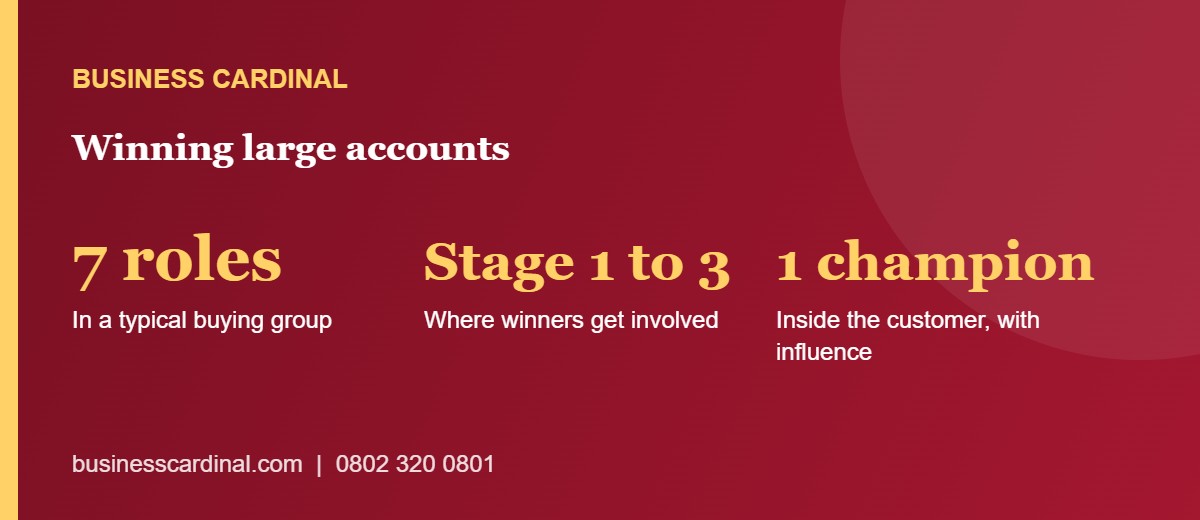
The biggest mistake is to enter at stage five. By the time a request for proposal arrives, the requirements are often written around another vendor’s solution. Winning sellers get involved at stages one to three, when they can shape how the customer sees the problem.
The buying group
Research on business buying consistently shows that complex purchases involve several decision-makers. In Nigerian organisations, a typical buying group includes:
| Role | What they care about |
|---|---|
| Economic buyer, often a director or MD | Return on investment, strategic fit, risk |
| User buyers | Ease of use, how the solution affects their daily work |
| Technical buyers, such as IT or engineering | Specifications, compatibility, security |
| Procurement | Process compliance, price, vendor credentials |
| Finance | Budget, payment terms, total cost |
| Legal and compliance | Contract terms, regulatory requirements |
| Internal champion | Making the project succeed, often for career reasons |
Each person can say no. Few can say yes alone. Sales teams must map the buying group early and understand each person’s priorities.
Find and develop a champion
A champion is someone inside the customer who wants your solution to succeed and will help you navigate the organisation. Champions share information about priorities, politics, budgets and competitors, and they sell for you when you are not in the room.
Test whether your contact is truly a champion:
- Do they give you access to other members of the buying group?
- Do they share information you could not get elsewhere?
- Do they have influence over the decision?
- Do they benefit personally or professionally if the project succeeds?
A friendly contact who cannot get you access to decision-makers is not a champion.
Lead with insight, not features
Senior buyers meet many vendors who talk about their products. Few bring ideas that help the buyer’s business. Insight-led selling starts with something the customer does not already know: a trend, a benchmark, a risk or an opportunity that affects their performance.
For example:
- A payroll services firm shows an HR director how the Nigeria Tax Act 2025 changes take-home pay across grades and creates new compliance risks.
- A logistics company shows a manufacturer how delivery delays in specific regions are costing it sales, using data from comparable clients.
- A security firm shows a bank how attacks on similar institutions have evolved, and where its controls are exposed.
Insight earns the right to a deeper conversation. Our selling with insights programme trains teams to build and deliver these conversations.
Qualify hard, and early
Long sales cycles consume time. Sales teams must decide which opportunities deserve effort. Ask:
- Is there a real need? What problem does the customer have, and what happens if they do nothing?
- Is there budget? Is money approved, or will it need to be found?
- Who decides? Do we know the economic buyer and the approval process?
- What is the timeline? What event drives the decision date?
- Can we win? Do we have a champion, a differentiated solution, and a relationship advantage?
Opportunities that fail these tests should be deprioritised or dropped. Sales teams that chase everything win less.
Managing the long cycle
Map the decision process
Ask the champion to walk you through every step from today to a signed contract. Who must approve? Which committee meets when? What documents are needed? Build a mutual plan with dates.
Stay visible between meetings
Long gaps between interactions let deals go cold. Share relevant insights, case studies, regulatory updates or invitations to events. Each touch should add value, not simply ask “any update?”
Prepare for vendor registration early
Large Nigerian buyers require vendor registration documents such as CAC documents, tax clearance, pension and ITF compliance certificates, audited accounts and sometimes NDPC registration or sector licences. Missing documents can disqualify a winning bid. Keep a current vendor pack ready.
Anticipate procurement
Procurement teams are measured on savings and compliance. Respect the process, submit complete bids on time, and expect a negotiation stage. Build room into pricing for it, and know your walk-away point.
Address risk
Large buyers fear failure more than they value innovation. Reduce perceived risk with references from similar clients, pilot projects, phased implementation, performance guarantees and clear support arrangements.
Writing proposals that win
A strong proposal for a large Nigerian buyer:
- Opens with the customer’s problem and desired outcomes, in their language.
- Shows the business case, with numbers.
- Explains the solution and why it fits their situation.
- Describes implementation, timelines and responsibilities.
- Provides relevant references and case studies.
- States pricing clearly, with options where helpful.
- Complies fully with the request for proposal format and requirements.
Many bids fail on compliance before evaluators read the content. Check every requirement.
A worked example
A Lagos HR technology firm had pursued a large manufacturer for 14 months. It had met the HR manager seven times, submitted two proposals and heard nothing.
After training, the sales team mapped the buying group and realised it had never met the finance director, who controlled the budget, or the IT manager, who had concerns about data security. The HR manager was supportive but lacked influence.
The team used the HR manager to request a meeting with the finance director and presented an analysis showing how payroll errors and manual processes were costing the company money under the new tax rules. It held a separate session with IT on data protection and hosting. Within three months, the company signed a contract for a phased rollout.
Details have been changed to protect client confidentiality.
Common mistakes
- Relying on a single contact.
- Entering the process only when a request for proposal arrives.
- Pitching features instead of business outcomes.
- Failing to qualify opportunities.
- Losing touch between meetings.
- Submitting non-compliant bids.
- Assuming price is the reason for every loss.
Selling to government and public sector buyers
Federal, state and local government agencies, and government-owned enterprises, are major buyers in Nigeria. They follow rules that private companies do not.
- Procurement law. Federal agencies follow the Public Procurement Act 2007, with thresholds that determine the procurement method and approval level. States have their own procurement laws.
- Registration. Vendors usually need registration on the relevant procurement portals and up-to-date compliance certificates, including tax clearance, pension, ITF and NSITF compliance.
- Budget cycles. Spending depends on appropriation and release of funds. A contract award does not guarantee timely payment.
- Transparency requirements. Bid openings, evaluations and awards follow formal procedures. Informal influence attempts carry legal and reputational risk.
Sales teams pursuing public sector work should build compliance into their process, price for payment delays, and avoid any practice that could be seen as improper inducement. Anti-corruption agencies are active, and the consequences of crossing the line are severe.
Account planning for strategic customers
For the largest opportunities and customers, a written account plan keeps the team aligned. A good plan covers:
- Customer overview: strategy, financial position, key challenges and priorities.
- Buying group map: who is involved, their influence, their attitude towards you, and who owns each relationship.
- Current position: what you sell today, share of wallet and competitor presence.
- Opportunities: specific needs you can address, with estimated value and timing.
- Risks: threats to the relationship, such as service problems, competitor moves or leadership changes.
- Action plan: activities, owners and dates for the next quarter.
Review account plans each quarter with senior management. They make relationships less dependent on individual reps and help new team members take over accounts smoothly.
Using references and case studies
Large buyers in Nigeria rely heavily on peer experience. A reference from a respected company in the same industry often carries more weight than any presentation. Build a reference programme:
- Identify satisfied customers willing to speak to prospects.
- Document case studies with measurable results, with the client’s permission.
- Prepare references to speak to the specific concerns of the prospect.
- Do not overuse your best references. Rotate them and thank them.
Where confidentiality prevents naming clients, describe the sector, size and results in anonymous form.
Measuring enterprise sales performance
Track metrics that reflect long-cycle selling:
- Number of qualified opportunities created.
- Pipeline value by stage and expected close date.
- Win rate on qualified opportunities.
- Average sales cycle length.
- Number of buying group members engaged per opportunity.
- Revenue from new versus existing accounts.
These measures help managers coach reps on the activities that drive results, rather than waiting for quarterly revenue to reveal problems.
After the contract: delivering on the promise
Winning the contract is the start of the next sale. Large buyers renew, expand and refer vendors who deliver. Hold a kickoff meeting with the customer’s team, agree success measures, report progress regularly and resolve problems quickly. A smooth first project turns a cautious buyer into a long-term account.
Frequently asked questions
Why do B2B sales cycles take so long in Nigeria?
Large organisations involve several decision-makers, formal procurement processes, vendor registration, budget approvals and legal review, each of which adds time.
What is a buying group?
The set of people inside a customer organisation who influence or approve a purchase, typically including the economic buyer, users, technical staff, procurement, finance and legal.
How do sales teams find a champion?
Look for a contact who benefits from the project’s success, has influence, shares useful information and can give access to other members of the buying group.
What is insight-led selling?
An approach where the seller opens with an insight about the customer’s business, such as a trend, benchmark or risk, rather than a product pitch, to earn a deeper conversation.
How can we shorten B2B sales cycles?
Engage earlier in the buying process, map the decision process with your champion, build a mutual plan, keep vendor documents ready and address risk concerns proactively.
How should sales teams approach government buyers in Nigeria?
Register on the relevant procurement portals, keep compliance certificates current, follow the Public Procurement Act 2007 or state procurement laws, price for payment delays and avoid any improper inducement.
How Business Cardinal can help
Business Cardinal trains Nigerian sales teams to sell to large organisations, using consultative, insight-led and trusted advisor approaches built around real accounts. We help teams map buying groups, qualify opportunities and manage long cycles. See our trusted advisor training, selling with insights and consultative selling training.
Win more enterprise deals: call 0802 320 0801 or 0807 576 5799, email hello@businesscardinal.com, or visit businesscardinal.com/contact.
This article is general information based on sales research and practice.
Related Post

What is ICFR? Internal Control over Financial Reporting Explained
Print 🖨 PDF 📄 eBook 📱What is ICFR? Internal Control over Financial Reporting Explained Let…
Digital Transformation in Nigerian Enterprises: Who’s Leading the Shift?
Print 🖨 PDF 📄 eBook 📱Digital Transformation in Nigerian Enterprises: Who’s Leading the Shift? Let…

Building a Strategy That Survives Nigeria’s Power and Infrastructure Challenges
Print 🖨 PDF 📄 eBook 📱Building a Strategy That Survives Nigeria’s Power and Infrastructure Challenges…
