


Sales Forecasting and Pipeline Management in Nigeria: How to Stop Missing Your Numbers

Ask a Nigerian sales director for next quarter’s forecast and you will often get a number built on hope. Reps report deals as “90% sure” that have not progressed in months. Managers add a cushion. The finance team discounts the whole thing by a third because it has been burned before. When the quarter ends, results miss the forecast, stock is wrong, cash is short, and nobody is quite sure why.
Accurate forecasting is not a finance problem. It is a sales management discipline. It depends on a clear sales process, honest pipeline data, and regular reviews that test every deal. Companies that get it right plan production, stock and cash with confidence. Those that do not lurch from surprise to surprise.
In 2027 the stakes are higher. Elections in January will disrupt buying in some sectors. Inflation remains in double digits. Customers are slower to commit. This guide explains how Nigerian sales teams can build a reliable pipeline, forecast accurately and use the forecast to manage performance.
Why sales forecasts go wrong
No defined sales stages. If “proposal sent” means different things to different reps, the pipeline cannot be compared or trusted.
Optimism bias. Reps want to look good. They keep dead deals in the pipeline and overstate the chance of closing.
Sandbagging. Some reps understate forecasts so they can beat them and earn bonuses.
Stale data. Deals sit unchanged for months because nobody reviews them.
Ignoring history. Forecasts are built without reference to actual conversion rates and sales cycle lengths.
No link to customer behaviour. A deal is marked “closing this month” because the rep wants it to close, not because the customer has committed to a decision date.
Build the pipeline on a defined sales process
A pipeline is only as good as the stages that define it. Each stage should have clear entry and exit criteria based on customer actions, not rep activity.
A typical B2B sales process might use these stages:
| Stage | Exit criteria (customer action) |
|---|---|
| Lead | Contact made, potential need identified |
| Qualified | Need, budget, decision-maker and timeline confirmed |
| Needs analysis | Customer has shared requirements and agreed to a solution discussion |
| Proposal | Customer has received a proposal and agreed to review it with decision-makers |
| Negotiation | Customer has indicated preferred vendor status and is negotiating terms |
| Verbal commitment | Customer has confirmed intention to buy, subject to paperwork |
| Closed won or lost | Contract signed or deal lost |
For FMCG and distribution businesses, the pipeline may track new outlets, distributors or listings rather than individual deals, but the principle is the same.
Use evidence-based probabilities
Assign each stage a probability based on your own historical conversion rates. If 30% of deals that reach proposal stage eventually close, the proposal stage probability is 30%, whatever an individual rep feels about a particular deal.
Weighted pipeline value is the sum of each deal’s value multiplied by its stage probability. It gives a more realistic view than the total pipeline.
Then layer judgement on top. For each deal expected to close this quarter, ask:
- Has the customer confirmed a decision date?
- Do we know who signs, and have we met them?
- Is budget approved?
- Has the customer’s procurement or legal process started?
- What could stop the deal?
Three forecast categories
Many sales teams classify each expected deal into one of three categories:
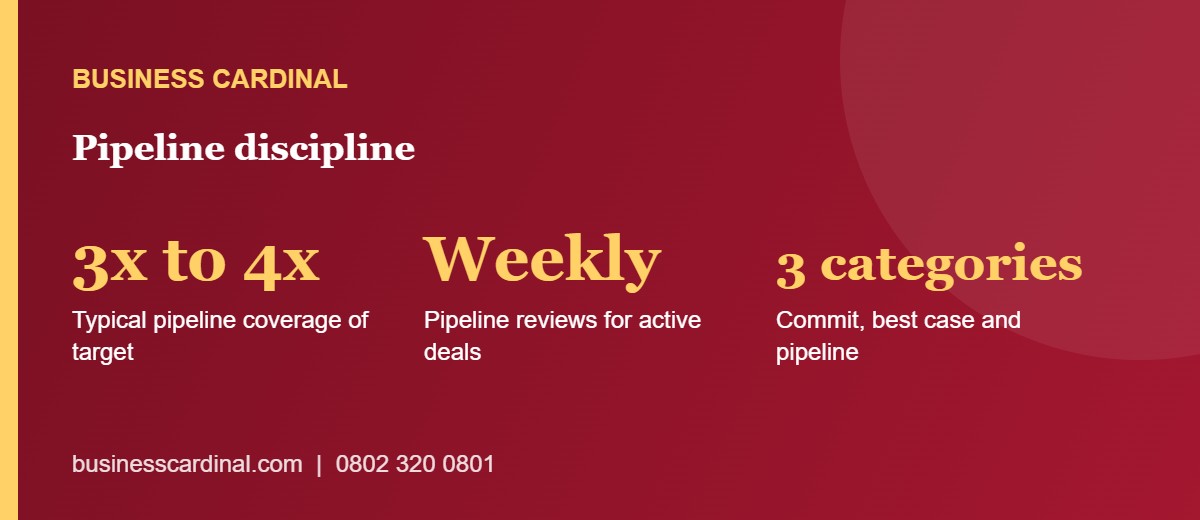
- Commit: deals the rep is confident will close this period, backed by clear customer evidence.
- Best case: deals that could close if things go well.
- Pipeline: deals in progress that are unlikely to close this period.
Leaders forecast the commit number and track best case as upside. Over time, compare each rep’s commit with actual results. Reps who consistently miss their commit need coaching on qualification.
Run disciplined pipeline reviews
A weekly or fortnightly pipeline review is the heart of forecasting. Good reviews:
- Focus on change. Which deals moved forward, which moved back, which are new, which were lost?
- Test the big deals. For the largest opportunities, ask the evidence questions above.
- Clean the pipeline. Remove deals with no activity for an agreed period unless there is a clear reason to keep them.
- Agree next actions. Every deal should have a next step with a date.
- Coach, not interrogate. Use the review to help reps think through how to advance deals.
Reviews that become blame sessions encourage reps to hide bad news.
Use the right metrics
Track a small set of pipeline metrics monthly:
- Pipeline coverage: total pipeline value relative to target. Many teams aim for three to four times target, depending on conversion rates.
- Conversion rates by stage.
- Average deal size.
- Sales cycle length: average time from lead to close.
- Win rate: deals won as a share of deals closed.
- Forecast accuracy: actual results compared with the commit forecast.
These metrics show where the process breaks. Low conversion from proposal to negotiation suggests weak proposals or poor qualification. Long cycles suggest problems navigating buying groups.
Adjust for Nigerian realities in 2027
Elections
Expect some customers to delay decisions until after the January 2027 elections. Review deals expected to close in December, January and February, and move those without firm commitments into later periods. Sectors tied to government spending may slow further.
Inflation and currency
Price changes affect pipeline values. A deal quoted in October may need repricing by January. Note the price validity of each proposal and flag deals where cost increases could force renegotiation.
Payment risk
A closed deal is not cash. In a tight credit environment, forecast collections as well as sales, using each customer’s payment history.
Channel stock
For FMCG and distribution businesses, distinguish between sell-in to distributors and sell-out to consumers. A forecast based on sell-in that ignores high channel stock will be followed by a slump.
Tools and CRM
A customer relationship management system makes pipeline management easier, but it does not fix poor discipline. Many Nigerian companies buy a CRM and find reps still keep their real pipeline in notebooks or WhatsApp. Make CRM use part of the process: reviews use only CRM data, commissions are paid only on deals recorded there, and managers coach from the system.
For smaller teams, a well-designed spreadsheet with clear stages, dates and next actions is better than an expensive system nobody uses.
A worked example
A Lagos-based industrial equipment supplier missed its quarterly forecast by more than 30% three quarters in a row. Its pipeline showed ₦2.4 billion in opportunities, but reps assigned their own probabilities and rarely removed dead deals.
The company defined seven stages with customer-based exit criteria, set probabilities from two years of historical data, and introduced a weekly pipeline review. In the first review, it removed ₦700 million of deals with no customer activity in 90 days. Reps were asked to separate commit and best-case deals.
Within two quarters, forecast accuracy improved to within 10% of actual results. Procurement planning improved, and the company reduced its stock of slow-moving equipment.
Figures are illustrative.
Common mistakes
- Defining stages by rep activity rather than customer action.
- Letting reps set their own probabilities.
- Keeping dead deals in the pipeline.
- Reviewing the pipeline only at quarter end.
- Treating the forecast as a target rather than a prediction.
- Forecasting sales without forecasting collections.
Forecasting in FMCG and distribution
Consumer goods companies and distributors forecast differently from project-based B2B sellers. Volumes come from thousands of outlets rather than a handful of deals. The forecast combines:
- Baseline demand from historical sell-out, adjusted for seasonality such as festive periods, school resumption and Ramadan.
- Distribution changes, including new outlets, new distributors and lost listings.
- Promotions planned for the period, with realistic estimates of uplift and the dip that follows.
- Price changes and their likely effect on volume.
- Channel stock, so that sell-in plans do not overload distributors.
- External factors, such as elections, fuel price changes and security conditions on key routes.
Field teams add value by reporting what they see in the market: competitor activity, retailer stock levels and shifts in customer demand. A forecast built only in head office misses these signals.
Linking the forecast to operations and finance
A sales forecast should drive decisions across the business:
- Production and procurement plan raw materials and output based on expected demand.
- Inventory planning sets stock levels by product and location.
- Finance projects revenue, collections and working capital needs.
- HR plans sales headcount and recruitment.
Hold a monthly meeting where sales, operations and finance agree a single forecast. Many companies call this sales and operations planning. Without it, each function works from its own numbers, and the company ends up with too much of what does not sell and too little of what does.
Sales capacity planning
Forecasts also show whether the team has enough capacity to hit targets. Work backwards from the target:
- Target revenue for the year.
- Divided by average deal size gives the number of deals needed.
- Divided by win rate gives the number of qualified opportunities needed.
- Divided by conversion from lead to qualified gives the number of leads needed.
- Compared with what each rep can handle, this gives the headcount and lead generation required.
If the numbers do not work, the target, the team or the process must change. Hoping for a better win rate is not a plan.
Incentives that encourage honest forecasts
Incentive plans affect forecast quality. If reps are punished for missing forecasts but not for sandbagging, they will forecast low. If they are rewarded for big pipelines, they will keep dead deals. Consider:
- Recognising forecast accuracy in performance reviews.
- Paying commission on closed revenue, not pipeline.
- Rewarding reps who remove dead deals and requalify honestly.
- Avoiding month-end pressure that pushes reps to pull deals forward with discounts.
Our sales performance and incentive program design service aligns incentives with the behaviour you want.
Win-loss analysis
Every closed deal teaches something. Review a sample of won and lost deals each quarter. Ask the customer, where possible, why they chose you or a competitor. Look for patterns: deals lost at the same stage, to the same competitor, or for the same reason. Feed the lessons into qualification criteria, proposals and training.
Start small
Teams that have never managed a pipeline formally should not try to do everything at once. Start with clear stages, a weekly review and a monthly forecast. Add metrics, CRM discipline and sales and operations planning once the basics are working. Consistency matters more than sophistication.
Share the forecast with the team
Reps who see how their deals add up to the team forecast understand why accuracy matters. Publish the weekly forecast summary to the whole sales team, celebrate accurate calls, and discuss misses without blame.
Frequently asked questions
How can sales teams forecast more accurately?
Define sales stages by customer actions, use historical conversion rates for probabilities, separate commit and best-case deals, and review the pipeline every week.
What is pipeline coverage?
The value of the sales pipeline relative to the sales target. Many teams aim for three to four times target, depending on their conversion rates.
What is the difference between a forecast and a target?
A target is what the company wants to achieve. A forecast is an honest prediction of what will happen based on the pipeline and evidence.
How often should sales pipelines be reviewed?
Weekly or fortnightly for active pipelines, with a deeper review each month and at quarter end.
How will the 2027 elections affect sales forecasts?
Some customers may delay decisions until after the elections. Review deals expected to close around January 2027 and move those without firm commitments into later periods.
What is sales and operations planning?
A regular process where sales, operations and finance agree a single demand forecast and plan production, inventory and cash around it.
How Business Cardinal can help
Business Cardinal helps Nigerian sales teams define their sales process, build pipeline discipline, and improve forecast accuracy. We train managers to run effective pipeline reviews and coach reps on qualification. See our sales effectiveness solutions, sales coaching training and CRM implementation and customer retention strategy.
Forecast with confidence: call 0802 320 0801 or 0807 576 5799, email hello@businesscardinal.com, or visit businesscardinal.com/contact.
This article is general information based on sales management practice.
Related Post

Comprehensive guide to tax planning for small businesses in Nigeria
Print 🖨 PDF 📄 eBook 📱Comprehensive guide to tax planning for small businesses in Nigeria…

Nigeria’s Informal Economy: The $200B Market Everyone Is Underestimating
Print 🖨 PDF 📄 eBook 📱Nigeria’s Informal Economy: The $200B Market Everyone Is Underestimating Let…

Building Strategy Around Constraints, Not Assumptions
Print 🖨 PDF 📄 eBook 📱Building Strategy Around Constraints, Not Assumptions Organizations often fall into…
