


Key Account Management in Nigeria: How to Protect and Grow Your Most Valuable Customers

In most Nigerian businesses, a small number of customers generate a large share of revenue. For a manufacturer, it may be three supermarket chains and five major distributors. For a services firm, it may be a handful of banks, telecoms operators or oil companies. For a technology company, it may be two or three enterprise clients.
These key accounts deserve a different approach. Losing one can cut revenue by a quarter. Growing one can transform results. Yet many companies manage their most valuable customers the same way they manage everyone else: a single sales rep, reactive service, and annual price negotiations that focus on discounts.
Key account management is a structured approach to understanding, serving and growing your most important customers. This guide explains how to identify key accounts, what a key account manager does, how to build account plans, and how to measure success, with examples from the Nigerian market.
What makes an account “key”
Not every large customer is a key account. Key accounts combine current value with strategic importance. Consider:
- Revenue and profit. How much the account contributes today, after discounts, rebates and cost to serve.
- Growth potential. How much more the customer could buy from you.
- Strategic value. Whether the account opens doors to new markets, enhances your reputation or provides learning.
- Relationship fit. Whether the customer values partnership and is willing to collaborate.
- Cost to serve. Some large customers demand so much service, credit and discount that they barely make money.
A simple matrix plots accounts by current value and potential. Accounts high on both are strategic key accounts. Those high in value but low in potential need protection and efficiency. Those low in value but high in potential deserve development effort. Those low on both are served through standard channels.
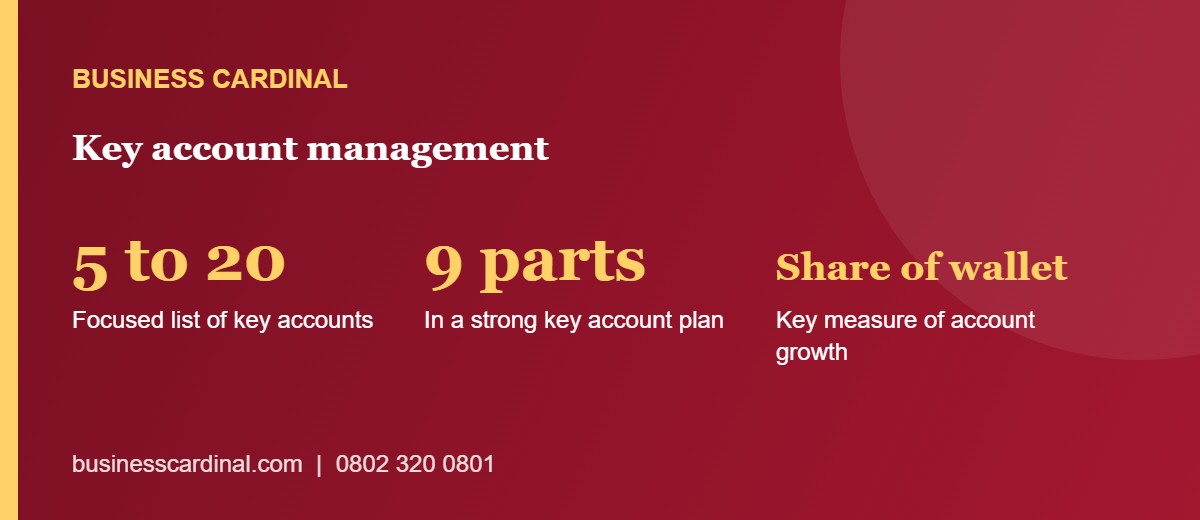
Most companies should have a short list of key accounts, often between five and twenty depending on their size. If everything is key, nothing is.
The role of the key account manager
A key account manager is more than a senior salesperson. The role combines:
- Relationship management across many levels of the customer organisation.
- Business understanding of the customer’s strategy, challenges and performance.
- Internal coordination of supply chain, finance, customer service, marketing and technical teams to deliver for the customer.
- Planning of account growth over several years.
- Commercial negotiation of terms that work for both sides.
The best key account managers act as the customer’s advocate inside their own company and as their company’s representative inside the customer. They need authority to mobilise internal resources and access to senior management.
Building multi-level relationships
A single relationship between your sales rep and the customer’s buyer is fragile. If either person leaves, the account is exposed. Key account management builds relationships at several levels:
| Your company | Customer |
|---|---|
| Managing director | Managing director or CEO |
| Key account manager | Head of procurement, category manager |
| Operations or supply chain | Logistics, warehouse or operations |
| Finance | Accounts payable, finance director |
| Technical or service team | Users, technical staff |
| Marketing | Marketing or category team |
Senior executive sponsorship matters in Nigeria, where relationships at the top often shape decisions. A visit from your MD to the customer’s MD once or twice a year signals commitment and opens strategic conversations.
Understanding the customer’s business
Key account managers should know their customers as well as the customers know themselves. That includes:
- The customer’s strategy, growth plans and priorities.
- Financial performance, from published results where available.
- Competitive pressures they face.
- How your product or service affects their performance.
- Their decision-making processes and internal politics.
- Changes in leadership or structure.
For listed customers, results published on the Nigerian Exchange and reported in the business press offer valuable insight. In November 2026, for example, several consumer goods companies reported higher profits but weaker volumes and much higher promotional spending. A supplier to those companies should understand what that means for their buying priorities: cost efficiency, promotional support and reliable supply.
The key account plan
Every key account should have a written plan, reviewed at least quarterly. A strong plan includes:
- Account profile. Customer overview, key facts and recent developments.
- Relationship map. Who is who, their influence, their view of your company, and who owns each relationship on your side.
- Current business. Products or services supplied, revenue, margins, share of wallet and trends.
- Customer needs and objectives. What the customer is trying to achieve and how you can help.
- Opportunities. Specific growth opportunities with estimated value, timing and actions.
- Risks. Threats to the account, such as competitor activity, service issues, payment risk or leadership changes.
- Value proposition. Why the customer should continue and expand with you.
- Action plan. Activities, owners and deadlines for the next 90 days.
- Targets. Revenue, margin, share of wallet and relationship goals.
Share appropriate parts of the plan with the customer. Joint business plans, agreed with the customer, are a sign of a mature key account relationship.
Creating value for the customer
Key accounts expect more than a good price. Ways to create value include:
- Insight. Share market data, consumer insights or benchmarks that help the customer make better decisions.
- Supply reliability. Guarantee availability during peak periods and shortages.
- Joint planning. Plan promotions, launches and inventory together.
- Process improvements. Simplify ordering, invoicing and logistics.
- Training. Train the customer’s staff on your products.
- Innovation. Offer early access to new products or services.
Every value-adding activity strengthens your position and reduces the pressure to compete on price alone.
Managing the commercial relationship
Key accounts are usually your most demanding negotiators. Protect margin by:
- Knowing the true profitability of each account, including rebates, promotional support, credit costs and service costs.
- Linking concessions to performance, such as volume growth, prompt payment or expanded listings.
- Negotiating annual agreements with clear terms, rather than renegotiating every order.
- Escalating major commercial decisions to senior management.
Credit management is critical in Nigeria. Large customers sometimes stretch payment far beyond agreed terms. Agree terms clearly, monitor them, and involve senior management early when payments slip.
Measuring key account performance
Track key accounts with a balanced set of measures:
- Revenue and gross margin by account.
- Share of wallet, meaning your share of the customer’s total spend in your category.
- Growth against plan.
- Customer satisfaction or relationship health scores.
- Service performance, such as on-time, in-full delivery.
- Days sales outstanding.
- Progress on account plan actions.
Review these monthly with key account managers and quarterly with senior management.
A worked example
A Lagos-based beverage manufacturer supplied a fast-growing supermarket chain with 18 outlets. The account was managed by a regional sales rep who also handled 40 smaller customers. Sales had grown, but margins had fallen as the chain demanded deeper discounts and longer credit.
The manufacturer appointed a dedicated key account manager and built an account plan. Analysis showed that the chain’s main priorities were reducing out-of-stocks and improving promotional performance. The manufacturer introduced a joint promotional calendar, shared category sales data, and committed to twice-weekly deliveries during peak periods. In return, it secured additional shelf space, a reduction in credit terms from 75 to 45 days, and a commitment to list two new products.
Within a year, revenue from the account grew by 30%, gross margin improved, and the manufacturer became the chain’s preferred supplier in its category.
Figures are illustrative.
Common mistakes
- Treating every large customer as a key account.
- Relying on a single relationship.
- Measuring revenue but not profitability.
- Focusing on price negotiations instead of value creation.
- Giving key account managers responsibility without authority to mobilise internal resources.
- Writing account plans that are never reviewed.
Key accounts across Nigerian sectors
The principles apply everywhere, but the key accounts look different by sector:
- FMCG manufacturers: modern trade chains, major distributors, and large institutional buyers such as hotels and caterers.
- Industrial suppliers: manufacturers, oil and gas operators, construction firms and utilities.
- Professional services: banks, telecoms operators, multinationals and government agencies.
- Technology and fintech: banks, payment processors, large retailers and public sector agencies.
- Logistics: manufacturers, e-commerce platforms and importers with regular volumes.
In each case, the key accounts are the customers whose loss would hurt most and whose growth would matter most.
When the buyer changes
One of the biggest risks in key account management is a change of personnel at the customer. A new procurement head may want to review all suppliers. A new managing director may change strategy. A trusted contact may move to a competitor.
Prepare by:
- Building relationships at several levels before a change happens.
- Documenting the value you deliver, with data, so a new decision-maker can see it quickly.
- Requesting an early meeting with any new leader to understand priorities.
- Reviewing the account plan for new risks and opportunities.
Companies that rely on one strong relationship often lose accounts when that person moves.
Organising for key account management
Smaller companies may ask senior sales staff to manage key accounts alongside other duties. Larger companies often create dedicated key account roles, supported by cross-functional teams. Whatever the structure:
- Give key account managers a manageable number of accounts.
- Give them authority to coordinate supply chain, finance and service teams.
- Assign an executive sponsor for each strategic account.
- Align incentives to account profitability and growth, not just revenue.
Recovering from service failures
Even strong relationships suffer from late deliveries, stock-outs, invoicing errors or quality problems. How you respond matters more than the failure itself. Acknowledge the problem quickly, explain what happened, fix it, and show what you have changed to prevent repetition. Senior involvement in serious failures reassures the customer. A well-handled recovery can strengthen trust.
Reviewing the key account portfolio
Review the list of key accounts every year. Customers grow, shrink, change strategy or become less profitable. An account that was strategic three years ago may now be better served through standard channels, and a smaller customer may have grown into a key account. Moving accounts in and out of the programme keeps resources focused where they create the most value.
Quarterly business reviews
Hold a formal business review with each key account every quarter. Review performance against agreed targets, service levels, issues raised and progress on joint initiatives. Present data, listen to feedback, and agree priorities for the next quarter. Customers value suppliers who take the relationship seriously enough to review it formally, and these meetings often surface new opportunities before competitors hear of them.
Protecting the account from competitors
Competitors target your best customers. Watch for warning signs: fewer orders, new trial listings, slower responses, or questions about pricing from people you rarely hear from. Respond early with a review meeting, not a discount.
Frequently asked questions
What is key account management?
A structured approach to managing a company’s most important customers, focused on understanding their business, building multi-level relationships, creating value and growing the account over time.
How many key accounts should a company have?
It depends on size, but most companies benefit from a focused list, often between five and twenty accounts, so that each receives proper attention.
What does a key account manager do?
Builds relationships across the customer organisation, understands the customer’s business, coordinates internal teams to deliver value, plans account growth and negotiates commercial terms.
What should a key account plan include?
An account profile, relationship map, current business analysis, customer needs, opportunities, risks, value proposition, action plan and targets.
How do you measure key account success?
Through revenue and margin growth, share of wallet, customer satisfaction, service performance, payment behaviour and progress on account plan actions.
What happens to a key account when the customer’s buyer changes?
The account is at risk. Build relationships at several levels beforehand, document the value you deliver, and meet any new decision-maker early to understand their priorities.
How Business Cardinal can help
Business Cardinal trains key account managers and sales leaders in Nigeria to build account plans, map relationships, create customer value and negotiate profitably. We also help companies design key account programmes and incentives. See our trusted advisor training, sales negotiation training and sales effectiveness solutions.
Grow your most valuable customers: call 0802 320 0801 or 0807 576 5799, email hello@businesscardinal.com, or visit businesscardinal.com/contact.
This article is general information based on sales management practice.
Related Post

$20 Billion Flows Home Every Year. So Why Isn’t Nigeria Getting Richer From It?
Print 🖨 PDF 📄 eBook 📱$20 Billion Flows Home Every Year. So Why Isn’t Nigeria…

Sales Negotiation in Nigeria: How to Hold Price With Distributors and Key Accounts

Sector Prioritization Frameworks: How to Identify High-Return Industries in Nigeria
Print 🖨 PDF 📄 eBook 📱Sector Prioritization Frameworks: How to Identify High-Return Industries in Nigeria…
