


Objection Handling in Nigerian Sales: How to Answer the 10 Objections Reps Hear Most

Every sales rep in Nigeria hears the same lines. “Your price is too high.” “Send me a proposal.” “We already have a supplier.” “Call me after the budget.” “Oga is not around.” Most reps respond with a discount, a brochure or a promise to follow up. Most of those deals then die quietly.
An objection is not a rejection. It is the buyer telling you what stands between them and a yes. A rep who treats objections as information wins more deals at better margins. A rep who treats them as attacks either caves or argues.
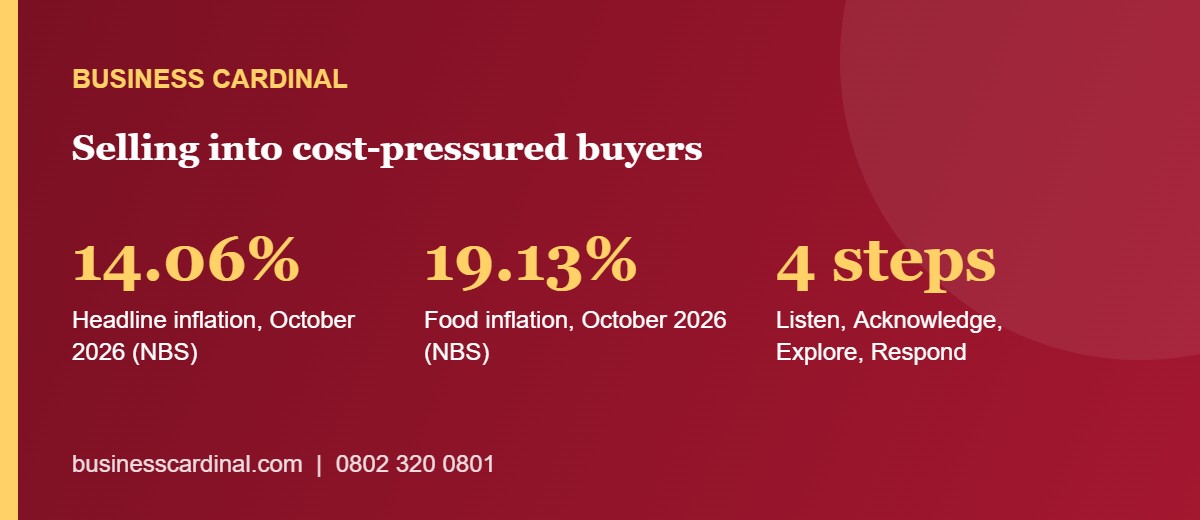
The stakes are higher now. Headline inflation eased to 14.06% in October 2026, but food inflation was still 19.13%, according to National Bureau of Statistics data reported by Nairametrics. Buyers in every sector are under cost pressure and are trained to push back. Price objections, delay objections and “we will manage what we have” objections are more frequent than they were two years ago.
This guide gives Nigerian sales teams a repeatable method for handling objections, then works through the ten objections reps hear most, with words they can use tomorrow.
Why most objection handling fails
Reps fail on objections for four predictable reasons:
- They answer too fast. The rep hears “too expensive” and jumps to a discount before learning what the buyer means.
- They answer the words, not the concern. “Send a proposal” often means “I am not convinced, and I want you to go away politely.”
- They argue. Proving the buyer wrong wins the point and loses the deal.
- They meet the objection too late. Many objections are predictable. A rep who has not raised them earlier is defending instead of leading.
The fix is a method that slows the rep down and turns each objection into a question.
The LAER method: a simple structure that works
LAER is a widely used four-step structure for handling objections. It is easy to remember under pressure.
| Step | What the rep does | Example words |
|---|---|---|
| Listen | Let the buyer finish. Do not interrupt or defend. | (Silence, nod, take notes) |
| Acknowledge | Show you heard the concern without agreeing that it is fatal. | “That is a fair point. Cost matters a lot right now.” |
| Explore | Ask questions to find the real issue behind the words. | “When you say too high, compared with what?” |
| Respond | Answer the real concern with evidence, options or a next step. | “Let me show you the cost per month over the contract.” |
The explore step does most of the work. In practice, half of all objections dissolve or change shape once the rep asks one or two good questions.
The ten most common objections and how to answer them
1. “Your price is too high.”
This is the most common objection and the most misread. It can mean the buyer has a cheaper quote, has no budget, does not see the value, or is testing you.
Explore first: “Too high compared with what? Another quote, your budget, or what you paid last year?”
Then respond to what you learn:
- If it is a competitor quote, compare scope line by line. Cheaper quotes often leave out delivery, training, warranty or support.
- If it is budget, offer a phased start or a smaller first order rather than a lower unit price.
- If it is value, translate the price into the cost of the problem you solve. A ₦4.8 million annual service is ₦400,000 a month. Compare that with the downtime, waste or lost sales it prevents.
Never discount without getting something back, such as a longer contract, faster payment or a larger volume.
2. “Send me a proposal.”
Sometimes this is a real request. Often it is a brush-off.
Explore: “Happy to. So the proposal is useful, what would you need to see in it to take it forward? And who else will read it?”
If the buyer cannot answer, the deal is not qualified. Book a second meeting to agree the scope before writing anything. A proposal written without a clear brief rarely wins.
3. “We already have a supplier.”
This is good news. It means the buyer spends money on what you sell.
Explore: “How long have you worked with them? If you could change one thing about the service, what would it be?”
Respond: Do not attack the incumbent. Position yourself as a second source, a benchmark or a solution to the one weakness the buyer named. Many Nigerian firms dual-source to manage supply risk. Offer a trial on one site, one product line or one region.
4. “We do not have budget right now.”
Explore: “When does your next budget cycle start? Who sets the priorities in it?”
Respond: Many companies are finalising 2027 budgets between November and January. Ask to help the buyer build the business case for the next cycle. Offer data the buyer can take to finance. A rep who helps write the budget line often wins the deal when the money arrives.
5. “Call me after the elections” or “Call me in the new year.”
Timing objections are common between November and March.
Explore: “What will be different then? Is there a decision or event you are waiting on?”
Respond: If there is a real trigger, agree a specific date and a specific next step. If there is no trigger, the objection is about priority, not timing. Go back and re-establish why the problem matters now. Calculate the cost of waiting three months.
6. “I need to discuss with Oga” or “The MD decides.”
Explore: “What do you think the MD will focus on? Cost, risk, timing? How do you normally present a supplier recommendation?”
Respond: Equip your contact to sell for you. Give them a one-page summary in the format the MD likes. Better still, ask for a short meeting with both of them. In many Nigerian businesses, decisions sit with the owner or MD. A rep who never meets the decision-maker is relying on luck.
7. “Your competitor offered better credit terms.”
Credit is a major lever in Nigerian trade, especially in distribution.
Explore: “What terms did they offer? And what would longer credit allow you to do?”
Respond: If your finance team allows it, trade terms for commitment. Offer 45 days for a guaranteed monthly volume, or an early payment discount instead of longer credit. If you cannot match, show the total cost. Longer credit priced into a higher unit price is not cheaper.
8. “We tried something like this before and it did not work.”
Explore: “What happened? What would have needed to be different?”
Respond: Listen carefully. The answer tells you exactly what the buyer fears. Address each point with how your approach differs. Offer a pilot with clear success measures agreed upfront.
9. “We can do it ourselves.”
Explore: “Who would own it internally? What would it take from their time?”
Respond: Compare the true internal cost, including staff time, management attention and mistakes, with your offer. Position your service as freeing their team for higher-value work rather than replacing them.
10. “I need to think about it.”
This is the vaguest objection and often hides a real one.
Explore: “Of course. To help you think it through, what is the main thing you are weighing up?”
Respond: The buyer will usually name the true concern. Handle that. If they do not, agree a specific date to reconnect and what you will bring.
Prevent objections before they arise
The best objection handling happens before the buyer speaks. Strong reps raise predictable concerns themselves.
- Pre-empt price. “Our price is not the lowest in the market. Let me show you why clients still choose us.”
- Pre-empt timing. “Many clients ask whether to wait until after the elections. Here is what we have seen.”
- Pre-empt the decision process. In the first meeting, ask who else is involved and how decisions get made.
Pre-empting builds trust. The buyer sees a rep who understands their world, not one who hopes the hard questions never come.
Worked example: a B2B office supplies distributor
This example is illustrative. The company and figures are for explanation only.
Chika, a sales rep at a Lagos office supplies distributor, is pitching a ₦12 million annual contract to a 400-staff insurance company. The procurement manager says: “Your price is 15% higher than our current supplier.”
Listen. Chika lets him finish and notes the 15%.
Acknowledge. “That is a real difference, and I understand why it matters this year.”
Explore. “Can I ask how the current supplier handles delivery and stock-outs? And how many orders a month does your team place?”
The manager admits deliveries are late twice a month. His team places 60 small orders a month because the supplier will not hold stock. Two admin staff spend about a day a week chasing orders.
Respond. Chika proposes consolidated weekly deliveries, a stock-holding arrangement and a monthly usage report. She calculates that the insurer can cut orders from 60 to 4 a month and free about 16 staff days a month. She offers a 3% reduction in exchange for a 24-month contract and 30-day payment.
The final price is 12% above the old supplier, but the total cost to the insurer is lower. The deal closes in three weeks.
How managers can build objection skills in their teams
Objection handling is a skill. Skills improve with practice and feedback, not with a one-off training day.
| Practice | How to run it | Frequency |
|---|---|---|
| Objection bank | Collect every objection heard in the month in a shared sheet, with the best responses | Ongoing |
| Role-play | Pair reps, one plays a tough buyer using real objections from the bank | Weekly, 30 minutes |
| Call reviews | Manager listens to a recorded call or joins a visit and scores the LAER steps | Twice a month per rep |
| Win and loss reviews | Review closed deals to see which objections were handled well or badly | Monthly |
| Talk tracks | Write short, tested responses for the top five objections in your market | Quarterly refresh |
Keep the role-plays realistic. Use your own product, your own prices and the objections your customers actually raise.
Common mistakes to avoid
- Discounting at the first push. You train buyers to push harder next time.
- Interrupting the buyer. You miss the real objection and signal that you are not listening.
- Arguing with facts the buyer believes. Explore why they believe it instead.
- Treating every objection the same way. A price objection from a buyer with no budget needs a different response from one with a competitor quote.
- Using a script word for word. Buyers hear it. Learn the structure, then use your own words.
- Ignoring the decision-maker. Handling objections with someone who cannot sign is wasted effort.
- Failing to log objections. Patterns in objections tell marketing, pricing and product teams what to fix.
Frequently asked questions
What is the best way to handle a price objection in Nigeria?
Ask what the price is being compared with before you respond. Then answer the real concern. Compare scope with competitor quotes, offer a phased start for budget limits, or show the cost of the problem you solve. Only reduce price in exchange for something such as volume, contract length or faster payment.
What does LAER stand for in sales?
LAER stands for Listen, Acknowledge, Explore and Respond. It is a four-step method that helps reps slow down, understand the real concern behind an objection and answer it with evidence or options.
How do I handle “send me a proposal” when I think it is a brush-off?
Agree, then ask what the buyer needs to see in the proposal and who else will read it. If they cannot answer, the opportunity is not qualified. Book a second conversation to agree the scope before writing.
Should I pre-empt objections or wait for the buyer to raise them?
Pre-empt the predictable ones. Raising price, timing or decision-process concerns yourself builds trust and lets you frame the discussion on your terms.
How long does it take to improve a team’s objection handling?
Most teams show clear improvement within 8 to 12 weeks of weekly role-play, call reviews and a shared objection bank. A single training day without follow-up rarely changes behaviour.
How Business Cardinal can help
Business Cardinal trains Nigerian sales teams to handle objections with confidence and protect margin. We build your objection bank from real customer conversations, write talk tracks for your market and run role-play sessions with your own products and prices. We coach sales managers to review calls and give useful feedback, so the skills last after training ends.
Explore our consultative selling training, sales negotiation training, sales coaching training and high-performance selling programme.
To book an objection handling workshop for your team, call 0802 320 0801 or 0807 576 5799, email hello@businesscardinal.com, or visit our contact page.
This article is general guidance for sales professionals. Examples are illustrative. Adapt the techniques to your products, customers and company policies.
Related Post

HOW TO START A PAINT MANUFACTURING BUSINESS IN NIGERIA.
Print 🖨 PDF 📄 eBook 📱

Africa’s Green Industrialization Drive: Implications for Nigeria’s Manufacturing Sector
Print 🖨 PDF 📄 eBook 📱Africa’s Green Industrialization Drive: Implications for Nigeria’s Manufacturing Sector Introduction…
How To Set Up A Microfinance Bank: A Step By Step Guide
Print 🖨 PDF 📄 eBook 📱How To Set Up A Microfinance Bank: A Step By…
