


Sales Commission Plans in Nigeria: How to Design a 2027 Incentive Scheme That Pays for Results

Most Nigerian sales teams start the year on the same commission plan they used last year. Targets go up, rates stay the same, and nobody checks whether the plan still drives the right behaviour. By March, the best sellers are chasing easy volume, margins are thinner than the board expected, and the finance team is arguing with sales over who earned what.
A commission plan is not a payroll formula. It is the clearest message you send your sales team about what matters. If the plan pays for volume, you get volume, even at a loss. If it pays for margin, collections and new accounts, you get those instead.
This guide sets out how to design a 2027 sales commission plan for a Nigerian business. It covers the choices that matter, a worked example, the tax and payroll points finance must handle, and the mistakes that turn a good plan into a source of conflict.
Why 2027 needs a fresh look at your plan
Three conditions make this a good year to rebuild your plan rather than roll it forward.
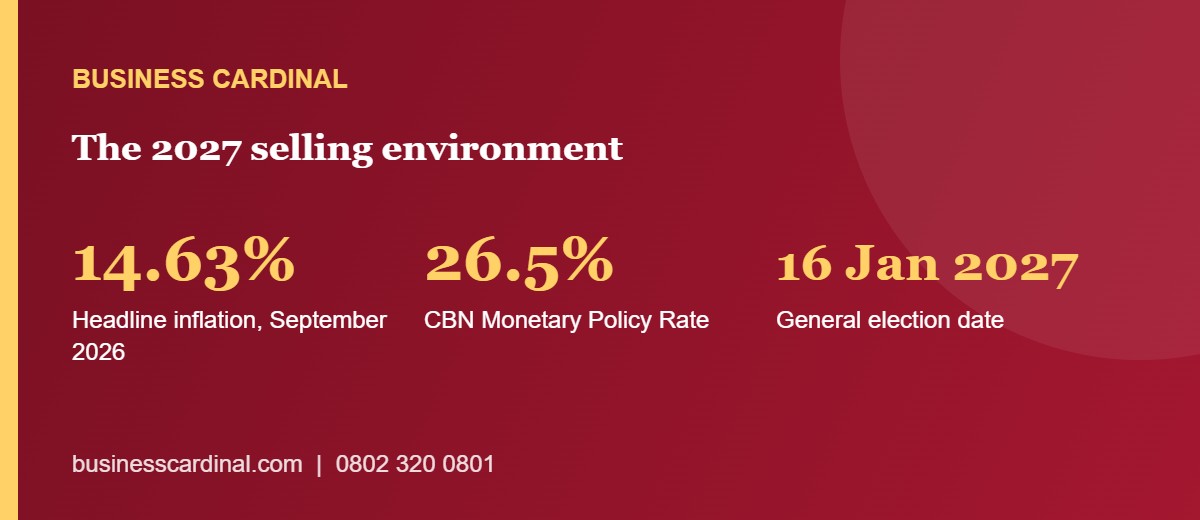
Prices are still moving. Headline inflation eased to 14.63% in September 2026, according to the NBS figures reported by Nairametrics. That is lower than a year earlier, but price increases still lift naira revenue without any extra selling effort. A plan that pays on naira turnover rewards inflation as much as performance.
Money is expensive. The Central Bank of Nigeria held the Monetary Policy Rate at 26.5% at its September 2026 meeting. Customer credit costs real money. A seller who books a large order on 90-day terms has used your working capital. The plan should reflect that.
The first quarter will be slow. The general election falls on 16 January 2027, straight after the festive break. Many B2B buyers will delay decisions. A plan built on twelve equal monthly targets will look broken by February and demoralise the team.
Start with what the business needs
Before you touch rates and thresholds, write down three to five outcomes the business needs from sales in 2027. Be specific. For example:
- Grow gross margin, not just revenue, by holding price on key lines
- Win a set number of new accounts in Abuja and Port Harcourt
- Cut days sales outstanding from 75 to 50
- Shift the mix towards a new product range
- Keep the top 20 accounts and grow their spend
Each outcome becomes a candidate measure in the plan. Pick no more than three for any one role. Sellers cannot focus on six measures at once, and a plan with too many parts pays everyone a little for everything.
The core design choices
Pay mix: how much is fixed and how much is variable
Pay mix is the split between base salary and target incentive. A hunter role that wins new business may run at 60% base and 40% incentive at target. An account manager who looks after existing clients may run at 80% base and 20% incentive. Field roles in FMCG distribution often sit somewhere in between.
A higher variable share drives harder selling but raises staff turnover in slow months. In a year with a slow first quarter, consider a slightly higher base for the January to March period, or a guaranteed minimum incentive for those months.
Quota: what counts as target
Set quotas from the bottom up. Look at each territory’s actual accounts, the pipeline and the realistic share you can win. Then compare the total with the company budget. If the bottom-up total falls short of the budget, the gap is a management problem, not something to load onto sellers.
Phase quotas by month or quarter to reflect real seasonality. If January and February are slow every election year, set lower targets for those months and higher ones for the second and third quarters.
Measure: what the commission is calculated on
| Measure | When it works | Watch out for |
|---|---|---|
| Revenue | Simple products, stable prices | Rewards inflation and discounting |
| Gross margin | Products with varied margins, price pressure | Sellers need margin data they trust |
| Cash collected | Long credit terms, high DSO | Delays payment to the seller, needs clear rules |
| New accounts | Expansion into new regions or segments | Easy to game with tiny first orders |
| Product mix | Launching a new range | Can pull focus from core lines |
Many Nigerian businesses get the best results by paying on gross margin collected. The seller earns commission only on margin from invoices the customer has paid. That one rule protects price and cash at the same time.
Rate and curve: how pay rises with performance
A flat rate pays the same percentage from the first naira to the last. A tiered curve pays a lower rate below target and a higher rate above it. Tiered plans reward your best performers more, which is usually what you want.
Set a threshold below which no commission is paid, often 50% to 70% of quota. Set an accelerator above 100% to reward over-performance. Avoid a hard cap unless you have a clear reason, such as a windfall order that the seller did little to win. Caps tell your best people to stop selling once they hit the limit.
Timing: when commission is paid
Monthly payment keeps motivation high but can reward deals that later go bad. Quarterly payment smooths results but feels distant to field staff. A common middle path pays monthly on collected margin, with a quarterly true-up for accelerators and clawbacks.
A worked example
The figures below are illustrative only.
A Lagos industrial supplies company sets a 2027 annual gross margin quota of N60 million for a key account manager. The plan pays on gross margin collected.
| Performance band | Commission rate on collected margin |
|---|---|
| Below 60% of quota | 0% |
| 60% to 100% of quota | 4% |
| Above 100% of quota | 7% |
In 2027 the seller collects N72 million of gross margin, which is 120% of quota.
- Margin from N36 million to N60 million earns 4%: N24 million × 4% = N0.96 million
- Margin above N60 million earns 7%: N12 million × 7% = N0.84 million
- Total commission: N1.8 million
Under the old plan, which paid 1.5% on revenue, the same seller would have earned on N300 million of sales: N4.5 million. Much of that revenue came from heavily discounted orders that added little margin. The new plan pays less in total but pays far more for each naira of profit the seller brings in. It also pays nothing on invoices the customer never settles.
Rules that prevent disputes
Most commission arguments come from grey areas the plan never addressed. Settle these in writing before the year starts:
- Split credit. Who earns commission when two sellers work on one deal, or when a deal crosses territories?
- House accounts. Which large accounts are managed centrally and earn no individual commission?
- Returns and credit notes. Commission paid on returned goods is deducted from the next payment.
- Clawbacks. Commission paid on invoices that become bad debt within a set period is recovered.
- Leavers. Is commission paid on collections that arrive after a seller leaves? For how long?
- Price approval. Deals below the approved price floor earn reduced commission or none.
- Plan changes. Management may change the plan mid-year only with written notice and only from the start of the next period.
Ask each seller to sign the plan document. A signed plan is far easier to enforce than an email.
Tax and payroll points finance must handle
Commission paid to employees is part of their employment income. It goes through payroll and is taxed under PAYE in the month it is paid, using the progressive bands in the Nigeria Tax Act 2025. A large quarterly payout can push a seller into a higher band for that month, so payroll should apply the annualised method consistently.
Commission also counts for pension where your scheme defines pensionable pay to include it, so check your pension policy. For agents and independent sales representatives who are not employees, payments sit outside PAYE but may attract withholding tax and VAT. Their contracts should make their status clear.
Finance should also accrue commission as it is earned, not when it is paid. That keeps monthly management accounts honest and avoids a year-end surprise.
Common mistakes to avoid
Rolling the old plan forward. Last year’s plan was built for last year’s market. Rebuild it from the business outcomes you need now.
Paying on invoiced revenue. This rewards discounting and ignores bad debts. Pay on collected margin where you can.
Too many measures. Three is the maximum for any role. More than that and the plan pays for activity, not results.
Unrealistic quotas. Targets set top-down from the board budget, with no link to territory potential, lead to early despair and staff turnover.
Late or wrong payments. Nothing destroys trust faster than a commission statement nobody can check. Give each seller a monthly statement that shows every invoice, collection and rate.
Changing rules mid-year. If you must change, give notice and apply the change from the next period only.
A 2027 rollout checklist
- Agree the three to five business outcomes with the board by end of November.
- Choose measures and pay mix for each sales role.
- Build bottom-up quotas by territory and phase them by month.
- Model the plan on 2026 actual results to test cost and fairness.
- Write the plan document, including all dispute rules.
- Brief sales managers first, then each seller one to one.
- Get every seller to sign before 31 December.
- Set up monthly commission statements in your CRM or payroll system.
- Review results at the end of the first quarter and adjust only for the next period.
Matching the plan to each sales role
One plan rarely fits every role. A field rep in Kano, a key account manager in Victoria Island and an inside sales agent in a call centre do different jobs. Their plans should reflect that.
| Role | Typical pay mix | Best primary measure | Secondary measure |
|---|---|---|---|
| New business hunter | 60% base, 40% variable | New account gross margin | First-year collections |
| Key account manager | 75% base, 25% variable | Account gross margin growth | Retention of named accounts |
| Field or route rep | 70% base, 30% variable | Collected gross margin by route | Outlet coverage or distribution points |
| Inside sales or telesales | 80% base, 20% variable | Qualified meetings or orders booked | Conversion rate |
| Sales manager | 70% base, 30% variable | Team margin against quota | Team DSO |
Managers should earn on the team’s result, not on their own deals. A manager who keeps the best accounts for themselves starves the team and weakens the pipeline.
Communicating the plan so sellers trust it
A good plan explained badly will fail. Sellers judge a plan by two questions: can I understand it, and can I check it?
Hold a short session for each team before the year starts. Walk through the plan with real examples from that territory. Show what a seller earns at 80%, 100% and 120% of quota. Answer every question, and publish the answers to the whole team so nobody hears a different story.
Then give each seller a simple calculator, even a one-page spreadsheet, that shows their earnings as they go. When sellers can see the link between a closed and collected order and their pay, the plan starts to work.
Finally, tell sellers when and how disputes will be resolved. Name the person who decides, set a deadline for raising a dispute, and keep a log of every ruling. Consistent rulings build trust. Inconsistent ones destroy it within a quarter.
Frequently asked questions
What is a good commission rate for sales staff in Nigeria?
There is no single rate. It depends on pay mix, margin and role. The better question is what total incentive a seller should earn at target, usually 20% to 40% of total pay, and then working back to a rate that delivers it on the chosen measure.
Should commission be paid on revenue or gross margin?
Gross margin is usually better where prices and discounts vary. It stops sellers buying volume with deep discounts. Paying on margin collected also protects cash.
Is sales commission taxable in Nigeria?
Yes. Commission paid to employees is employment income and goes through PAYE in the month it is paid. Payments to independent agents may attract withholding tax and VAT instead.
How do we handle commission on bad debts?
Set a clawback rule. If an invoice that earned commission becomes a bad debt within an agreed period, the commission is deducted from future payments. Better still, pay only on collected invoices.
How should we set quotas for an election year?
Phase them. Set lower targets for January and February 2027 and higher ones for the second and third quarters, based on each territory’s real pipeline.
Should sales managers earn commission on their own deals?
It is better to pay managers on the team result. Paying them on personal deals encourages them to keep the best accounts and compete with their own sellers.
How Business Cardinal can help
Business Cardinal designs sales incentive plans, builds quotas from territory data and trains sales managers to run them. We model each plan on your actual results before rollout, so you know the cost and the likely payouts. See our sales performance and incentive programme design, compensation benchmarking and benefits strategy and CRM implementation services.
To design your 2027 commission plan, call 0802 320 0801 or 0807 576 5799, email hello@businesscardinal.com, or visit businesscardinal.com.
This article is general guidance based on public data available on 11 November 2026. The worked example is illustrative. Take payroll and tax advice on your own plan.
Related Post

How Regulatory Uncertainty Impacts Long-Term Feasibility Studies in Nigeria
Print 🖨 PDF 📄 eBook 📱How Regulatory Uncertainty Impacts Long-Term Feasibility Studies in Nigeria Let…

Succession Planning for Nigerian Family Businesses: Avoiding Value Loss in Nigeria
Print 🖨 PDF 📄 eBook 📱Succession Planning for Nigerian Family Businesses: Avoiding Value Loss in…
The Economics of Turnaround Management: Lessons from Failed Brands in Nigeria
Print 🖨 PDF 📄 eBook 📱The Economics of Turnaround Management: Lessons from Failed Brands in…
