


Sales Negotiation in Nigeria: How to Hold Price With Distributors and Key Accounts

Every Nigerian sales manager knows the moment. The distributor says your competitor is offering 5% more. The key account buyer says the budget has been cut and asks for a discount. The customer says they will sign today if you drop the price. And the rep, under pressure to close before month end, gives away margin that took months to build.
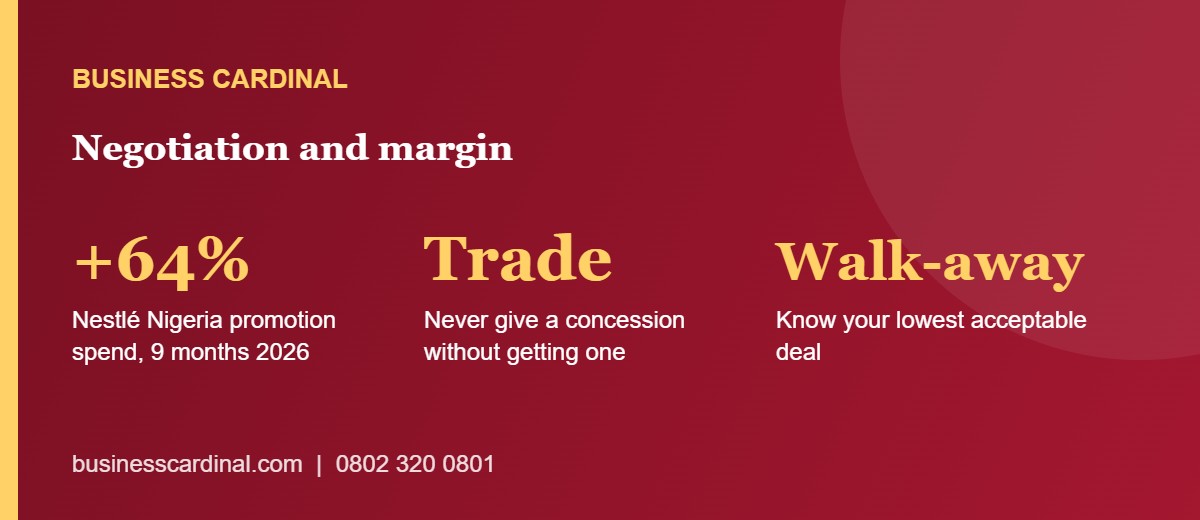
With inflation at 14.63% in September 2026 and shoppers buying less in many categories, customers are pushing harder on price than at any time in recent years. Nigeria’s large consumer goods companies have shown how expensive it can get. Nestlé Nigeria’s consumer promotion spending rose 64% in the first nine months of 2026, while revenue grew 10.4%. Discounts and concessions are eating into the profits that cheaper finance and price increases delivered.
Negotiation is where much of that margin is won or lost. This guide explains why Nigerian sales teams give away too much, the principles of value-based negotiation, and how to train reps and managers to hold price without losing the deal.
Why sales teams concede too easily
Targets drive behaviour. When reps are paid on volume and the month is ending, a discount looks like the fastest way to close. The cost falls on the company, not the rep.
Fear of losing the customer. Many reps believe that refusing a concession means losing the account. In practice, customers who stay only for the lowest price rarely stay long.
No preparation. Reps walk into negotiations without knowing their walk-away point, the customer’s alternatives or what they can trade.
Unclear authority. When reps can approve discounts on the spot, customers learn to ask every time.
Habit. Once a customer has received a discount, they expect it again. Every concession sets a precedent.
The principles of value-based negotiation
1. Never give without getting
Every concession should be traded for something of value. If the customer wants a lower price, ask for a larger order, faster payment, a longer contract, better shelf placement, or exclusivity in a category. “If you can commit to 500 cartons a month for six months, I can look at the price” is a trade. “OK, I’ll give you 3%” is a gift.
2. Know your walk-away point
Before any negotiation, decide the lowest price or worst terms you will accept. Calculate it from your margin, not from the customer’s demand. A rep who knows the walk-away point negotiates with confidence.
3. Understand the customer’s alternatives
The customer’s best alternative to doing a deal with you sets their real bargaining power. If your competitor cannot supply in the volumes they need, or their quality is poor, the customer’s leverage is weaker than they claim. Research before you concede.
4. Sell value before price
Customers negotiate on price when they do not see differences in value. Reps should be able to explain, in the customer’s terms, what the product or service delivers: faster stock turns, fewer returns, reliable supply, credit terms, merchandising support or technical service.
5. Concede slowly and in decreasing steps
If you must move on price, make small concessions, and make each one smaller than the last. Large or growing concessions signal there is more to give.
6. Separate the people from the problem
Nigerian business relationships are personal. Protect the relationship while being firm on terms. “I value working with you, and I want to find a deal that works for both of us” keeps the conversation constructive.
Common negotiation scenarios in Nigeria
The distributor demanding better margins
Distributors in Nigeria face high financing costs, transport expenses and pressure from retailers. Their demands for margin are often real. But giving extra margin without conditions rewards poor performers as much as good ones.
Instead, link margin to performance: volume tiers, timely payment, coverage of agreed outlets, stock levels and data sharing. A distributor who hits targets earns more. One who does not, does not.
The key account buyer with a budget cut
Large buyers in supermarkets, telecoms, banks or manufacturers often claim budget cuts to secure discounts. Ask questions before conceding. Which budget? By how much? What other options are they considering? Could scope be reduced instead of price? Could payment terms change?
Often the buyer has room to move, or the real issue is something other than price, such as delivery performance or a competing internal priority.
The “sign today if you drop the price” close
This is a classic pressure tactic. The customer creates urgency to extract a concession. Respond calmly: “I understand you want to move quickly. Let us agree the scope and terms first, then look at price together.” If the deal only closes with a margin-destroying discount, it may not be worth closing.
The competitor price match
When a customer says a competitor is cheaper, ask to see the offer. Compare like with like: quantities, quality, delivery, credit terms, after-sales support. Many “cheaper” offers are not comparable. Where they are, decide whether the account is worth matching, based on its long-term value.
Preparing for a negotiation
A simple preparation sheet improves results. Before every significant negotiation, reps should write down:
| Item | Questions |
|---|---|
| Objective | What do we want from this negotiation? |
| Walk-away point | What is the worst deal we will accept? |
| Customer’s interests | What does the customer really need? |
| Customer’s alternatives | What happens if they do not deal with us? |
| Our alternatives | What do we do if we do not reach a deal? |
| Tradeables | What can we offer that costs us little but is valuable to them? |
| Concession plan | What will we give, in what order, and for what in return? |
| Authority | What can I approve, and what needs escalation? |
Managers should review preparation sheets for major accounts before the meeting.
Controlling discounts through policy
Training works best with clear rules. A discount policy should set:
- Approval levels by discount size, so larger discounts need more senior sign-off.
- Standard trade terms that reps cannot change without approval.
- A requirement to document what was received in return for each concession.
- Regular reporting of discounts by rep, customer and product.
When reps cannot give away margin on the spot, customers stop expecting it. And when managers see discount data, they can coach the reps who concede most.
Training negotiation skills
Negotiation is a skill learned through practice. Effective training:
- Uses real scenarios. Role plays built on your own customers, products and objections.
- Includes preparation practice. Reps complete preparation sheets for live deals.
- Gives feedback. Coaches observe role plays and real negotiations, and give specific feedback.
- Trains managers first. Managers must model the behaviour and coach it.
- Tracks results. Measure average discount, price realisation and margin by rep before and after training.
Our sales negotiation training uses this approach, built around the customers and objections your team faces every week.
A worked example
A Lagos distributor of industrial consumables found that its average discount had crept from 4% to 11% over two years. Margins had fallen by almost half. Reps could approve up to 15% discount without reference to management.
The company introduced a discount approval matrix, trained its 22 reps in value-based negotiation, and required a preparation sheet for any deal above ₦5 million. Managers reviewed discount reports weekly and coached reps with the highest discounts.
Within two quarters, the average discount fell to 6%, while volumes stayed broadly flat. The margin recovered on the same revenue was worth several times the cost of the programme.
Figures are illustrative.
Common mistakes
- Conceding on price before exploring other options.
- Giving concessions without asking for anything in return.
- Letting reps approve large discounts on the spot.
- Matching competitor prices without checking the offer.
- Training reps but not managers.
- Not measuring discounts and margin by rep.
Negotiating payment terms, not just price
In Nigeria, payment terms often matter as much as price. A customer who pays in 90 days instead of 30 costs you two months of financing at rates well above 20% a year. A 5% discount for payment in 14 days may be cheaper for you than carrying the receivable.
Train reps to see terms as part of the price:
- Calculate the cost of credit for each customer, using your actual borrowing rate.
- Offer early payment discounts only where they cost less than the financing saved.
- Link credit limits to payment history, and review them every quarter.
- Never extend terms to win a deal without approval from finance.
A rep who wins a deal at full price but agrees 120-day terms may have given away more than one who offered a small discount for cash on delivery.
Negotiating with a buying team
Large customers often negotiate as a team, with procurement leading and users or finance in the room. Prepare for this:
- Agree roles in your own team: who leads, who handles technical questions, who watches for signals.
- Identify what each person on the customer side cares about. Procurement wants savings, users want performance, finance wants predictable cost.
- Address each person’s concerns so that procurement cannot use one group’s doubts as leverage on price.
- Take breaks to consult privately before agreeing to significant changes.
Silence and patience
Many Nigerian reps fill every pause with a new offer. Silence after a customer’s demand is uncomfortable, but it is powerful. Let the customer explain the demand. Ask questions. “What would make that work for you?” often reveals that the real issue is delivery, quality or credit, not price.
Patience also matters at month end. Customers know when reps are under pressure to close. Sales leaders who refuse to reward last-week discounting break that cycle.
Documenting the agreement
Once terms are agreed, confirm them in writing the same day: price, quantities, delivery schedule, payment terms, rebates and any conditions. Misunderstandings in Nigeria often arise weeks later, when a customer remembers a concession differently. A clear written summary protects both sides and prevents a second round of negotiation.
Rebates and incentives as alternatives to discounts
Rather than cutting the invoice price, consider volume rebates paid after targets are met, growth incentives on year-on-year increases, or marketing support funds tied to agreed activities. These reward the behaviour you want and protect the list price, which matters when other customers compare notes.
Review lost deals honestly
When a deal is lost on price, ask the customer what really decided it. Many losses blamed on price turn out to be about delivery, relationships or trust. Those lessons improve the next negotiation.
Frequently asked questions
What is value-based negotiation?
An approach that focuses on the value the product or service delivers to the customer and trades concessions for something in return, rather than reducing price to close the deal.
How can sales reps avoid giving too many discounts?
Prepare before every negotiation, know the walk-away point, sell value before discussing price, trade every concession for something in return, and follow a clear discount approval policy.
How should we respond when a customer says a competitor is cheaper?
Ask to see the offer and compare like with like, including quantity, quality, delivery, credit terms and support. Decide whether to match based on the account’s long-term value.
Should sales reps have authority to approve discounts?
Reps can have limited authority for small discounts, with larger concessions requiring manager or senior approval. This protects margin and reduces customers’ expectation of automatic discounts.
How do we measure the impact of negotiation training?
Track average discount, price realisation and gross margin by rep and customer before and after training.
Are payment terms part of a sales negotiation?
Yes. Longer credit terms carry financing costs that can exceed the value of a price discount, so sales teams should negotiate price and payment terms together with input from finance.
How Business Cardinal can help
Business Cardinal delivers research-based sales negotiation training for Nigerian sales teams, distributors and key account managers. We build programmes around your products, customers and objections, train managers to coach, and help design discount policies that protect margin. See our sales negotiation training and sales effectiveness solutions.
Protect your margins in 2027: call 0802 320 0801 or 0807 576 5799, email hello@businesscardinal.com, or visit businesscardinal.com/contact.
Figures are from published company results as of November 2026 and illustrative examples.
Related Post

Strategic Consolidation Trends in Nigeria’s Fintech Industry
Print 🖨 PDF 📄 eBook 📱Strategic Consolidation Trends in Nigeria’s Fintech Industry Let me tell…
Comprehensive Accounts Payable Management Checklist for Businesses in Nigeria
Print 🖨 PDF 📄 eBook 📱Comprehensive Accounts Payable Management Checklist for Businesses in Nigeria Get…

From Pitch Deck to Investment Memo: What Actually Influences Investor Decisions
Print 🖨 PDF 📄 eBook 📱From Pitch Deck to Investment Memo: What Actually Influences Investor…
