


Tech-Driven Data Collection: How Digital Tools Improve Market Accuracy
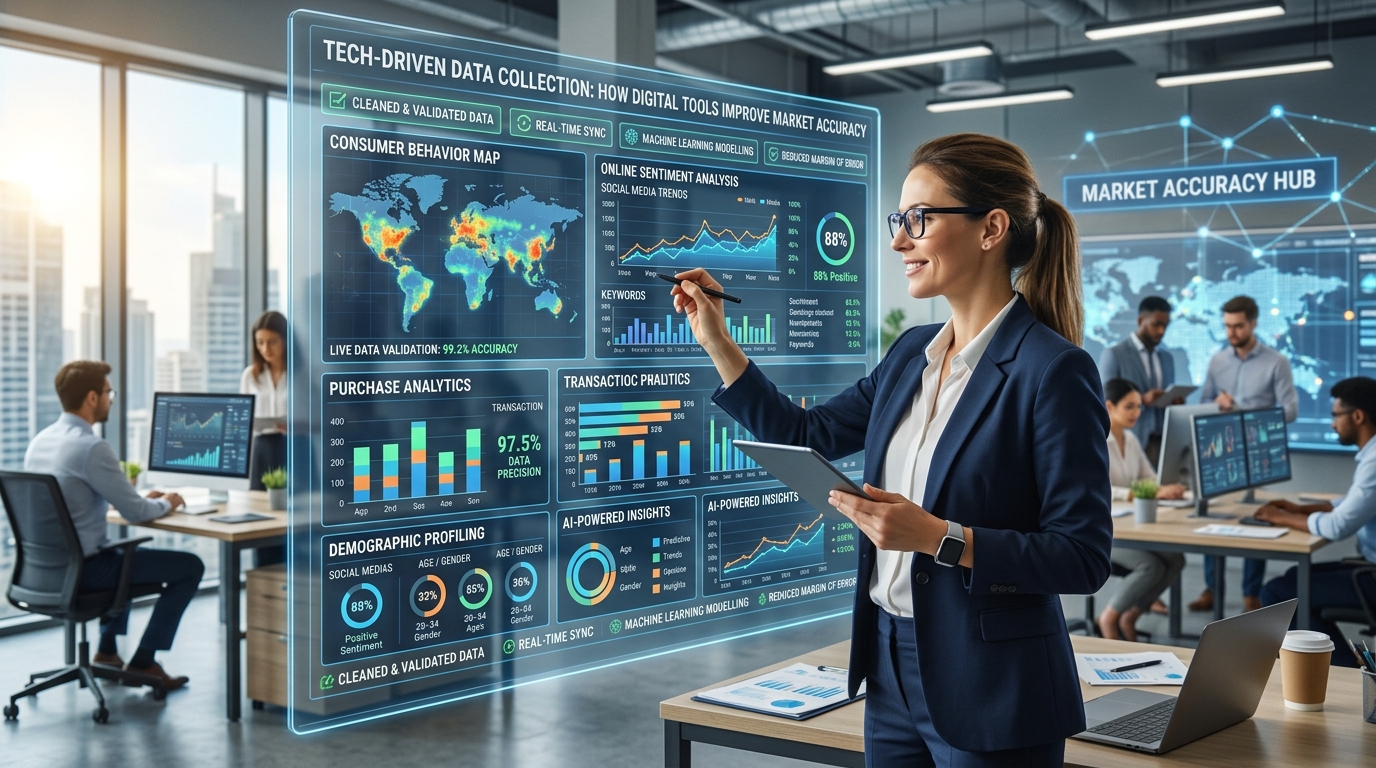
Tech-Driven Data Collection: How Digital Tools Improve Market Accuracy
Let me ask you a question that every business leader should consider.
How confident are you in the accuracy of your market data?
If you are still relying on traditional research methods alone, you might be missing critical insights. Traditional approaches have value. But they struggle with limitations in speed, scale, and precision.
The digital revolution has changed everything. Technology-driven data collection methods are now delivering unprecedented accuracy and actionable insights that drive business growth.
This article explores how digital tools are reshaping market research methodologies. You will learn how to make more informed decisions in an increasingly competitive marketplace.
If you need professional support, market research services can help you leverage tech-driven data collection for better accuracy.
Understanding market research in the digital age
Before diving into technological innovations, let us understand what modern market research entails.
According to the American Marketing Association , marketing research is “the function that links the consumer, customer, and public to the marketer through information.” This information is used to identify and define opportunities and problems, generate and evaluate actions, monitor performance, and improve understanding of the process.
In simpler terms, market research is the systematic process of gathering, analyzing, and interpreting information about a market. This includes data about target audiences, competitors, and industry trends.
In 2025, this definition has expanded to encompass real-time data streams, AI-powered analytics, and multi-channel digital touchpoints that were unimaginable just a decade ago.

Mobile data collection: research at your fingertips
Mobile technology has fundamentally transformed how researchers connect with respondents.
The mobile revolution in market research
The proliferation of smartphones has created unprecedented opportunities for market researchers. With over 6.8 billion smartphone users globally as of 2025, mobile devices have become the primary gateway for reaching diverse populations.
Mobile data collection tools allow researchers to conduct surveys anywhere, anytime. Respondents can participate from their location of choice, eliminating geographical barriers. This improves response rates by 35-40% compared to traditional methods.
Mobile apps enable immediate feedback collection at the point of experience. Whether customers are in-store, using a product, or engaging with a service, you can capture their insights instantly.
Modern mobile surveys incorporate photos, videos, voice recordings, and geolocation data. This provides richer, more contextual insights than text-based responses alone. By capturing data in the moment, mobile tools also minimize the memory distortions that plague retrospective surveys.
Latest updates in mobile data collection (2025)
Recent innovations have further enhanced mobile research capabilities.
AI-powered adaptive surveys are changing the game. New mobile survey platforms use artificial intelligence to adjust question flows in real-time based on previous responses. This creates personalized survey experiences that improve completion rates by up to 50%.
Wearable integration is another breakthrough. Market research apps now sync with smartwatches and fitness trackers. They collect behavioral and biometric data alongside survey responses for deeper consumer insights.
5G-enhanced rich media has eliminated bandwidth constraints. Researchers can now collect high-quality video testimonials and conduct virtual focus groups seamlessly through mobile devices.
Progressive web apps (PWAs) eliminate the need for app downloads. They allow instant survey participation through mobile browsers while maintaining app-like functionality and offline capabilities.
Online surveys and panels: scaling research efficiently
Digital survey platforms and online panels have democratized market research.
The power of digital survey platforms
Online surveys have evolved from simple questionnaire tools to sophisticated research platforms. They combine speed, scale, and precision.
Digital surveys can be designed, distributed, and completed within hours rather than weeks. This enables businesses to respond quickly to market changes.
Online surveys reduce costs by 40-60% compared to traditional methods. They eliminate printing, postage, data entry, and interviewer expenses.
Researchers can precisely segment audiences based on demographics, behaviors, purchase history, and psychographic profiles. This ensures responses come from the most relevant participants.
Modern platforms incorporate attention checks, consistency validation, and automated data cleaning. These built-in quality controls identify and filter out low-quality responses.
Online panel evolution
Pre-recruited research panels have matured significantly. They offer researchers immediate access to verified, profiled respondents.
Leading panel providers maintain millions of verified members across demographic segments. This enables statistically significant studies in even niche markets.
New panel platforms use blockchain technology to verify respondent identity and prevent duplicate participation. This addresses long-standing concerns about panel quality.
AI algorithms now personalize rewards based on respondent preferences and study complexity. This improves participation rates while controlling costs.
Innovations in online research
Conversational AI surveys are transforming the respondent experience. Next-generation platforms employ natural language processing. Respondents interact with surveys through conversational interfaces that feel more like chat conversations than traditional questionnaires. This increases engagement by 45%.
Gamified research experiences incorporate game mechanics and interactive elements. These transform surveys into engaging experiences, particularly effective with younger demographics.
Privacy-preserving analytics address growing data privacy concerns. New technologies enable analysis of encrypted survey data without exposing individual responses. This addresses GDPR and privacy compliance while maintaining analytical power.
Cross-platform continuity allows respondents to start surveys on one device and seamlessly continue on another. This reduces abandonment rates by 30%.
High Performance Selling (HPS) sales training programme can help your sales teams leverage survey insights for better customer engagement.
Social media analytics: mining the digital conversation
Social media platforms have become invaluable sources of unsolicited consumer opinions.
Listening to the digital pulse
Social media analytics tools enable researchers to tap into billions of organic conversations happening daily across platforms.
Advanced natural language processing algorithms analyze social media posts, comments, and reviews. They gauge public opinion about brands, products, and industry trends with unprecedented speed.
Social listening tools detect emerging patterns and topics gaining momentum. This allows businesses to anticipate market shifts before they fully materialize.
By monitoring competitor mentions and customer feedback, organizations gain insights into competitive positioning, strengths, and vulnerabilities.
Sophisticated network analysis identifies key opinion leaders and brand advocates who shape consumer perceptions within target markets.
The authenticity advantage
Unlike traditional surveys where respondents know they are being studied, social media provides access to unfiltered opinions.
Consumers share honest experiences without the social desirability bias that can skew survey responses. Visual content like photos and videos provides contextual understanding of how products are actually used.
Temporal analysis reveals how sentiment evolves over time in response to events, campaigns, or product launches.
2025 advances in social media research
Multimodal AI analysis tools now analyze text, images, videos, and audio simultaneously. They extract insights from memes, Stories, Reels, and TikTok content that previous text-only tools missed.
Predictive sentiment modeling uses machine learning to forecast sentiment trends before they peak. This gives brands 3-7 days advance warning of potential reputation issues or viral opportunities.
Cross-platform integration provides unified analytics dashboards. They aggregate data from emerging platforms like Threads, BeReal, and Discord communities alongside traditional social networks for comprehensive social intelligence.
Emotion AI algorithms now detect subtle emotional nuances beyond simple positive or negative sentiment. They identify specific emotions like frustration, delight, confusion, or anticipation with 85% accuracy.
Big data and AI analytics: uncovering hidden patterns
The convergence of big data technologies and artificial intelligence has fundamentally transformed what is possible in market research.
From data collection to data intelligence
Modern market research generates massive datasets from multiple sources. Transaction records, website interactions, sensor data, surveys, and social media all contribute to the data deluge.
AI and machine learning turn this data into actionable intelligence.
AI algorithms identify complex relationships and patterns across millions of data points that human analysts would never detect. They reveal hidden market segments and opportunity areas.
Machine learning models forecast customer behavior, market trends, and demand fluctuations with increasing accuracy. This enables proactive strategy development.
Natural language generation systems automatically produce narrative reports highlighting key findings, anomalies, and recommendations. This accelerates the journey from data to decisions.
AI enables dynamic market segmentation that evolves as customer behaviors change. This supports hyper-personalized marketing and product development.
The data quality imperative
The power of AI analytics depends entirely on data quality. Modern research platforms incorporate several safeguards.
Automated data validation flags inconsistencies, outliers, and potential errors in real-time during collection.
Multi-source data fusion reconciles and integrates data from disparate sources, creating unified customer views.
Bias detection and correction tools identify sampling biases, measurement errors, and algorithmic biases that could skew results.
Breakthroughs in AI-powered research
Synthetic data augmentation uses generative AI to create synthetic datasets that preserve statistical properties of real data. This addresses privacy concerns and sample size limitations, particularly valuable for niche market research.
Causal AI moves beyond correlation. New causal inference algorithms identify true cause-and-effect relationships in observational data. They answer “why” questions that previously required expensive experimental studies.
Automated hypothesis generation systems now autonomously explore datasets to propose novel hypotheses and research questions that human researchers might overlook. This opens new avenues of inquiry.
Quantum-enhanced analytics are early but promising. Quantum computing applications are beginning to solve complex optimization problems in market segmentation and pricing research that are intractable for classical computers.
Tax advisory and tax consulting services can help you understand the tax implications of investing in AI-powered research tools.
Geolocation and IoT data: context-aware insights
The Internet of Things and ubiquitous location tracking have created new dimensions of market intelligence.
Location intelligence transforms understanding
Geolocation data provides unprecedented insights into consumer behavior in physical spaces.
Retailers and real estate developers analyze foot traffic patterns to optimize store locations, layout designs, and staffing schedules.
Competitive proximity mapping helps businesses understand how competitor locations affect customer traffic and market share in specific geographies.
Location data reveals complete customer journeys. You can see where customers travel before and after visiting your business, competitor visits, and cross-shopping patterns.
Marketers can deliver location-specific messages and offers based on real-time positioning and historical movement patterns.

IoT expands the data universe
Connected devices generate continuous streams of behavioral data.
Smart home insights reveal actual product usage patterns, frequency, and contexts that survey responses cannot capture accurately.
Sensors provide data on conditions like weather, temperature, and time of day that influence purchasing and consumption decisions.
Usage data from connected products forecasts replacement needs and service opportunities before customers recognize them.
Developments in location and IoT research
Privacy-compliant location analytics use new differential privacy techniques. These enable valuable location insights while mathematically guaranteeing individual privacy, addressing regulatory concerns while maintaining research value.
Digital twin modeling allows researchers to create virtual replicas of physical retail environments populated with simulated customers based on real behavioral data. They can test store layouts and merchandising strategies without costly physical changes.
Edge computing analytics process data directly on IoT devices rather than centralized servers. This enables real-time insights with reduced latency and enhanced privacy protection.
Ambient intelligence systems integrate multiple sensor types including video, audio, and environmental sensors. They create comprehensive understanding of customer experiences in physical spaces while respecting privacy boundaries.
Balancing technology and human expertise
The digital transformation of market research represents far more than technological novelty. It is a fundamental shift in how businesses understand and respond to their markets.
Digital tools have democratized access to high-quality research. They have accelerated insight generation from months to days. And they have enabled analysis of human behavior at unprecedented scales and granularity.
However, technology is ultimately an enabler, not a replacement for strategic thinking and human judgment. The most valuable insights emerge when sophisticated tools are guided by experienced researchers who understand what questions to ask, how to design valid studies, and how to translate data into actionable business strategy.
Recommended reading from our blog
If you want to strengthen your market research and data collection capabilities, these related articles will help.
Building a Risk-Aware Culture in Your Organization – Data-driven decision-making starts with organizational culture.
Board Evaluation: Why It Matters for Nigerian Businesses – Stronger oversight leads to better research investments.
Recommended services
Ready to harness the power of tech-driven market research for your business? These services are designed to help.
Market research services – AI-powered consumer insights and trend analysis.
Due diligence and background verification – Thorough market and competitor analysis.
Contract documentation and review support – Ensure your research agreements are sound.
Reference Links
The following authoritative sources were cited in this article:
-
American Marketing Association – Definition of Marketing Research (Approved 2017)
-
Business Cardinal – Research-based sales training, sales coaching and sales consulting firm in Lagos, Nigeria
Where to go from here
The digital transformation of market research is here to stay. Businesses that embrace tech-driven data collection will gain significant competitive advantages.
But remember this. Technology provides powerful tools. However, extracting meaningful insights requires human expertise, contextual understanding, and strategic thinking.
At Business Cardinal, we combine cutting-edge digital tools with deep industry knowledge and methodological rigor. We select and combine technologies based on your specific research objectives, not one-size-fits-all templates.
Our digital research capabilities include mobile-optimized surveys designed for low-bandwidth environments, social media monitoring across English and local languages, advanced analytics with visualization dashboards, real-time reporting portals, and secure data handling compliant with international standards.
Contact us today to discuss how our tech-driven market research capabilities can support your strategic objectives.
📧 Email: hello@businesscardinal.com
📞 Phone: +234 802 320 0801
📍 Address: 5, Ishola Bello Close, Off Iyalla Street, Alausa, Ikeja, Lagos, Nigeria
Related Post

How Nigerian Companies Can Use Scenario Planning for Economic Shocks
Print 🖨 PDF 📄 eBook 📱How Nigerian Companies Can Use Scenario Planning for Economic Shocks…
Export Incentives in Nigeria: What You Need to Know
Print 🖨 PDF 📄 eBook 📱Export Incentives in Nigeria: What You Need to Know Get…
From Pitch Deck to Investment Memo: What Actually Influences Investor Decisions
Print 🖨 PDF 📄 eBook 📱From Pitch Deck to Investment Memo: What Actually Influences Investor…

There are no comments