


Board Evaluation: Why It Matters – Board Assessment Nigeria – Stronger Oversight
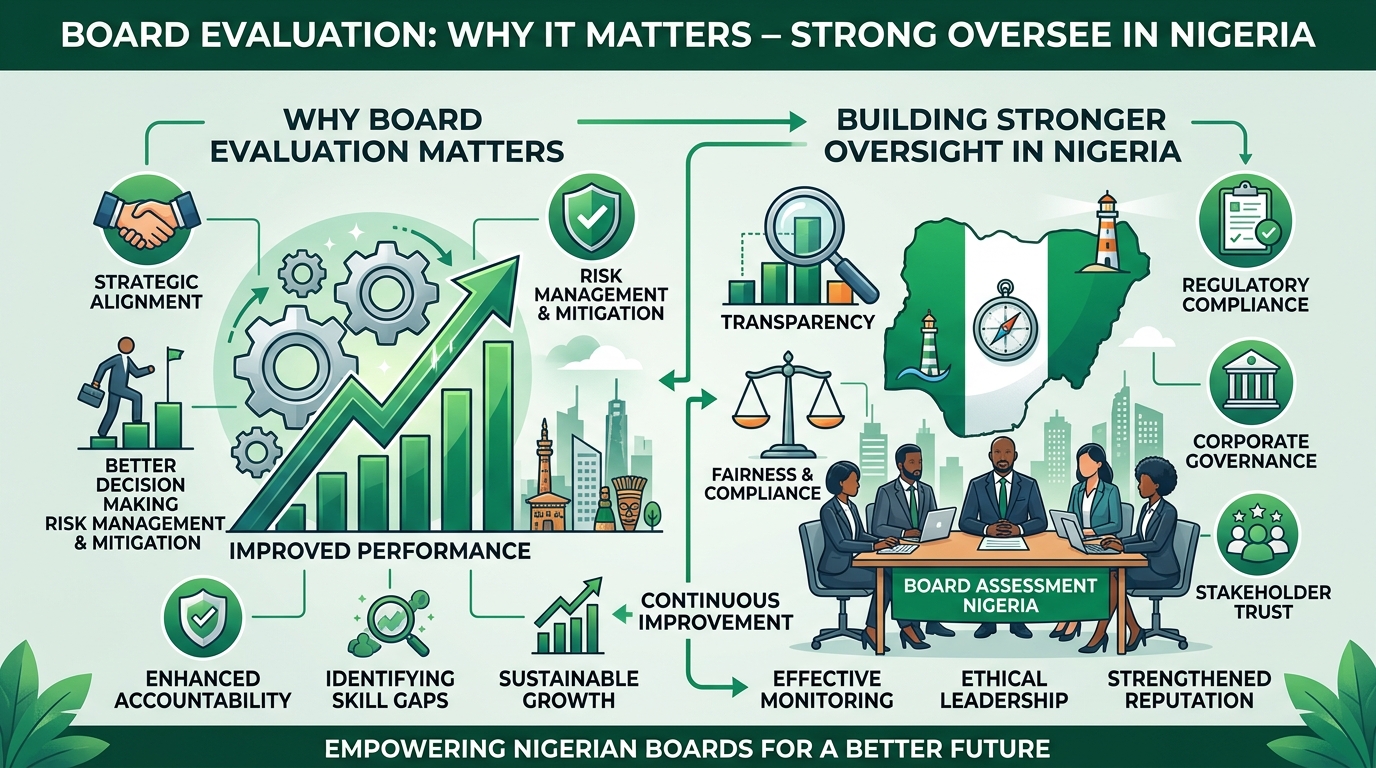
Board Evaluation: Why It Matters – Board Assessment Nigeria – Stronger Oversight
Boards that never examine how well they are functioning are boards that have decided to trust assumption over evidence.
In Nigerian organizations, board evaluation remains one of the most consistently underperformed governance requirements. It is acknowledged in annual reports, referenced in governance checklists, and rarely conducted with the depth or independence that makes it genuinely useful.
Yet the quality of board performance is arguably the single most important determinant of organizational governance quality. A board that understands its own strengths and weaknesses, that holds itself accountable for improving its collective effectiveness, and that uses honest self-assessment to drive better oversight delivers governance value that no policy document or compliance framework can replicate.
Let me walk you through what board evaluation is, what Nigerian law and governance standards require, how a meaningful evaluation is conducted, what it should cover, and how its findings should be used to strengthen board performance.
Business Cardinal provides Independent Board Evaluation Services to help Nigerian boards assess and improve their governance effectiveness.
What is board evaluation and what is it actually for?
Before working through how board evaluation should be conducted, it is worth being clear about what it is designed to achieve, because the purpose determines the design and the design determines the value.
Board evaluation serves several distinct but related purposes. It provides the board with an honest picture of how effectively it is functioning as a collective body, including how well it works as a team, whether its meetings are productive and well-managed, whether the right topics are receiving adequate attention, and whether the board’s composition reflects the skills and experience needed to govern the organization effectively.
It provides individual directors with feedback on their contribution to board discussions, their preparation for meetings, their relationships with fellow directors and with management, and their command of the business and governance issues they are expected to oversee. It provides the Nominations and Governance Committee with evidence to inform decisions about board renewal, director development, and succession planning. And it provides external stakeholders, including investors, regulators, and auditors, with evidence that the board takes its own governance accountability seriously.

What board evaluation is not
Board evaluation is not a rubber-stamp exercise in which directors confirm their own satisfaction with their collective performance. It is not a vehicle for managing personalities or settling boardroom disputes. It is not a one-size-fits-all questionnaire that generates scores without context. And it is not a compliance activity that produces a paragraph in the annual report without influencing how the board actually operates.
The distinction between genuine board evaluation and performative board evaluation is one of the most important governance distinctions Nigerian boards need to make. The former creates real change. The latter creates the illusion of accountability while delivering none of its benefits.
Read our Guide to Nigerian Code of Corporate Governance 2018 for comprehensive compliance insights.
What Nigerian governance standards require on board evaluation
The Nigerian Code of Corporate Governance 2018 addresses board evaluation explicitly, and the requirements are more specific than many Nigerian boards appreciate or apply in practice.
The NCCG requires that the board conduct a formal and rigorous annual evaluation of its own performance, the performance of its committees, and the performance of individual directors including the Chairman. The Code requires that the evaluation process be described in the annual report, including the methodology used, who conducted the evaluation, and the key findings and actions arising from it.
The Code further recommends that at least every three years, the board evaluation be facilitated by an independent external party rather than conducted purely internally. This recommendation reflects the well-established principle that self-assessment without external reference points is vulnerable to confirmation bias and social dynamics that prevent honest appraisal.
What the annual report must disclose
The annual report disclosure on board evaluation must go beyond a statement that an evaluation was conducted. It should describe the process followed including whether the evaluation was internal or externally facilitated, the areas of board performance that were assessed, the key themes emerging from the evaluation, and the specific actions the board has committed to taking in response to the findings.
Investors and governance analysts read board evaluation disclosures critically. Boilerplate statements that the board conducted its annual evaluation and found its performance satisfactory communicate nothing meaningful and are increasingly being challenged by institutional investors who expect substantive disclosure.
The SEC Nigeria and the NGX have both been strengthening their scrutiny of corporate governance disclosures in annual reports, including the depth and credibility of board evaluation disclosures. Companies whose annual reports contain superficial evaluation disclosures are increasingly being identified as governance concerns in regulatory reviews and institutional investor assessments.
The three levels of board evaluation: what must be assessed
Effective board evaluation is not a single assessment. It operates at three distinct levels, each addressing a different dimension of board performance, and a genuine evaluation must address all three to provide the board with a complete and actionable picture.
Level One: The board as a collective body
The first level assesses the performance of the board as a whole, examining how effectively the board functions as a governance body rather than how individual directors perform.
Board Composition and Skills. Does the board have the right mix of skills, experience, and perspectives to govern the organization effectively given its current strategy, risk profile, and operating environment? Are there material gaps in the board’s collective competence in areas like digital technology, sustainability, international markets, financial reporting, or sector-specific expertise?
Board Dynamics and Culture. Does the board operate as a genuinely collegiate body in which all members feel able to contribute their perspectives? Is there a culture of constructive challenge and open debate, or do certain voices dominate while others are marginalized?
Meeting Effectiveness. Are board meetings well-structured and productive? Is the agenda appropriate, covering the right topics in appropriate depth? Is board paper quality adequate, providing directors with the information they need to make informed decisions?
Strategic Oversight. Does the board spend adequate time on strategy? Does it challenge management’s strategic thinking effectively? Does it maintain a long-term perspective while also discharging its oversight responsibilities for near-term performance and compliance?
Risk Oversight. Does the board have a comprehensive picture of the principal risks facing the organization? Is risk management embedded in strategic decision-making?
Level Two: Board committee performance
The second level assesses the performance of each board committee separately, since each committee has a distinct mandate.
Audit Committee Evaluation. Does the Audit Committee have the right composition, with sufficient financial expertise and genuine independence? Is it effectively overseeing the integrity of financial reporting? Is its relationship with the external auditors appropriate?
Risk Committee Evaluation. Does the Risk Committee have a comprehensive view of the enterprise risk landscape? Is the risk management framework it oversees fit for purpose?
Remuneration Committee Evaluation. Is the Remuneration Committee setting executive compensation structures that align management interests with shareholder value creation?
Nominations and Governance Committee Evaluation. Is the Nominations and Governance Committee driving a rigorous and criteria-based approach to director selection? Is it maintaining an up-to-date board skills matrix?

Level Three: Individual director performance
The third level assesses the performance of each individual director, including the Chairman, against the expectations of their specific role.
Individual Director Assessment Areas. Assessment typically covers preparation for board and committee meetings, command of the business and industry context, ability to engage substantively with strategic, financial, and risk issues, relationships with fellow directors and with management, availability and engagement between meetings, and commitment to ongoing development.
Chairman Assessment. The Chairman’s evaluation deserves particular attention because the Chairman’s role in setting the board’s culture, managing its dynamics, and ensuring its effectiveness is uniquely influential.
Managing Sensitive Outcomes. Individual director assessment is the most sensitive dimension of board evaluation because it directly addresses the performance of specific people who are often prominent, experienced, and accustomed to being treated with deference. This sensitivity is precisely why external facilitation adds so much value.
Our Director Performance Assessment provides individual feedback that respects relationships while driving improvement.
Internal vs. external board evaluation: understanding the difference
The debate between internal and external board evaluation is not simply a question of cost. It is a question of what kind of evaluation the board needs at a given point in its development.
Internal board evaluation
An internal board evaluation is designed, conducted, and analyzed by people within the organization, typically the Company Secretary working with the Chairman or the Nominations and Governance Committee. It usually involves a questionnaire completed by all directors covering standard areas of board performance.
Internal evaluation is appropriate for boards that are functioning reasonably well and are using the evaluation primarily to maintain ongoing awareness of their performance. It is cost-effective and can be conducted relatively quickly.
The limitations of internal evaluation are significant. Directors completing internal questionnaires are subject to social pressures that influence their responses. The absence of external benchmarks means the board has no comparative reference point for assessing whether its performance is genuinely strong or merely familiar.
External board evaluation
An external board evaluation is facilitated by an independent specialist with no existing relationship with the board or the organization. It typically involves individual interviews with each director in addition to documentary review and observation of board meetings.
External evaluation adds value through independence, allowing directors to be more honest in their assessments. It adds value through expertise, with specialist evaluators bringing structured frameworks and governance best practice knowledge. And it adds value through credibility, with external evaluation findings carrying more weight with investors and regulators.
The NCCG recommends external facilitation at least every three years. Boards navigating significant governance challenges or responding to investor concerns about governance quality should consider external evaluation more frequently.
Check out Internal vs External Board Evaluation: What Nigerian Boards Need to Know for comparative analysis.
How a board evaluation should be conducted: a step-by-step process
A well-designed board evaluation follows a structured process that ensures the assessment is comprehensive, the findings are credible, and the outcomes are actionable.
Step One: Scoping and design
The evaluation begins with a clear definition of its scope and objectives. What specific aspects of board performance are most important to assess? Are there particular governance concerns that should receive focused attention?
The scoping conversation should involve the Chairman, the Chair of the Nominations and Governance Committee, and, where an external evaluator is being engaged, the evaluator themselves.
Step Two: Data collection
Data collection for a comprehensive board evaluation draws on multiple sources.
Director Questionnaires. Structured questionnaires covering key dimensions of board performance provide a quantitative baseline.
Individual Director Interviews. Confidential one-on-one interviews with each director allow for more nuanced discussion of board performance issues.
Documentary Review. Review of board papers, board minutes, committee reports, and previous evaluation findings provides an evidence-based perspective.
Board Meeting Observation. Observation of one or more board meetings provides insights about board dynamics, discussion quality, and meeting management.
Step Three: Analysis and findings
The analysis phase involves synthesizing data from all sources into a coherent set of findings that identify the board’s principal strengths, its most significant improvement opportunities, and the priority actions that would have the greatest positive impact.
Findings should be specific and evidence-based rather than general and impressionistic.
Step Four: Feedback and discussion
Evaluation findings should be presented first to the Chairman, who needs to understand the results before the full board discussion. The full evaluation report should then be presented to and discussed by the full board.
Step Five: Action planning and follow-through
The final and most important step is translating evaluation findings into a specific, time-bound action plan that assigns responsibility for each improvement action and establishes how progress will be monitored.
The action plan should be reviewed at the next board meeting and progress against it should be tracked throughout the year.
Common board evaluation failures in Nigerian organizations
Knowing what goes wrong helps boards avoid the patterns that make evaluation useless.
The Questionnaire-Without-Discussion Failure. Directors complete a questionnaire, results are compiled, and the summary is circulated without any facilitated discussion. Without discussion, findings do not become shared understanding.
The Social Harmony Failure. Directors moderate their assessments of each other’s performance to avoid discomfort, producing results that reflect social dynamics rather than governance reality.
The No-Action Failure. The evaluation produces substantive findings that are acknowledged and then never referenced again. No action plan is developed and no follow-up is scheduled.
The Compliance-Only Failure. The evaluation is designed with the primary purpose of producing an annual report disclosure, not generating governance insight. The disclosure accurately reflects the evaluation in the sense that both are equally empty of content.
The Chairman-Exemption Failure. The evaluation covers board and committee performance but does not genuinely assess the Chairman’s performance, representing a significant governance gap.
Our Board Evaluation Action Planning helps translate findings into measurable governance improvements.
Using board evaluation findings: turning insight into governance improvement
The value of a board evaluation is entirely determined by what the board does with the findings.
Board composition changes
Where the evaluation identifies gaps in board skills, experience, or diversity, the Nominations and Governance Committee should initiate a structured director recruitment process to address those gaps.
Director development
Where the evaluation identifies knowledge or capability gaps, development programs should be commissioned to address them.
Process improvements
Where the evaluation identifies inefficiencies in meeting management, inadequate board paper quality, or insufficient time for strategic discussion, specific improvements should be implemented.
Succession planning
Where the evaluation reveals concerns about the board’s long-term composition, including a concentration of long-serving directors or inadequate succession planning, a board renewal plan should be developed.
Key terms every Nigerian board member should know
Board Effectiveness Review. Another term for board evaluation, emphasizing focus on how effectively the board is discharging its governance responsibilities.
Board Skills Matrix. A tool that maps the skills, experience, and attributes currently represented on the board against those needed to govern effectively.
Individual Director Assessment. The component addressing the performance of each director separately.
External Facilitation. The conduct of a board evaluation by an independent specialist, providing independence, expertise, and credibility.
Action Plan. The documented set of specific, time-bound improvements the board commits to implementing in response to evaluation findings.
Board Renewal. The process of refreshing board composition over time through planned director retirements and new appointments.
Nominations and Governance Committee. The board committee responsible for overseeing board composition, director selection, succession planning, and the board evaluation process.
Chairman Assessment. The component that specifically assesses the performance of the Chairman in their unique role.
The bottom line
A board that never seriously examines how well it is functioning is a board operating on assumption. In governance, assumptions are expensive.
The NCCG requires annual board evaluation and external facilitation at least every three years. SEC Nigeria and NGX are strengthening scrutiny of governance disclosures. Investors expect substantive disclosure of evaluation findings and actions.
But compliance is not the point. The point is governance effectiveness. A board that understands its own strengths and weaknesses, that holds itself accountable for improvement, and that uses honest self-assessment to drive better oversight delivers governance value that no policy document can replicate.
The question is not whether your board conducts an evaluation. It is whether your board conducts an evaluation that actually makes a difference.
Related services from Business Cardinal
-
Independent Board Evaluation Services – External facilitation with specialist governance expertise.
-
Director Performance Assessment – Individual feedback respecting relationships while driving improvement.
-
Board Evaluation Action Planning – Translating findings into measurable governance improvements.
Recommended reading from the Business Cardinal blog
-
Guide to Nigerian Code of Corporate Governance 2018 – Comprehensive compliance insights.
-
Internal vs External Board Evaluation: What Nigerian Boards Need to Know – Comparative analysis.
-
Board Skills Matrix Template for Nigerian Boards – Practical tool guidance.
Let’s work together
When did your board last conduct a rigorous, honest evaluation of its own performance? Business Cardinal provides independent board evaluation services that give Nigerian boards the honest, expert, and actionable assessment they need to govern more effectively.
Contact us today:
📧 Email: hello@businesscardinal.com
📞 Phone: +234 802 320 0801
📍 Address: 5, Ishola Bello Close, Off Iyalla Street, Alausa, Ikeja, Lagos, Nigeria
Contact Business Cardinal to request a board evaluation consultation.
The investment in understanding how your board is performing is one of the highest-return governance investments your organization can make.
Business Cardinal – Your Partner in Board Effectiveness
References
-
Institute of Directors. Board Evaluation — Guidance for Directors. Available at: https://www.iod.com/resources/corporate-governance/board-evaluation/
-
Financial Reporting Council of Nigeria. Nigerian Code of Corporate Governance 2018. Available at: https://www.frcnigeria.gov.ng
-
Securities and Exchange Commission Nigeria. Corporate Governance Rules and Guidelines. Available at: https://www.sec.gov.ng
-
Nigerian Exchange Group. NGX Listing Rules and Governance Requirements. Available at: https://www.ngxgroup.com
-
Institute of Directors Nigeria. Board Effectiveness and Governance Standards. Available at: https://www.iod-nigeria.org
-
International Finance Corporation (IFC). Board Evaluation Toolkit for Emerging Markets. Available at: https://www.ifc.org/corporategovernance
-
Organisation for Economic Co-operation and Development (OECD). G20/OECD Principles of Corporate Governance. Available at: https://www.oecd.org/corporate/principles-corporate-governance/
-
Spencer Stuart. Board Index and Board Evaluation Best Practices. Available at: https://www.spencerstuart.com
Related Post
Audit Regulation and Oversight in Nigeria: An Analysis of the Role of the Financial Reporting Council (FRC)
Print 🖨 PDF 📄 eBook 📱 Audit Regulation and Oversight in Nigeria: An Analysis of…

Fraud Risk Assessments: A CFO’s Guide to Spotting and Preventing Fraud Early in Nigeria
Print 🖨 PDF 📄 eBook 📱Fraud Risk Assessments: A CFO’s Guide to Spotting and Preventing…
Health & Safety Compliance Checklist for Businesses in Nigeria
Print 🖨 PDF 📄 eBook 📱Health & Safety Compliance Checklist for Businesses in Nigeria Get…

There are no comments