


The Role of Company Secretaries in Governance: Strategic Insights for Nigerian Businesses
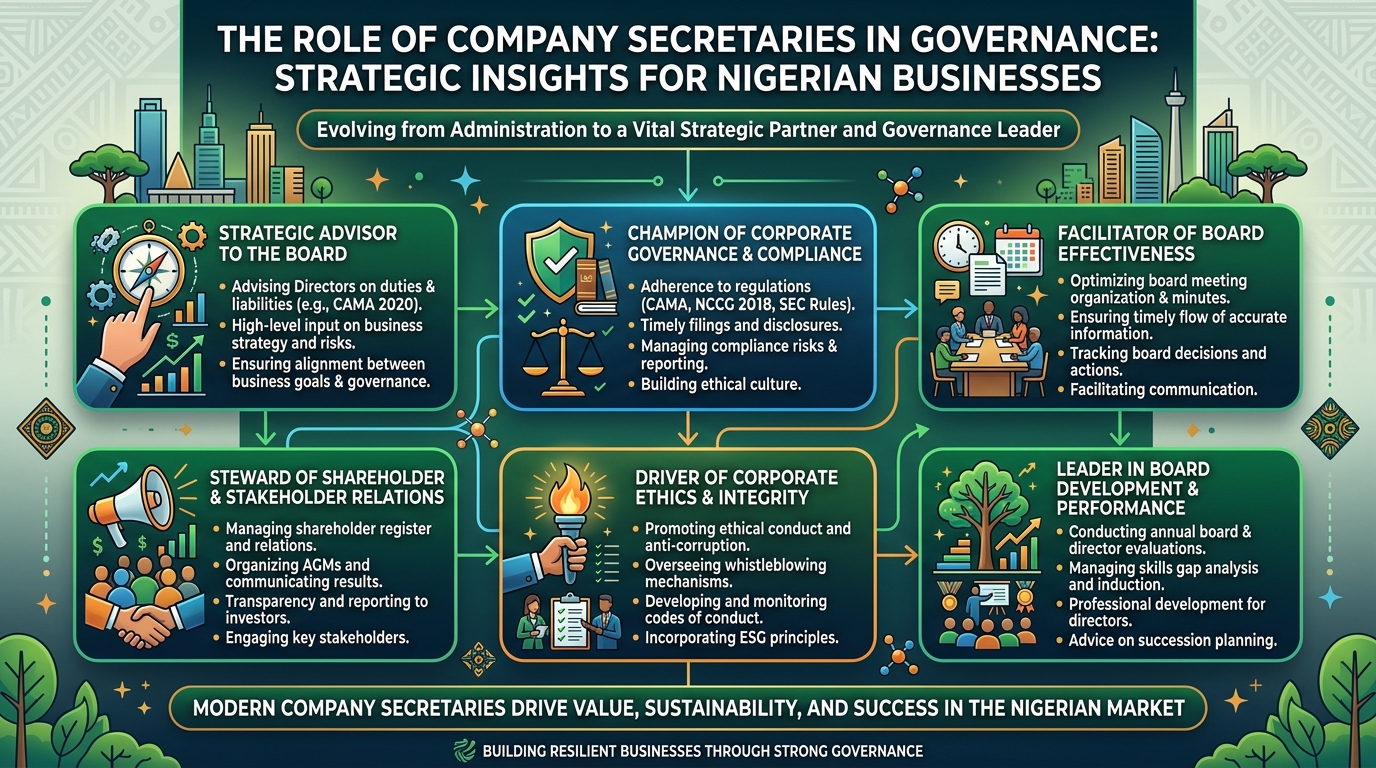
The Role of Company Secretaries in Governance: Strategic Insights for Nigerian Businesses
Let me tell you about a transformation happening in Nigerian boardrooms.
The company secretary is no longer the person who just takes minutes and files annual returns. That old stereotype is dead.
Today, the company secretary has evolved into a pivotal strategic governance officer. As regulatory demands intensify and boards face mounting accountability pressures, understanding the full scope of company secretarial roles and responsibilities is no longer optional. It is essential for sustainable business growth, long-term investor confidence, and organisational resilience.
Nigerian businesses, whether publicly listed or privately held, are increasingly recognising that strong corporate governance begins with a capable and well-positioned company secretary.
This article explores the strategic importance of company secretaries, their evolving responsibilities under Nigerian law, current governance trends, and why organisations must invest in professional governance support to remain competitive and compliant.
If you need professional support, our company secretarial and governance advisory services for Nigerian businesses can help you strengthen your governance framework.
Who is a company secretary? A foundational definition
Before exploring the broader responsibilities, let us ground the conversation in a clear definition.
According to the Chartered Governance Institute UK and Ireland, a company secretary is defined as “a senior position in a private sector company or public sector organisation, typically reporting directly to the board of directors and responsible for ensuring that an organisation complies with relevant legislation and regulations, and keeps board members informed of their legal responsibilities.

In the Nigerian context, this definition takes on even greater significance. The Companies and Allied Matters Act (CAMA) 2020 formally recognises the company secretary as a key officer of the company, mandating that every public company and certain categories of private companies must appoint a qualified company secretary.
The law does not treat this as a ceremonial position. It is a compliance necessity, a governance imperative, and increasingly, a strategic advisory function that sits at the heart of how Nigerian companies are managed and held accountable.
A company secretary is not simply someone who takes meeting minutes. This is a governance professional whose work shapes how boards make decisions, how companies interact with regulators, and how organisations protect the interests of their shareholders and stakeholders.
For a broader perspective on governance, check out our corporate governance framework for Nigerian companies.
The legal framework governing company secretaries in Nigeria
Every governance conversation in Nigeria must begin with the law. Without a clear understanding of the legal framework, organisations cannot appreciate why the company secretary role carries the weight it does.
CAMA 2020 and the company secretary.
CAMA 2020 represents the most significant overhaul of Nigerian corporate law in decades. It replaced the 1990 CAMA and introduced sweeping reforms that directly affect the appointment, qualifications, and responsibilities of company secretaries.
Section 330 of CAMA 2020 specifically addresses the qualifications required for a company secretary of a public company. The individual must be a member of a recognised professional body, possess relevant expertise in law, finance, or governance, and demonstrate the capacity to fulfil the compliance and advisory functions expected of the role. This is not a position that can be filled casually or assigned to a junior administrative officer.
The Corporate Affairs Commission (CAC) has also raised its standards for enforcement. Companies that fail to maintain a properly appointed and qualified company secretary now face increased penalties and regulatory scrutiny. Filing obligations, annual returns, changes in directorship, and statutory notifications all pass through the company secretariat.
The Nigerian Code of Corporate Governance 2018.
Beyond CAMA 2020, the Nigerian Code of Corporate Governance 2018, issued by the Financial Reporting Council of Nigeria (FRCN), provides detailed guidance on governance best practices. It explicitly recognises the company secretary as a resource to the board, responsible for supporting board effectiveness, facilitating induction and training of directors, and ensuring that board decisions are properly recorded and implemented.
SEC Nigeria guidelines.
The Securities and Exchange Commission Nigeria released updated Corporate Governance Guidelines that place significantly greater emphasis on board transparency, environmental, social and governance (ESG) reporting requirements, and the repositioning of the company secretary as the organisation’s chief governance officer rather than merely a compliance functionary.
NGX requirements.
Companies listed on the Nigerian Exchange Group (NGX) are now expected to demonstrate structured and professional board secretariat support as part of their listing obligations and annual governance disclosures.
This legal and regulatory context makes one thing clear: the company secretary in Nigeria is not an optional appointment. It is a legal obligation backed by professional standards, regulatory enforcement, and an increasingly sophisticated governance environment.

Core roles and responsibilities of a company secretary in Nigeria
The scope of responsibilities is broader than most people realise, and each function carries significant implications for organisational compliance and performance.
1. Board support and administration.
One of the most visible functions is supporting the effective operation of the board of directors. This includes preparing and circulating board meeting notices and agendas within required timeframes, ensuring board papers are comprehensive and distributed in advance, recording accurate minutes of board and committee meetings, and following up on the implementation of board resolutions.
A poorly managed board process can lead to invalid resolutions, shareholder disputes, and regulatory consequences. The company secretary ensures that the board operates efficiently, decisively, and in accordance with the company’s constitution and applicable law.
2. Regulatory compliance and filing.
The company secretary is the primary officer responsible for ensuring that the company meets all its statutory filing obligations. This includes filing annual returns with the CAC, notifying the CAC of changes in directorship or shareholding, filing special resolutions passed by shareholders, maintaining the company’s registered address and statutory particulars, and ensuring compliance with sector-specific regulatory requirements from bodies such as the CBN, SEC, or NAICOM.
Non-compliance attracts penalties and reputational damage, which is why a competent company secretary is so critical to organisational risk management.
3. Shareholder relations and general meeting management.
The company secretary plays a central role in managing the relationship between the company and its shareholders. This includes overseeing the organisation of Annual General Meetings and Extraordinary General Meetings, ensuring notices are issued within prescribed timeframes, managing proxy voting procedures, maintaining the register of members, and communicating dividend-related information to shareholders.
Under CAMA 2020, shareholder rights have been strengthened. Companies that fail to manage these obligations properly face the risk of shareholder litigation and regulatory sanction.
4. Statutory record keeping.
Every company is legally required to maintain a set of statutory registers and records. The company secretary is responsible for maintaining the register of members, the register of directors and their interests, the register of charges and debentures, and the minutes of board and general meetings.
These records must be available for inspection by shareholders and regulators upon request. Failure to maintain accurate and up-to-date statutory records is a compliance breach that can expose the company to penalties and legal challenges.
5. Advisory function to the board.
This is perhaps the most strategically significant responsibility. Beyond administration and compliance, the company secretary advises directors on their fiduciary duties, their obligations under CAMA 2020 and other applicable legislation, and the governance implications of proposed board decisions.
This advisory function positions the company secretary as an in-house governance consultant, someone the board can rely on for impartial, expert guidance on complex governance matters. The quality of this advisory function often separates well-governed Nigerian companies from poorly governed ones.
For support with board support, our board secretariat and governance support services can help.
The strategic governance dimension
Governance is no longer simply about regulatory compliance. In the modern business environment, governance is a competitive advantage, a trust-building mechanism, and a driver of long-term organisational value.
Risk governance.
The company secretary assists the board in identifying governance-related risks, including regulatory risks, reputational risks arising from poor board conduct, and operational risks linked to governance failures. By proactively surfacing these risks and recommending appropriate frameworks, the company secretary helps the board fulfil its oversight responsibilities more effectively.
ESG integration.
The company secretary is increasingly called upon to support the organisation’s engagement with environmental, social, and governance principles. International investors, development finance institutions, and multilateral lenders now evaluate the ESG posture of Nigerian companies as part of their investment due diligence.
The company secretary helps the board understand ESG frameworks, facilitates the development of governance policies that align with ESG standards, and supports the preparation of sustainability reports and disclosures.
Board evaluation.
The Nigerian Code of Corporate Governance 2018 recommends that boards conduct annual performance evaluations. The company secretary typically coordinates this process, working with the board chair to design the evaluation framework, collate feedback from directors, prepare evaluation reports, and follow up on recommendations for improvement.
Succession planning.
Many Nigerian companies handle succession planning poorly. The company secretary can contribute meaningfully by advising the board on governance frameworks that support leadership continuity, ensuring that succession planning policies are documented and regularly reviewed, and facilitating conversations about board renewal and director development.
Cross-border governance.
With the growing presence of multinational corporations and private equity investment in Nigeria, company secretaries are now expected to have working knowledge of cross-border governance requirements. This includes familiarity with the UK Companies Act for dual-listed entities, IFC governance frameworks applied to development finance-backed organisations, and governance expectations of multilateral bodies such as the African Development Bank.
Qualifications and professional standards for company secretaries in Nigeria
The credentials required to serve as a company secretary in Nigeria are clearly defined by law.
Recognised professional bodies.
Under CAMA 2020, a company secretary for a public company must be a member of at least one recognised professional body. The accepted bodies include the Institute of Chartered Secretaries and Administrators of Nigeria (ICSAN), which is the primary professional body for governance practitioners in Nigeria. The Nigerian Bar Association for qualified legal practitioners with relevant corporate governance expertise. The Institute of Chartered Accountants of Nigeria (ICAN) for professionally qualified accountants. And the Association of Certified and Chartered Secretaries and Administrators.
ICSAN, in particular, runs a robust certification programme and continuing professional development (CPD) structure specifically tailored to the Nigerian governance environment. Membership of ICSAN signals that a company secretary has been trained in the specific legal, regulatory, and governance frameworks that apply to Nigerian companies.
Continuous professional development.
Continuous professional development is not optional for company secretaries in Nigeria. The governance landscape changes frequently, driven by regulatory updates, new legislation, and evolving best practices. A company secretary who does not invest in ongoing learning is a liability rather than an asset.
ICSAN has been actively expanding its digital governance curriculum to address the realities of modern board management. New modules on virtual board meeting facilitation, digital board portal administration, cybersecurity governance, data privacy compliance under the Nigeria Data Protection Act 2023, and ESG reporting frameworks have been introduced. These are now core competencies that every Nigerian company secretary is expected to possess.
Why Nigerian companies must prioritise the company secretary role
Many Nigerian businesses continue to treat the company secretary role as a formality or a box-ticking exercise. This approach is not only legally risky. It is strategically costly.
Consequences of under-investment.
Regulatory fines from the CAC for compliance failures have increased significantly under CAMA 2020. Investor confidence is directly linked to governance quality. Poorly governed companies struggle to attract foreign direct investment or secure bank financing on favourable terms. Board member liability is substantially increased when there is no competent company secretary actively monitoring governance obligations. Reputational risk arising from AGM irregularities, shareholder litigation, or public regulatory sanctions can be severely damaging.
Returns from professional governance support.
Companies with strong secretarial functions experience smoother regulatory interactions, fewer compliance surprises, better-informed boards, more effective shareholder engagement, and greater overall confidence from stakeholders. A professionally managed company secretariat is not an overhead to be minimised. It is a strategic asset that pays dividends in reduced risk, enhanced credibility, and stronger organisational performance.
For support with compliance, our CAC compliance and annual returns filing assistance can help.
Emerging trends in corporate governance in Nigeria for 2025
The governance landscape is evolving at a rapid pace. Company secretaries must stay ahead of these developments.
Digital board governance.
The adoption of board management software platforms is growing steadily among Nigerian corporates, listed companies, financial institutions, and development organisations. These platforms enable secure distribution of board papers, digital voting, real-time minute taking, and audit trails for governance decisions. Company secretaries are at the forefront of implementing and managing these digital transitions.
ESG reporting mandates.
The NGX has introduced sustainability disclosure requirements for listed companies, and the SEC has signalled its intent to strengthen ESG reporting standards further. Company secretaries are playing a central role in helping boards understand their ESG obligations, develop relevant policies, and prepare the governance sections of sustainability reports.
Whistleblowing and internal reporting frameworks.
Strong whistleblowing governance requires robust policies, clear reporting channels, and assured confidentiality protections. The company secretary typically facilitates the development and communication of these frameworks within the organisation.
Virtual and hybrid general meetings.
CAMA 2020 and updated SEC guidelines permit companies to hold fully virtual or hybrid Annual General Meetings. Managing these meetings effectively requires the company secretary to develop new technical competencies and updated procedural frameworks that ensure shareholder participation rights are fully protected in digital environments.
Data privacy governance.
The Nigeria Data Protection Act 2023 imposes significant obligations on organisations regarding the collection, processing, and protection of personal data. Company secretaries are increasingly involved in ensuring that board governance processes, shareholder data management, and statutory records handling comply with data protection requirements.
Key company secretarial terms every business leader should know
Company Secretary. A senior governance officer responsible for ensuring compliance with legislation and regulations and keeping board members informed of their legal responsibilities.
CAMA 2020. The Companies and Allied Matters Act 2020, Nigeria’s primary corporate legislation governing company formation, administration, and governance.
Statutory Registers. Legally required records including register of members, register of directors, register of charges, and minutes of board and general meetings.
Annual General Meeting (AGM). The mandatory annual meeting of shareholders required under CAMA 2020 for all companies.
Board Resolution. A formal decision made by the board of directors, documented and recorded by the company secretary.
Proxy Voting. A mechanism allowing shareholders to vote at general meetings without being physically present.
Corporate Governance Code. A set of principles, standards, and best practices for governing companies, including the Nigerian Code of Corporate Governance 2018.
ESG. Environmental, Social, and Governance principles increasingly integrated into corporate governance frameworks.
Board Evaluation. A systematic assessment of board performance, composition, and effectiveness.
Whistleblowing Policy. A framework for reporting misconduct within an organisation with protection for reporters.
Recommended reading from the Business Cardinal blog
If you want to strengthen your governance framework, these related articles will help.
Building a Risk-Aware Culture in Your Organization – Strong governance starts with a culture that values accountability. Read the Guide.
Board Evaluation: Why It Matters – Board Assessment Nigeria – Stronger Oversight – Regular board evaluations are essential for governance quality. Read the Article.
Corporate Governance Lessons from Nigerian Bank Failures – Some failures involved poor secretarial governance. Learn from the past. Read the Guide.
Recommended services from Business Cardinal
Ready to strengthen your governance through professional company secretarial support? These services are designed to help Nigerian businesses achieve governance excellence.
Company Secretarial and Governance Advisory Services for Nigerian Businesses – Comprehensive company secretarial support and governance advisory.
Board Secretariat and Governance Support Services – Professional board administration, minute-taking, and governance support.
CAC Compliance and Annual Returns Filing Assistance – Statutory filing and compliance management.
Digital Board Governance and Board Portal Advisory – Implementation of digital board management solutions.
ESG Governance and Sustainability Reporting Advisory – ESG integration and sustainability disclosure support.
Where to go from here
The company secretary is no longer a back-office administrator. This role is now a strategic governance officer whose work shapes board effectiveness, regulatory compliance, and investor confidence.
Start by assessing your current secretarial capacity. Then identify gaps. Then invest in professional support.
The companies that prioritise strong secretarial governance will be the ones that attract investment and build lasting trust.
Let’s work together
Is your board fully protected by a competent and professional governance structure? Is your company secretary equipped to handle the demands of Nigerian corporate law, SEC guidelines, ESG requirements, and modern board management?
At Business Cardinal, we provide expert advisory services in corporate governance, company secretarial support, board consulting, regulatory compliance, and governance training, all tailored specifically for Nigerian businesses.
Not theory. Not generic advice. Practical, actionable support tailored to your specific organisation.
Contact us today:
📧 Email: hello@businesscardinal.com
📞 Phone: +234 802 320 0801
📍 Address: 5, Ishola Bello Close, Off Iyalla Street, Alausa, Ikeja, Lagos, Nigeria
Contact Business Cardinal to discuss your governance needs.
Good governance is not a destination. It is a continuous journey. Let us be your trusted partner on that journey.
Business Cardinal – Your Partner in Governance Excellence
References
-
Chartered Governance Institute UK and Ireland – Definition of Corporate Governance
-
Companies and Allied Matters Act 2020 – Federal Republic of Nigeria
-
Nigerian Code of Corporate Governance 2018 – Financial Reporting Council of Nigeria
-
Securities and Exchange Commission Nigeria – Corporate Governance Guidelines
-
Institute of Chartered Secretaries and Administrators of Nigeria (ICSAN) – Professional Body
-
Nigerian Exchange Group – Sustainability Disclosure Guidelines
-
Financial Reporting Council of Nigeria – Whistleblowing Standards
-
Nigeria Data Protection Act 2023 – NITDA
Related Post
Contract Review Checklist for Businesses in Nigeria
Print 🖨 PDF 📄 eBook 📱Contract Review Checklist for Businesses in Nigeria Get Started Call-to-action…

Competitive Intelligence in Nigeria: How Companies Track Rivals Legally and Effectively
Print 🖨 PDF 📄 eBook 📱Competitive Intelligence in Nigeria: How Companies Track Rivals Legally and…

Africa’s Green Industrialization Drive: Implications for Nigeria’s Manufacturing Sector
Print 🖨 PDF 📄 eBook 📱Africa’s Green Industrialization Drive: Implications for Nigeria’s Manufacturing Sector Introduction…

There are no comments