


Governance Structures for Family-Owned Businesses in Nigeria: A Guide to Smooth Succession
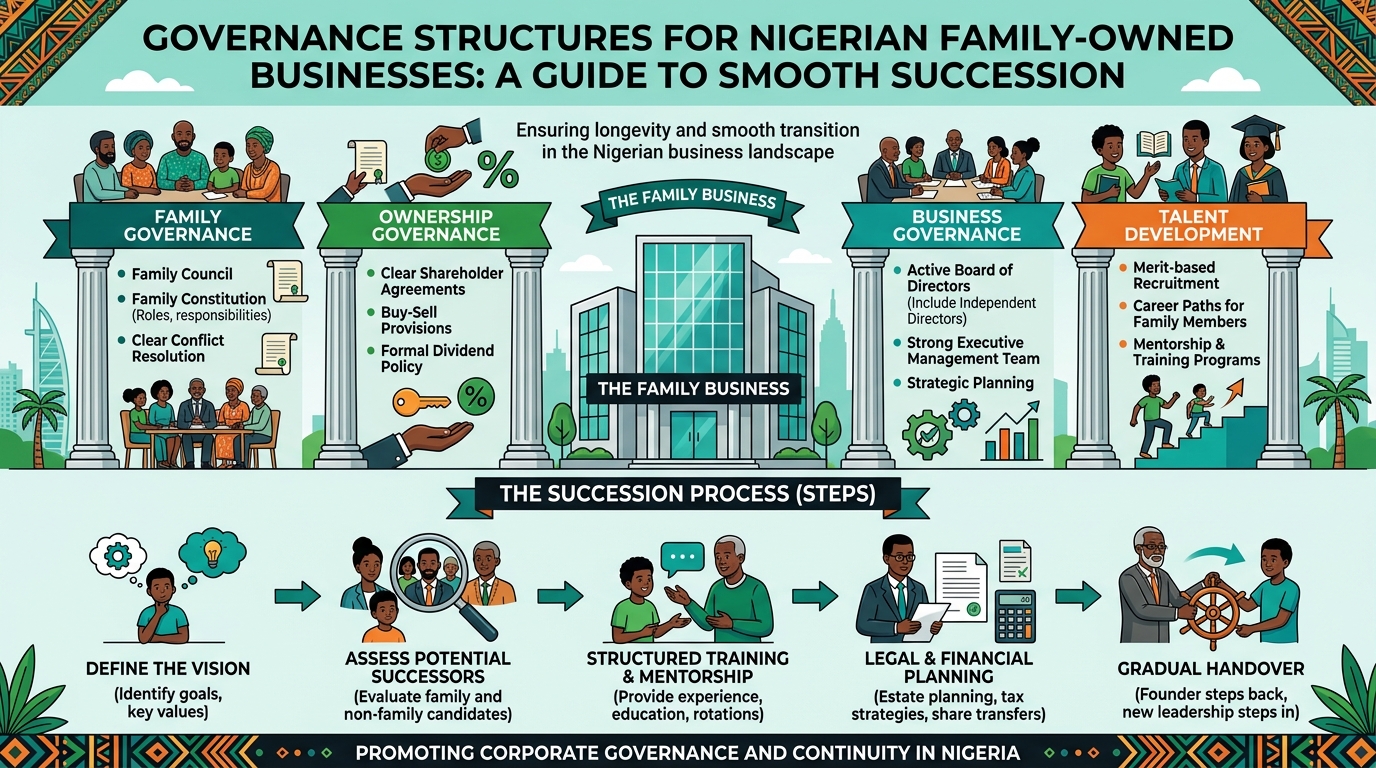
Governance Structures for Family-Owned Businesses in Nigeria: A Guide to Smooth Succession
Let me tell you a story that repeats itself too often in Nigeria.
A founder builds a business over thirty years. Blood, sweat, and tears. He wakes up one day, looks around, and realises he is tired. But he has no plan for who takes over.
His children have different ideas. His extended family has expectations. His managers are nervous.
When he dies suddenly, chaos erupts. The business that took decades to build fractures in months. Not because it was a bad business. Because there was no governance.
Family-owned businesses are the backbone of the Nigerian economy. From the trading enterprises of the 1960s that grew into diversified conglomerates, to the first-generation entrepreneurs building companies across technology, agriculture, real estate, and financial services today.
But the statistics on family business survival are sobering. Everywhere in the world. And Nigeria is no exception.
The first generation builds. The second generation manages. The third generation, in too many cases, presides over decline or dissolution.
The single most important variable that determines whether a family business survives generational transition is governance.
This article explains what governance structures family-owned businesses need. Why they matter. And how Nigerian families can build them before the pressures of growth, conflict, or succession make the absence of governance impossible to ignore.
If you need professional support, our family business governance advisory for Nigerian enterprises can help you build structures that last.

Why family businesses are different
Many Nigerian family business owners believe that because they trust their family members, formal governance structures are unnecessary.
That belief is one of the most expensive misconceptions in business.
According to the Institute for Family Business (IFB), family business governance is defined as “the structures, processes, and mechanisms through which a family-owned business is directed, controlled, and made accountable to its owners. It encompasses both the governance of the business itself and the governance of the family as an owning group.”
In a conventional publicly listed company, the people who own the business, the people who govern it, and the people who manage it are largely distinct groups. Defined roles. Clear accountability relationships.
In a family business, these three groups overlap significantly. Often completely.
The founder may be simultaneously the majority shareholder, the chairman, and the chief executive. Children may be shareholders, board members, and operational managers at the same time.
This overlap creates efficiencies in the early stages. Speed. Trust. Unified decision-making.
It creates serious problems as the business grows. As the family expands across generations. As interests, capabilities, and ambitions begin to diverge.
For a deeper understanding of how governance applies across different business structures, check out our corporate governance framework for Nigerian companies.
The three systems every family business must manage
The core challenge of family business governance is managing three interdependent systems at the same time.
The family system is governed by relationships, emotions, history, and shared identity. Driven by love, loyalty, and sometimes by long-standing grievances. Decisions are often made based on who someone is rather than what they bring.
The ownership system is governed by economic interests, rights, and obligations. Shareholders have legal rights to information, dividends, and participation in major decisions. These rights exist regardless of family dynamics.
The business system is governed by strategy, performance, and professional management. Driven by market competition, customer demands, operational efficiency, and financial sustainability.
When these three systems are not properly structured and separated, family conflicts become business conflicts. Business decisions become family disputes. Ownership rights become sources of destructive competition.
Why Nigerian family businesses face additional pressures
Nigerian family businesses face universal challenges in a context shaped by specific local dynamics.
Polygamous family structures can dramatically expand the shareholder base across generations. Complex webs of competing ownership claims can paralyze decision-making.
Cultural expectations around the roles of male and female family members can create succession conflicts. Especially when the most capable next-generation leader is a daughter in a family that always assumed a son would take over.
Extended family networks create pressure on hiring and resource allocation decisions. This can compromise professional management standards.
Absence of documented agreements about ownership rights and succession arrangements means the death or incapacitation of a founder frequently triggers disputes no one was prepared for.
If your family business faces these pressures, our succession planning and leadership transition services can help you get ahead of them.
The three circles: a framework every owner should know
One of the most useful frameworks for thinking about family business governance is the Three Circle Model, developed by Tagiuri and Davis at Harvard Business School. It maps the intersection of family, ownership, and business.
Circle One: The family.
This includes all family members whether or not they are shareholders or employees. Their governance needs are met through the family council and family constitution.
Circle Two: The ownership.
This includes all shareholders whether or not they are family members or employees. Their governance needs are met through shareholder agreements, dividend policies, and share transfer arrangements.
Circle Three: The business.
This includes everyone employed in the business whether or not they are family members or shareholders. Their governance needs are met through professional management systems, HR policies, and accountability structures.

Where the circles overlap.
The most governance-intensive positions are at the intersections. A family member who is also a shareholder and also an employee sits at the center where all three circles meet. They have family interests, ownership interests, and professional interests simultaneously. And these interests do not always point in the same direction.
Nigerian family businesses engaging with development finance institutions, private equity investors, or international commercial lenders are increasingly encountering due diligence that examines the separation of these three circles.
The family constitution: the most important document you do not yet have
A family constitution is not a legal formality. It is the agreement that keeps the family together through every season of the business.
Sometimes called a family charter or family protocol, it is the written record of the family’s agreements about how they will relate to each other as owners. How decisions will be made. What values will guide the family’s stewardship of the business. And how conflicts will be resolved.
What a family constitution should cover.
Shared vision and values. A clear statement of the family’s vision for the business and the values that will guide how the business is owned and managed. This is not a marketing statement. It is a genuine articulation of what the family stands for.
Ownership policies. The rules governing share transfers between family members. Conditions under which shares can be sold outside the family. The process for valuing shares when a family member wants to exit. Rights and obligations of different categories of shareholders.
Employment policies. Criteria family members must meet before employment. Minimum educational qualifications. Requirement for external work experience. Performance management standards that apply equally to family and non-family employees. Compensation policy for family employees.
Dividend policy. How profits are shared between reinvestment and distributions to shareholders. This is one of the most frequently contested issues. A documented policy removes this as a recurring source of conflict.
Governance structures. How the board will be constituted. How the family council will operate. How major decisions will be made. What decisions require shareholder approval versus board approval versus management authority.
Conflict resolution. Every family business will experience conflict. The question is whether there is a process for resolving it that does not require litigation. A clear escalation path. Direct negotiation. Family council. Independent mediator. Formal legal resolution as a last resort.
Succession arrangements. The criteria for selecting the next generation of leadership. The process for transitioning leadership. The role of retiring family members. Ownership arrangements for the founder’s generation.
How to create a family constitution.
The process of creating a family constitution is as valuable as the document itself. It requires family members to have difficult but necessary conversations about topics they may have avoided for years.
These conversations are best facilitated by an independent governance advisor who can maintain neutrality, keep discussions focused, and help the family move through disagreements to documented agreement.
The process typically involves a series of family meetings over several months. It is not a quick exercise. But it is one of the most valuable investments a Nigerian family business can make.
The Nigerian Code of Corporate Governance 2018 explicitly encourages family enterprises to formalize their governance arrangements. As regulatory frameworks continue to evolve, the family constitution is increasingly the document that demonstrates to regulators, lenders, and investors that a family business is professionally governed.
For help drafting your family constitution, our family constitution and governance documentation services can guide you through the process.
The board of directors: from rubber stamp to real governance
Many Nigerian family businesses have a board of directors in name only. Board meetings are held infrequently. Attended exclusively by family members. Used primarily to ratify decisions already made by the founder.
This is not a board. It is an administrative formality. And it provides none of the governance value that a properly constituted board can deliver.
What a family business board should actually do.
Set strategic direction. Approve major capital allocation decisions. Oversee management performance. Manage risk at the enterprise level. Ensure the business is run in a way that protects and grows the value of the family’s ownership stake.
Plus one function unique to family businesses. Maintaining the boundary between family interests and business interests. Ensuring business decisions are made on the basis of what is best for the enterprise, not what is most convenient or agreeable to the controlling family.
Why independent non-executive directors change everything.
Bringing one or two genuinely independent directors onto the board introduces a quality of strategic challenge and external perspective that family-only boards almost never achieve.
Independent directors ask the questions that family members are too close to ask. They bring experience from other sectors. They provide a check on decisions that might prioritise family preferences over business interests. They give lenders and investors confidence. And they provide a sounding board that most Nigerian business leaders genuinely lack.
What qualifications should an independent director have?
The right independent directors are not necessarily the most famous or most decorated individuals available. They are people with relevant sector expertise, sound commercial judgment, personal integrity, and the confidence to speak honestly.
For a Nigerian manufacturing business, an independent director with experience in supply chain management, export markets, and regulatory compliance adds more value than a distinguished public figure with no manufacturing experience.
Board size and composition at different stages.
First generation, founder-led business. The board may consist of the founder, one or two senior family members, and one or two independent directors. The primary priority is establishing the habit of regular board oversight.
Second generation, multiple family shareholders. The board needs to expand and formalise. A clear majority of independent directors is advisable. The CEO should not be the chairman. Board committees including Audit, Risk, and Remuneration should be established.
Third generation and beyond. The family may have dozens of shareholders across multiple branches. The board should be substantially composed of independent directors. Family representation should be limited. Professional management may be entirely non-family.
If you need help structuring your board, our board establishment and governance advisory services can help.
The family council: governing the family so it does not destroy the business
The board governs the business. The family council governs the family. Both are necessary. Neither can replace the other.
One of the most damaging governance mistakes is trying to manage family issues through the board. Board meetings become arenas for family grievances. Personal disputes about roles and compensation. Debates about which family member deserves what position.
When this happens, the board cannot function as a governance body. And the business suffers.
What the family council is.
A regular meeting of family members, whether or not they are employed in the business or sit on the board. A space specifically designed for family matters related to the business.
Where family members discuss business performance at a level appropriate for shareholders rather than managers. Where concerns about family employment practices are raised. Where dividend expectations are managed. Where family disagreements are addressed before they escalate to the board.

What the family council is not.
It is not a decision-making body for the business. It does not approve budgets. It does not appoint managers. It does not determine business strategy.
Its role is to represent the voice of the family as an owning group. To maintain alignment between the family’s vision and values and the direction of the business. To serve as the forum within which family governance documents are developed and updated.
The family assembly for larger families.
For larger families, particularly in the second or third generation where the number of shareholders may be significant, the family assembly supplements the family council.
A broader gathering that includes all family members above a defined age. Typically an annual event. A forum where family members learn about the business, understand their rights and responsibilities as shareholders, and develop the shared identity that sustains stewardship across generations.
Family council governance in practice.
A well-run family council meets regularly, at least quarterly. Has a defined membership. Follows a structured agenda. Keeps records of its discussions and decisions.
It has a chairperson, typically a senior and respected family member who is not the CEO, who facilitates discussions and ensures all family members have an opportunity to speak. It has terms of reference that define its mandate, its relationship to the board, and its authority and limitations.
Nigerian family businesses engaging with private equity partners or development finance institutions are increasingly being asked to demonstrate that family governance structures are in place. Sophisticated investors recognise that their absence represents a material risk.
Succession planning: the test most family businesses fail
Every family business will eventually face a leadership transition. The question is whether it will be planned or forced upon you.
Succession is the ultimate test of family business governance in Nigeria. And it is the test that most are unprepared for.
The death or incapacitation of a founder without a documented succession plan has destroyed businesses that took decades to build. Disputes over leadership succession have divided families and paralysed companies.
Governance structures exist, in significant part, to ensure that succession is a planned, well-managed transition rather than a crisis.
Leadership succession: choosing the right next leader.
Effective leadership succession planning begins years before the actual transition. It requires an honest assessment of the next generation’s capabilities, interests, and readiness to lead.
Not every founder’s child has the ability or the desire to run the business. Forcing an unwilling or unqualified family member into leadership because of birth order or parental preference is one of the most reliable ways to destroy a family business.
The governance structures should include a clear, criteria-based process for identifying and developing the next generation of leadership.
Ownership succession: protecting what has been built.
Ownership succession requires legal and financial planning. Preparation of wills. Structuring of share ownership in ways that minimise succession disputes. Establishment of mechanisms such as family trusts that can hold and manage family shareholdings.
What is a family trust and why does it matter?
A family trust is a legal arrangement in which ownership of business assets is held by a trustee, typically a professional trust company, on behalf of the family beneficiaries.
A well-structured trust protects business assets from being fragmented by inheritance disputes. Provides a mechanism for distributing income according to agreed rules. Ensures business continuity even when individual family members die or become incapacitated.
Many successful multigenerational Nigerian family businesses have used trust structures to protect their ownership arrangements.
Common succession mistakes Nigerian families make.
Waiting too long to start. Many founders begin thinking about succession only when their health declines. By then, the options are narrower and the risks are higher. Succession planning should begin at least five to ten years before the anticipated transition.
Assuming the eldest son will lead. Birth order is not a governance strategy. The next leader should be selected based on capability, commitment, and demonstrated performance.
Failing to prepare the next generation. Succession without preparation is a formula for failure. Next generation leaders need structured development. Formal education. External work experience. Mentorship. Progressive exposure to leadership responsibilities.
Not documenting anything. Verbal agreements about succession do not survive the death of the person who made them. Everything must be documented in legally sound instruments.
Next generation development: building the leaders the business will need
Nigerian family businesses that want to transition leadership to the next generation need to invest deliberately in developing that generation.
Formal education relevant to the business. Work experience in other organisations before joining the family business. Structured mentorship within the business. Progressive exposure to leadership responsibilities starting with operational roles and building toward strategic ones. Development of governance literacy that enables them to understand their roles as both shareholders and stewards.
Several Nigerian family business networks and business schools including Lagos Business School have been developing next generation leadership programs tailored to family business successors.
If you want to invest in your next generation, our next generation leadership development programmes can help.
Professionalising the family business: what it means and what it does not
Professional management and family values are not in conflict. The right governance structures allow both to coexist.
One concern family business owners frequently express is that professionalising the business will erode the values, culture, and personal commitment that make family businesses distinctive. This concern is understandable but it reflects a misunderstanding.
What professionalisation actually involves.
Introducing systems, processes, and structures that allow the business to perform consistently and accountably regardless of which individual is making decisions. Clear job descriptions. Documented accountability frameworks. Performance management systems. Financial controls. Governance structures that operate independently of any single person’s presence.
What it does not mean.
It does not mean replacing family values with bureaucratic process. It does not mean handing management to external professionals and removing the family from the business. It does not mean treating the business like a publicly listed company.
The family advantage that governance protects.
The family advantage in business, the long-term orientation, the deep institutional knowledge, the commitment to reputation and relationships, the willingness to invest through difficult cycles, is most sustainable precisely when protected by governance structures.
Good governance does not replace family values. It creates the structures within which those values can be sustained, communicated, and embedded as the business grows beyond the capacity of any single family member to personally oversee every decision.

Key terms every family business owner should know
Family Constitution. A documented agreement among family members setting out shared values, ownership rules, employment policies, dividend policy, governance structures, conflict resolution process, and succession arrangements.
Family Council. A regular meeting of family members that governs the family’s relationship with the business, separate from the board of directors which governs the business itself.
Family Assembly. A broader annual gathering of all family members above a defined age, primarily for communication and education about the business.
Independent Non-Executive Director. A board member with no material relationship with the company, its management, or its controlling shareholders, providing objective oversight.
Shareholder Agreement. A legal contract between shareholders defining rights and obligations, rules for share transfers, dividend policy, decision-making authority, and dispute resolution.
Family Trust. A legal structure in which business assets or shareholdings are held by a trustee on behalf of family beneficiaries.
Succession Plan. A documented strategy for transitioning leadership and ownership from one generation to the next.
Three Circle Model. A framework for understanding the relationship between family, ownership, and business.
Recommended reading from the Business Cardinal blog
If you want to strengthen your family business governance, these related articles will help.
Building a Risk-Aware Culture in Your Organization – Family businesses face unique risks. A risk-aware culture starts with governance. Read the Guide.
Board Evaluation: Why It Matters – Board Assessment Nigeria – Stronger Oversight – Regular board evaluations help family businesses identify governance gaps. Read the Article.
Corporate Governance Lessons from Nigerian Bank Failures – Many governance failures happened in family-influenced banks. Learn from the past. Read the Guide.
Recommended services from Business Cardinal
Ready to build governance structures that protect your family business across generations? These services are designed to help.
Family Business Governance Advisory for Nigerian Enterprises – We help you assess current structures, identify gaps, and build governance frameworks that work for your family.
Family Constitution and Governance Documentation Services – We facilitate the conversations and draft the documents that keep families aligned across generations.
Succession Planning and Wealth Transfer Advisory for Family Businesses – Plan for leadership and ownership succession before crisis forces the issue.
Next Generation Leadership Development Programmes – Build the leaders your business will need tomorrow, starting today.
Where to go from here
The families that build businesses lasting across generations are not necessarily the ones with the most talented individuals.
They are the ones with the governance structures that channel talent, manage conflict, plan for succession, and protect the family’s shared investment in what they have built together.
Start with one conversation. Then document one agreement. Then build one structure.
The best time to build governance for your family business was ten years ago. The second best time is now.
Let’s work together
Has your family had the governance conversations your business needs you to have?
At Business Cardinal, we help Nigerian families build the governance structures that protect what they have built. We understand the cultural context. We know the emotional weight of these decisions. And we have practical frameworks that work.
Not theory. Not generic advice. Practical, actionable support tailored to your family and your business.
Contact us today:
📧 Email: hello@businesscardinal.com
📞 Phone: +234 802 320 0801
📍 Address: 5, Ishola Bello Close, Off Iyalla Street, Alausa, Ikeja, Lagos, Nigeria
Contact Business Cardinal to discuss your family business governance needs.
Let us help you build a governance legacy that lasts.
Business Cardinal – Your Partner in Family Business Governance
References
-
Institute for Family Business – What is Family Business Governance?
-
Financial Reporting Council of Nigeria – Nigerian Code of Corporate Governance 2018
-
International Finance Corporation (IFC) – IFC Family Business Governance Handbook
-
Lagos Business School – Family Business Programme
-
PricewaterhouseCoopers Nigeria – Family Business Survey Nigeria Insights
-
OECD – G20/OECD Principles of Corporate Governance
-
Securities and Exchange Commission Nigeria – Corporate Governance Requirements
-
Tagiuri, R. and Davis, J. – Bivalent Attributes of the Family Firm (Three Circle Model)
Related Post
Employee Handbook Compliance Checklist for Businesses in Nigeria
Print 🖨 PDF 📄 eBook 📱Employee Handbook Compliance Checklist for Businesses in Nigeria Get Started…

Tech-Driven Data Collection: How Digital Tools Improve Market Accuracy
Print 🖨 PDF 📄 eBook 📱Tech-Driven Data Collection: How Digital Tools Improve Market Accuracy Let…

Land Use, Property Rights & Investment Risk: The Untold Issues
Print 🖨 PDF 📄 eBook 📱Land Use, Property Rights & Investment Risk: The Untold Issues…

There are no comments