


Restructuring Nigerian Manufacturing Companies Facing High Energy Costs
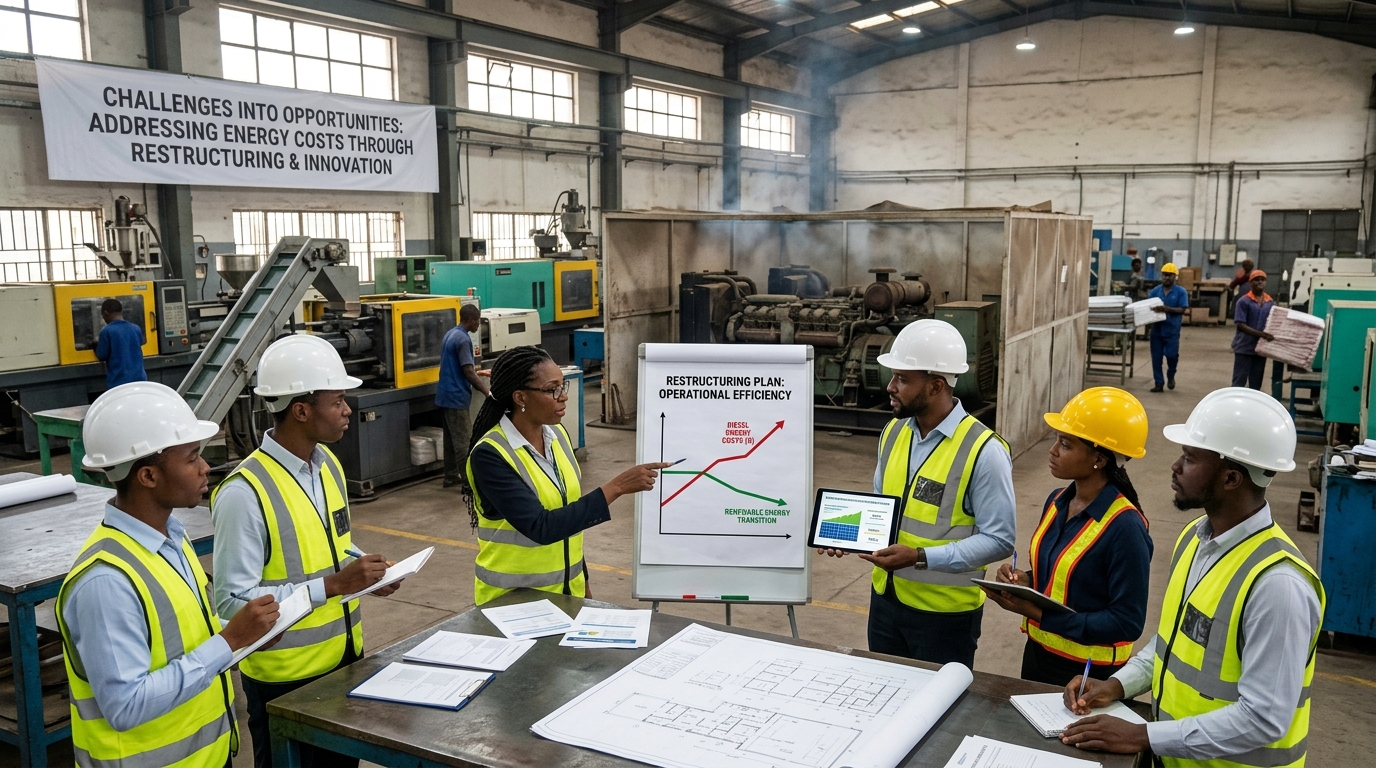
Restructuring Nigerian Manufacturing Companies Facing High Energy Costs
Let me tell you about a specific kind of commercial despair that Nigerian manufacturing leaders are experiencing right now.
It is not the ordinary pressure of competitive markets. It is not the usual challenge of economic cycles.
It is the despair of watching the cost of producing a unit of output increase by 40 to 60 percent because of energy costs alone. While the market price that customers are willing to pay has moved by far less than that. While international competitors whose energy costs are a fraction of Nigerian levels continue to supply Nigerian consumers at prices that the Nigerian manufacturer can no longer match without running at a loss.
The fuel subsidy removal of June 2023 dramatically increased diesel costs for factories that depend on generator power. Electricity tariff increases have followed under the sector’s commercialization reform. The persistent unreliability of grid supply forces ongoing generator dependency.
This is not a temporary disruption. It is a structural change in the economics of Nigerian manufacturing.
The manufacturers who will survive this environment are not those waiting for energy costs to return to pre-crisis levels. They are those who are restructuring their businesses to compete effectively at the new energy cost reality.
This article provides a practical restructuring framework for Nigerian manufacturers facing high energy costs, written specifically for the people who are living this problem and who need actionable guidance rather than academic analysis.
If you need professional support, our manufacturing restructuring advisory for Nigerian companies can help you build a path forward.
Understanding the pain points of Nigerian manufacturers
This article is written for Nigerian manufacturing leaders confronting an energy cost reality that has fundamentally changed the economics of their businesses.
The factory owner whose diesel bill has increased by more than 100 percent since June 2023, watching this single cost item eliminate the operating margin that made the business viable.
The manufacturing CEO whose electricity tariffs have increased and who cannot build reliable production planning around grid power whose availability is unpredictable.
The managing director whose imported raw material costs have escalated with naira devaluation at the same time as energy costs have risen, creating a double cost squeeze that revenue growth alone cannot resolve.
The board of a Nigerian manufacturing company being asked to make capital investment decisions in an energy cost environment that makes the business case for every proposed investment significantly harder to justify than it was two years ago.
According to the Corporate Finance Institute (CFI), business restructuring is defined as “a corporate action taken to significantly modify the financial or operational structure of a company. Restructuring is typically done when a company is facing significant problems, such as declining revenues, financial distress, or significant changes in the business environment that threaten its long-term viability.”
The Nigerian manufacturing sector’s energy cost crisis has intensified beyond what most manufacturers anticipated. The combination of the subsidy removal’s impact on diesel costs, electricity tariff increases, the naira’s continued weakness, and inadequate new electricity generation capacity has created an energy cost environment that is structurally higher than the pre-reform baseline.
Manufacturers whose restructuring strategies are built on the assumption of energy cost normalisation will be consistently disappointed. Those whose strategies accept the new energy cost reality and build businesses that are competitive within it are the ones who will define Nigerian manufacturing in the decade ahead.

The full extent of the energy cost problem
The first requirement for effective restructuring is an honest, granular understanding of the full extent of the energy cost problem, which is almost always larger and more complex than the diesel bill alone suggests.
The direct energy cost dimension.
The most visible component is the cost of diesel-powered electricity generation. Manufacturers who depend on diesel generators for the majority of their productive power hours are spending a proportion of their revenue on diesel that, in most cases, exceeds what their manufacturing counterparts in better-infrastructure markets spend on all of their energy combined.
The calculation of true diesel cost per unit of production is the first analytical step. For many Nigerian manufacturers, this calculation reveals that energy cost alone makes their products uncompetitive against imported alternatives at current diesel prices.
Grid electricity costs, where available, add a second dimension that has been growing with tariff reform. The electricity tariff increases implemented under the Nigerian Electricity Regulatory Commission (NERC) cost-reflective tariff agenda have raised the cost of grid power for qualifying industrial customers significantly.
The indirect energy cost dimension.
Beyond direct costs, high energy prices impose indirect costs that the energy bill alone does not capture.
Production planning uncertainty created by grid power unreliability means manufacturing operations cannot be scheduled with the efficiency that reliable power enables. Production lines that must account for potential power interruptions require buffer time and buffer capacity that reduce the utilisation of capital equipment and labour.
Quality consistency problems associated with voltage fluctuations and power quality issues create additional costs through increased proportion of output that fails quality standards, requiring rework or scrapping.
Equipment maintenance cost acceleration occurs because power quality issues are more damaging to sensitive manufacturing equipment than stable grid power, increasing the frequency and cost of maintenance and shortening equipment operating lifetimes.
Competitive disadvantage accumulation occurs as the compound effect of higher unit costs, production inefficiency, and quality inconsistency relative to international competitors progressively erodes market position.
Stage one of restructuring: the energy strategy transformation
The energy strategy transformation is the foundation of the restructuring plan. Every other aspect of the restructuring builds on the energy strategy foundation and is shaped by the energy cost baseline it establishes.
The energy audit as the starting point.
The starting point is a comprehensive energy audit that establishes the current energy consumption baseline with the granularity needed to make investment decisions.
An energy audit conducted for restructuring purposes needs to provide total energy consumption by production area, shift, and product category, enabling understanding of which parts of the operation consume energy most intensively. It needs to provide energy cost per unit of output for each major product category, enabling comparison between the energy cost embedded in different products. It needs to provide peak and off-peak demand profiles revealing opportunities for load shifting. It needs to provide equipment-level energy consumption analysis identifying specific machines where consumption is disproportionate to productive output.
The solar investment decision.
For the majority of Nigerian manufacturers, the most commercially important energy strategy decision is the solar power investment decision. The fuel subsidy removal has transformed the economics of solar investment.
At current diesel prices, the payback period for solar investment for a manufacturing facility with significant daytime energy consumption is in many cases between 18 months and four years. After that, the solar system generates effectively free electricity for its 20-plus-year useful life. The internal rate of return on solar investment frequently exceeds 30 percent.
The solar investment business case should be built on the specific energy demand profile of the facility, current diesel prices and their realistic forward trajectory, available roof or ground space for solar panel installation, grid connection status and the opportunity for hybrid solar-grid operation, and available financing options including outright purchase, equipment leasing, and power purchase agreements.
The Rural Electrification Agency (REA) has developed programs supporting private sector solar investment that Nigerian manufacturers should assess as part of their energy strategy development.
Gas-powered generation for large manufacturers.
For manufacturers with high energy intensity whose solar investment alone cannot provide sufficient generation capacity, gas-powered generation offers a cost-effective alternative.
The economics of gas-powered generation depend on the accessibility of natural gas supply at the manufacturing location, the availability of CNG (compressed natural gas) distribution infrastructure where pipeline gas is not directly accessible, and the capital cost of gas generation equipment relative to the manufacturer’s scale of operation.
Manufacturers located near existing gas distribution infrastructure or within the expanding CNG distribution network should conduct a rigorous comparative analysis of gas generation versus diesel generation versus solar hybrid configurations.
Energy efficiency investment.
Alongside energy source strategy, energy efficiency investment that reduces the total quantity of energy required to produce a unit of output addresses the energy cost problem from the demand side.
Energy efficiency improvements create savings across all energy cost categories simultaneously because fewer units of energy at the same price means lower total energy cost regardless of the source.
Nigerian manufacturing energy efficiency improvements include replacement of energy-intensive lighting with LED alternatives consuming 60 to 80 percent less electricity. Process heat recovery systems capturing waste heat from high-temperature manufacturing processes. Variable speed drives for electric motors reducing energy consumption by matching motor speed to actual process requirements. Compressed air system optimisation eliminating leaks, pressure mismatches, and inefficient usage patterns.
For support with energy transformation, our manufacturing energy strategy and solar investment advisory can help.
Stage two: operational restructuring around the new energy reality
Once the energy strategy is defined, the manufacturing operation must be redesigned to operate efficiently within the new energy cost baseline.
Production scheduling for energy cost optimisation.
The timing of energy-intensive production activities can be reorganised to minimise energy cost even before any investment in energy sources or equipment.
For manufacturers with grid connections providing access to cheaper off-peak tariffs, shifting energy-intensive production to off-peak periods and reducing or eliminating production during peak tariff hours can reduce energy costs significantly without any capital investment.
For manufacturers operating hybrid solar and grid systems, scheduling the most energy-intensive production activities to coincide with peak solar generation hours reduces the proportion of energy consumed from more expensive sources.
Product mix optimisation for energy cost efficiency.
Not all products have the same energy intensity. The energy cost embedded in each product varies with the production process, processing time, temperature requirements, and equipment used.
A systematic analysis of energy cost per unit by product reveals which products are most adversely affected by the energy cost increase and which retain acceptable margin even at current energy prices.
This analysis informs portfolio restructuring decisions. Concentrating production capacity on the highest-margin-at-current-energy-cost products. Reducing or eliminating production of products whose energy cost intensity makes them uncompetitive. Developing new products specifically designed around low-energy-intensity production processes.
Factory consolidation and capacity rationalisation.
Manufacturers with multiple production facilities or excess production capacity should evaluate factory consolidation as a component of their energy cost restructuring.
The fixed energy costs of maintaining multiple facilities, including overhead generation capacity, HVAC and lighting costs, and energy management labour, can be reduced through consolidation into fewer, higher-utilisation facilities.
Factory consolidation requires careful analysis of which facilities have the most favourable energy supply situations, which can most efficiently be adapted for solar or gas generation, and which serve the geographic distribution requirements of the product range.
For support with operational restructuring, our manufacturing operational restructuring and efficiency advisory can help.
Stage three: financial restructuring for the new cost reality
The energy cost increase has permanently raised the fixed cost base of manufacturing operations in ways that require explicit financial restructuring.
Repricing for energy cost recovery.
The most fundamental financial restructuring decision is the pricing decision: whether and how much of the energy cost increase to pass through to customers through higher selling prices.
Manufacturers who are transparent with key customers about the energy cost drivers of price increases, who can demonstrate the cost data supporting the increase, and who can articulate the steps they are taking to manage energy costs are in a stronger position to obtain customer acceptance than those whose pricing conversations are vague.
Debt restructuring for capital investment capacity.
The capital investment required for energy strategy transformation typically exceeds the free cash flow capacity of a manufacturer whose profitability is being compressed by energy costs. This creates a capital investment paradox: the investment needed to resolve the energy cost problem cannot be funded from current operations.
Breaking this paradox requires financial restructuring that creates capital capacity for energy investment. This may involve renegotiation of existing bank facilities, access to the Bank of Industry energy efficiency financing programs providing concessional financing for qualifying energy investments, power purchase agreement structures with solar developers eliminating upfront capital requirements, and in some cases, working with equity investors whose capital can fund energy transformation.
Working capital restructuring for changed operations.
The operational changes associated with energy cost restructuring change the working capital requirements of the business and must be explicitly planned and financed.
Product mix changes may change inventory patterns. Factory consolidation changes logistics and distribution working capital requirements. Capital investment in energy infrastructure creates additional working capital requirements during installation and commissioning periods.
Several Nigerian development finance institutions, including the Bank of Industry, the Development Bank of Nigeria, and international lenders including the IFC and the AfDB, have been specifically developing financing products for Nigerian manufacturers investing in energy cost reduction.
For support with financial restructuring, our manufacturing financial restructuring and energy investment financing can help.
Stage four: strategic repositioning for long-term competitiveness
Operational and financial restructuring restores viability. Strategic repositioning creates the competitive advantage that sustains it.
Building energy cost as a competitive advantage.
Manufacturers that invest most aggressively and effectively in energy transformation can build an energy cost advantage over competitors who have been slower to make this investment. A manufacturer with a well-designed solar installation and optimised production scheduling has structural energy cost advantages over competitors still operating on diesel dependency.
This energy cost advantage is a genuine competitive differentiator. It allows sustainable pricing below the cost floor of less energy-efficient competitors while maintaining acceptable margins. It creates financial headroom for commercial investment, quality improvement, and market development. It provides manufacturing operations with cost predictability that enables confident pricing, planning, and customer commitment.
Local input development as an energy-adjacent strategy.
High energy costs make the import content of manufacturing inputs even more expensive, because the energy required to produce, transport, and process imported materials compounds with the forex cost of those materials. Local input development that reduces import dependency simultaneously addresses both the forex cost and the energy cost dimensions of input cost escalation.
Manufacturers who invest in local raw material supply chains, supplier development programmes, and product reformulation that increases local content proportion are addressing multiple structural cost vulnerabilities simultaneously.
Export market development for energy cost recovery.
The naira’s depreciation makes Nigerian-manufactured goods more competitively priced in export markets than at any previous period, providing a strategic opportunity for energy-restructured manufacturers to develop export revenues that are dollar-denominated and therefore immune to further naira weakness.
Export market development requires investment in product quality and consistency certification, export market relationship development, and logistics capabilities for international distribution. But for manufacturers whose energy restructuring has restored cost competitiveness, the export opportunity created by the currency environment is genuinely significant.

Key restructuring terms for Nigerian manufacturing leaders
Energy Intensity. The quantity of energy consumed per unit of manufacturing output, expressed as a measure of how much energy is required to produce each unit of a specific product.
Power Purchase Agreement (PPA). A commercial arrangement where a renewable energy developer installs and owns generation equipment on a manufacturer’s premises and sells the electricity generated at an agreed tariff, eliminating the manufacturer’s need for upfront capital investment.
Load Shifting. The rescheduling of energy-intensive production activities from peak tariff periods to off-peak periods to reduce energy cost by optimising consumption timing.
Factory Consolidation. The reduction in the number of production facilities operated by a manufacturer, concentrating production in fewer, higher-utilisation facilities to reduce fixed overhead costs including energy overhead.
Energy Audit. A systematic assessment of a manufacturing operation’s energy consumption that identifies specific areas where consumption is highest and where efficiency improvements would generate the greatest cost reduction.
CNG (Compressed Natural Gas). An alternative to diesel fuel for generator-powered electricity generation offering lower cost per unit of energy in the post-subsidy-removal environment for facilities within range of CNG distribution infrastructure.
Variable Speed Drive (VSD). A motor control technology that adjusts electric motor speed to match actual process requirement rather than running at full speed continuously, reducing energy consumption in processes with variable load requirements.
Solar Hybrid System. An energy supply configuration combining solar photovoltaic generation with battery storage and alternative generation sources, optimising solar energy use while maintaining reliable power supply when solar generation is insufficient.
Energy Payback Period. The time required for energy cost savings generated by an energy efficiency or renewable energy investment to equal the capital cost of that investment.
Cost-Reflective Tariff. An electricity tariff structure designed to recover the full cost of electricity supply, implemented by NERC as part of Nigeria’s electricity sector commercialisation reform.
Recommended reading from the Business Cardinal blog
If you want to strengthen your strategic planning and risk management for manufacturing, these related articles will help.
Building a Risk-Aware Culture in Your Organization – Manufacturing restructuring requires a culture that adapts to structural changes. Read the Guide.
Board Evaluation: Why It Matters – Board Assessment Nigeria – Stronger Oversight – Strong board oversight is essential for manufacturing restructuring governance. Read the Article.
Corporate Governance Lessons from Nigerian Bank Failures – Some failures involved poor strategic adaptation. Learn from the past. Read the Guide.
Recommended services from Business Cardinal
Ready to restructure your manufacturing business for the new energy cost reality? These services are designed to help Nigerian manufacturers build competitive operations.
Manufacturing Restructuring Advisory for Nigerian Companies – Comprehensive restructuring advisory integrating energy strategy, operational redesign, and financial restructuring.
Manufacturing Energy Strategy and Solar Investment Advisory – Energy audit, solar investment business case, and renewable energy strategy development.
Manufacturing Operational Restructuring and Efficiency Advisory – Production scheduling optimisation, product mix analysis, and factory consolidation planning.
Manufacturing Financial Restructuring and Energy Investment Financing – Debt restructuring, working capital optimisation, and energy investment financing strategy.
Manufacturing Strategic Repositioning and Competitiveness Advisory – Energy cost advantage development, local input sourcing, and export market development.
Where to go from here
Nigerian manufacturers who are waiting for the energy cost crisis to resolve itself are making a strategic bet that the available evidence does not support. The energy cost environment has changed structurally, not cyclically.
The manufacturers who will define Nigerian industry in the decade ahead are those who are restructuring now for the environment that exists rather than hoping for the environment that preceded it.
The restructuring work is demanding. It requires honest diagnosis, strategic clarity, financial creativity, and organisational leadership. But for manufacturers who complete this restructuring, the result is a business that is genuinely competitive, with structural cost advantages over competitors who delayed.
Start with an energy audit. Then develop your solar investment business case. Then optimise your production scheduling. Then restructure your finances. Then reposition your business.
The manufacturers who act now will capture the market opportunities of the post-restructuring landscape.
Let’s work together
Is your manufacturing business positioned to compete in Nigeria’s new energy cost reality?
At Business Cardinal, we help Nigerian manufacturers restructure for the environment that exists, not the one they wish for. We understand the energy cost crisis. We know the solar investment economics. And we have practical experience helping manufacturers build competitive operations at the new energy cost baseline.
Not theory. Not generic advice. Practical, actionable support tailored to your specific manufacturing business.
Contact us today:
📧 Email: hello@businesscardinal.com
📞 Phone: +234 802 320 0801
📍 Address: 5, Ishola Bello Close, Off Iyalla Street, Alausa, Ikeja, Lagos, Nigeria
Contact Business Cardinal to discuss your manufacturing restructuring needs.
Request a manufacturing restructuring advisory consultation today. Take the first step toward building a manufacturing business genuinely equipped to compete in Nigeria’s new energy cost reality.
Business Cardinal – Your Partner in Manufacturing Restructuring
References
-
Corporate Finance Institute (CFI) – Business Restructuring Definition
-
Nigerian Electricity Regulatory Commission (NERC) – Cost-Reflective Tariff Framework
-
Rural Electrification Agency (REA) – Renewable Energy Investment Programs
-
Bank of Industry Nigeria – Manufacturing Energy Efficiency Financing
-
Manufacturers Association of Nigeria – Energy Cost Impact Reports
-
Financial Reporting Council of Nigeria – Governance Standards
-
International Finance Corporation (IFC) – Renewable Energy Investment Support
-
African Development Bank (AfDB) – Energy Sector Assessment
-
World Bank – Manufacturing Competitiveness
-
McKinsey Global Institute – Manufacturing Restructuring

There are no comments