


Strategic Planning for Businesses Dependent on Imported Raw Materials
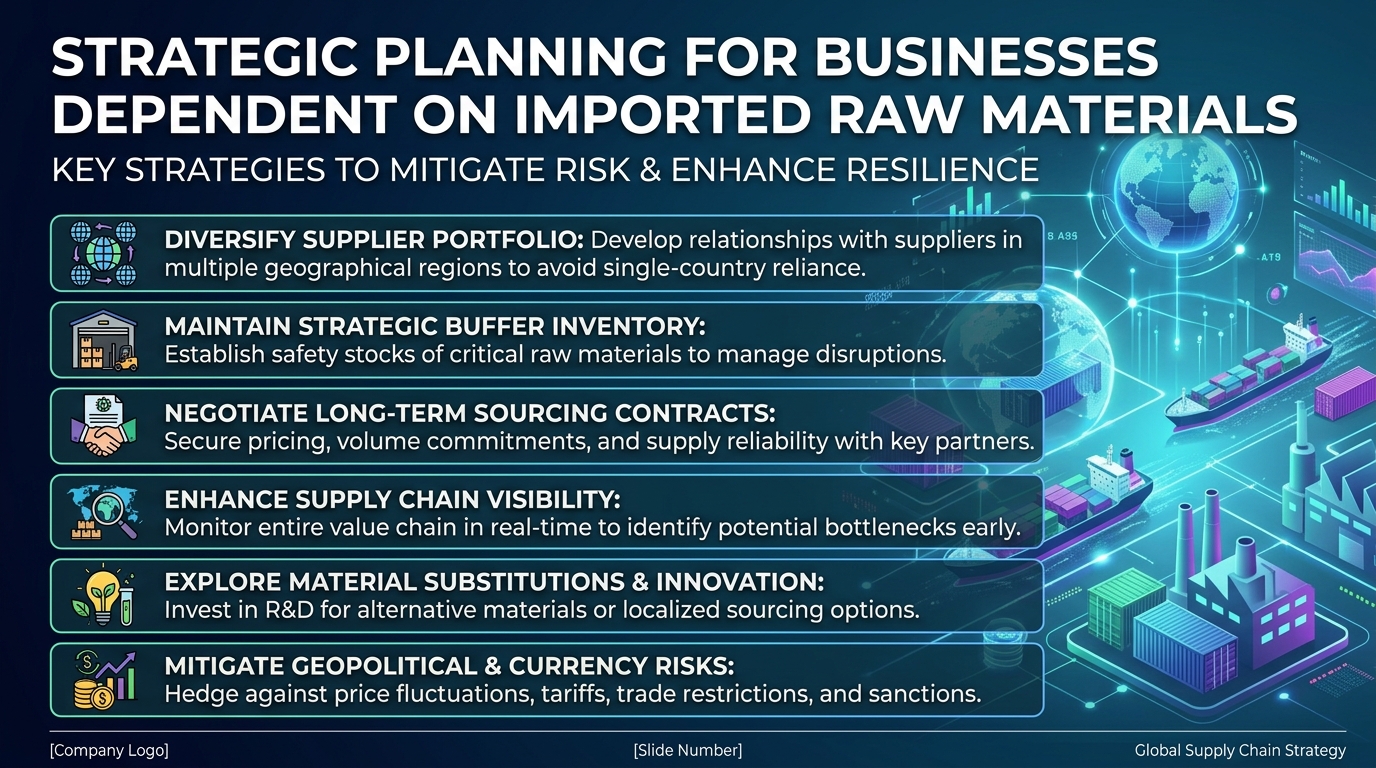
Strategic Planning for Businesses Dependent on Imported Raw Materials
Let me describe a reality that too many Nigerian business owners know too well.
The exchange rate moves and your cost of goods changes overnight.
A port congestion episode delays a critical shipment and your production line slows.
A new import restriction arrives and a material that was routine to source suddenly requires a workaround that takes months to build.
A supplier in Asia revises their minimum order quantity upward and your working capital is committed to inventory volumes your warehouse was not designed to hold.
These are not edge cases. They are the operating reality of thousands of Nigerian manufacturers, processors, pharmaceutical companies, food and beverage producers, and industrial businesses whose production depends on raw materials that Nigeria does not yet produce in sufficient quantity, quality, or consistency to replace what must be sourced internationally.
This article is about how to build a strategy that takes that dependency seriously, manages it systematically, and works deliberately to reduce it over time.
If you need professional support, our supply chain risk management and import strategy advisory for Nigerian businesses can help you build resilience.
Understanding the true cost of import dependency
Most Nigerian businesses are underestimating what import dependency actually costs them.
The obvious cost of importing raw materials is the purchase price plus freight, insurance, and customs duties. Most Nigerian businesses track these costs carefully. What many are not tracking with equal rigor are the less visible costs of import dependency that, taken together, often exceed the direct procurement costs in strategic significance.
According to the Institute for Supply Management (ISM), supply chain risk is defined as “the likelihood of an event occurring within a supply network that will adversely affect the ability of the focal firm to meet customer demand or impact its financial performance.”

The working capital cost.
Imported raw materials require payment well before they arrive on the production floor. From the moment a letter of credit is established or a wire transfer is made, through shipping transit, customs clearance, and inland transportation, Nigerian manufacturers are typically financing 60 to 120 days of raw material inventory before that inventory generates a single naira of revenue.
When the naira depreciates during this financing period, the naira cost of the in-transit inventory rises before it has been sold. This creates a valuation loss that is not always visible in conventional management accounts but that directly erodes the profitability of the procurement cycle.
The quality and consistency cost.
International supply chains introduce quality variability that domestic supply chains typically do not. Shipments from the same supplier can vary in specification, contamination levels, moisture content, or other quality parameters in ways only discovered when the material is received.
The cost of quality failures includes rejected shipments, production downtime while replacement materials are sourced, expedited replacement procurement at premium prices, and in the worst cases, finished goods that fail quality standards because substandard raw materials were not detected before use.
Few businesses have built systematic processes for quantifying the total quality cost of their import supply chains. This means they cannot accurately compare the true cost of importing against the true cost of sourcing locally.
The strategic flexibility cost.
Perhaps the most significant and least measured cost is its impact on strategic flexibility. A business whose production depends on materials that take three months to procure cannot respond quickly to market opportunities that require production changes, cannot easily scale down volumes when demand contracts without stranding working capital, and cannot pivot product range or production mix at the pace market conditions sometimes require.
In Nigeria, where policy changes, exchange rate movements, and demand shifts can happen faster than international procurement cycles, the strategic inflexibility imposed by long import lead times is a genuine competitive disadvantage.
For a broader perspective on risk management, check out our enterprise risk management advisory for Nigerian companies.
The strategic planning failure that import-dependent businesses make most often
The most consequential strategic planning failure is not a failure of procurement strategy or financial management. It is a failure of strategic assumption.
These businesses build annual budgets and multi-year strategic plans that assume their import supply chains will function broadly as they have in the past. That exchange rates will move within manageable ranges. That port clearance times will be predictable. That international suppliers will maintain their pricing, quality, and delivery commitments.
When the assumptions break, as they regularly do in the Nigerian context, the plan does not have a built-in response. The business improvises. It manages the immediate crisis as best it can, absorbs costs not budgeted, and waits for conditions to stabilise.
The strategic opportunity to use the crisis as a catalyst for structural supply chain improvement is typically missed in the rush to restore operational normality.
The single-supplier concentration risk.
Many import-dependent businesses have developed deep, long-standing relationships with single international suppliers. These relationships offer genuine benefits including pricing certainty, quality consistency, credit terms, and operational efficiency. They also create a concentration risk only fully visible when the relationship is disrupted.
A supplier that goes out of business, experiences a production disaster, is acquired by a competitor, or simply decides to prioritise other markets creates an immediate production crisis for a buyer with no alternative source qualified and ready to supply.
Single-supplier dependency for critical raw materials is one of the most straightforward supply chain risks to understand and one of the most commonly left unaddressed.
Building a strategic framework for import-dependent Nigerian businesses
The framework must address three time horizons simultaneously and must be governed at board level.
The immediate horizon: stabilising the supply chain.
For businesses currently experiencing supply chain stress, the immediate priority is stabilising procurement and protecting production continuity. This requires a clear map of critical raw material dependencies, current inventory position, outstanding orders in the supply pipeline, and realistic lead times for replenishment.
The stabilisation strategy should identify which materials are most critical to production continuity, which have the longest and most uncertain procurement lead times, and which represent the highest forex exposure. These highest-risk materials should receive disproportionate management attention.
Building contingency sourcing relationships, even where they are not immediately activated, is a stabilisation priority consistently deferred until a crisis makes it urgent. The right time to qualify a second supplier is before the first supplier fails.
The medium-term horizon: restructuring the import supply chain.
Supplier diversification across currency zones is a strategic response. Businesses that source all raw materials from US dollar-denominated suppliers have concentrated currency exposure. Diversifying across multiple currency zones, sourcing some from euro-denominated European suppliers, some from renminbi-denominated Chinese suppliers, distributes risk across multiple currency pairs whose movements are not perfectly correlated.
Lead time reduction and supply chain compression involve deliberately seeking suppliers who can offer shorter lead times even at modestly higher unit prices. For businesses sourcing from China, sourcing from regional trading hubs in Dubai or Singapore that maintain inventory of commonly traded industrial raw materials can compress lead times significantly.
Strategic inventory management requires explicit calculation of optimal safety stock levels for each critical imported raw material. The cost of a production stoppage caused by a stockout typically far exceeds the working capital cost of maintaining strategic inventory buffers.
The long-term horizon: reducing import dependency structurally.
Local input substitution programmes should start with comprehensive mapping of the organisation’s imported input bill, categorising each material by local substitutability and strategic priority. Materials that are both highly substitutable locally and high in import value or strategic risk should be first priorities.
Supplier development work is required, working with potential local suppliers to close quality, consistency, and scale gaps. This investment builds supply chain assets whose long-term value typically justifies the investment.
Product reformulation that changes raw material composition to reduce reliance on imported ingredients builds on R&D investment rather than supplier development. Nigerian food and beverage companies that have successfully reformulated products to increase local ingredient proportion have both reduced import dependency and improved cost position.
Vertical integration into upstream production for the most strategically critical raw materials where local supply does not currently exist is the most ambitious but potentially most valuable strategy. Nigerian companies that have invested in agricultural production, mining operations, or basic industrial processing have transformed their competitive position.
For support with strategic framework development, our import supply chain restructuring and local sourcing advisory can help.
The forex management dimension of import strategy
Import dependency and forex risk are inseparable and must be managed together.
Procurement timing as a forex management tool.
Businesses that monitor exchange rate movements systematically and have inventory capacity and working capital flexibility to accelerate procurement when rates are relatively favourable can meaningfully reduce their average effective import exchange rate.
Opportunistic procurement requires working capital capacity to hold larger than normal inventory positions, adequate storage infrastructure, treasury monitoring capability tracking exchange rate movements in sufficient granularity, and procurement decision authority that can be exercised quickly.
Forward contracts for import procurement.
For businesses with predictable import schedules and material foreign currency payables, forward foreign exchange contracts offer a mechanism for locking in the naira cost of future imports at current exchange rates. This eliminates the uncertainty about the naira cost of materials already on order.
Forward contracts are available through Nigerian commercial banks for major currency pairs including USD, EUR, and GBP. Building forward contract capability into the treasury management framework reduces earnings volatility and supports more reliable financial planning.

Port and logistics strategy: the operational dimension
Even perfect procurement strategy can be undermined by port and logistics failures.
Port clearance strategy.
The average customs clearance time at Nigerian ports, while improving with the Nigeria Customs Service National Single Window platform and Authorized Economic Operator (AEO) programmes, remains longer and more variable than international benchmarks.
The strategic response requires proactive compliance management ensuring all import documentation is complete, accurate, and submitted in advance. It requires relationships with competent clearing agents who can navigate the port process efficiently. And it requires production planning buffers that account for realistic variability in clearance times.
The NCS’s implementation of the National Single Window platform and AEO programmes are creating meaningful improvements for well-prepared businesses. Import-dependent companies that have invested in AEO qualification are already experiencing clearance time improvements.
Inland transportation and warehousing.
Logistics challenges do not end at the port gate. Inland transportation involves infrastructure quality variability, security risks on specific routes, and carrier reliability issues.
Building reliable inland logistics arrangements, including relationships with multiple reputable freight carriers, awareness of route alternatives, and warehousing capacity close to both port and production locations, reduces logistics risk.
For support with logistics, our customs compliance and port logistics optimisation advisory can help.
Governance of import strategy: making supply chain risk a board-level concern
Import dependency of the scale many Nigerian businesses carry is a strategic risk that must be governed at board level.
Board-level supply chain risk oversight.
The board should receive regular reporting on concentration of import dependency by supplier, material, and currency zone, current inventory position for critical imported materials relative to safety stock targets, outstanding foreign currency payables and their forex exposure, progress of local sourcing development programmes, and any emerging supply chain disruptions.
The Risk Committee should include supply chain risk as a standing element of the risk register, with defined risk appetite parameters for supplier concentration, inventory days coverage, and unhedged forex exposure.
Strategic investment in supply chain resilience.
The board should explicitly approve and fund strategic investments including supplier qualification programmes for alternative and local sources, strategic inventory buffer targets requiring working capital investment above short-term optimisation, and local supplier development programmes requiring patient capital.
These investments are typically evaluated against short-term return on investment criteria that do not capture their full strategic value. The board’s role is to ensure supply chain resilience investments are evaluated against their full strategic value.
Key supply chain and import strategy terms every business leader should know
Landed Cost. The total cost of an imported raw material including purchase price, international freight, insurance, import duties, clearing agent fees, and inland transportation. The correct basis for comparing imported and local sourcing options.
Safety Stock. The buffer inventory held above average cycle stock to protect against variability in supply lead times and demand.
Supplier Diversification. The deliberate development of multiple qualified sources for critical raw materials, reducing concentration risk.
Currency Zone Diversification. The deliberate sourcing from suppliers in different currency zones to reduce concentration of forex exposure.
Local Content. The proportion of a product’s raw material inputs sourced domestically rather than imported.
Forward Contract. An agreement to buy or sell a specified amount of foreign currency at a specified exchange rate on a specified future date.
Supply Chain Compression. The deliberate reduction of procurement lead times through supplier selection, logistics optimisation, and supply chain redesign.
Vertical Integration. Extending operations into upstream supply activities, producing raw materials previously sourced externally.
Authorized Economic Operator (AEO). A designation granted by Nigeria Customs Service to businesses meeting supply chain security and customs compliance standards, entitling them to expedited clearance.
Import Substitution. A strategy of developing local production capacity to replace imported goods or raw materials.
Recommended reading from the Business Cardinal blog
If you want to strengthen your strategic planning and risk management, these related articles will help.
Building a Risk-Aware Culture in Your Organization – Import dependency requires a culture that takes supply chain risk seriously. Read the Guide.
Board Evaluation: Why It Matters – Board Assessment Nigeria – Stronger Oversight – Strong board oversight is essential for supply chain risk governance. Read the Article.
Corporate Governance Lessons from Nigerian Bank Failures – Some failures involved poor supply chain risk management. Learn from the past. Read the Guide.
Recommended services from Business Cardinal
Ready to transform import dependency from vulnerability to strategic resilience? These services are designed to help Nigerian businesses manage supply chain risk.
Supply Chain Risk Management and Import Strategy Advisory for Nigerian Businesses – Comprehensive advisory for import-dependent businesses.
Import Supply Chain Restructuring and Local Sourcing Advisory – Strategic framework for reducing import dependency.
Forex Risk Management and Treasury Advisory for Import-Dependent Businesses – Integrated forex and procurement strategy.
Customs Compliance and Port Logistics Optimisation Advisory – Operational support for import clearance and logistics.
Board-Level Supply Chain Risk Governance Advisory – Governance frameworks for supply chain risk oversight.
Where to go from here
Your import supply chain is either a managed strategic risk or an unmanaged strategic vulnerability. Which one it is depends on the decisions your organisation has made deliberately.
Nigerian businesses navigating import dependency without a structured strategic framework are carrying risks in their supply chains, their forex exposure, and their long-term competitive position. These risks compound quietly until a disruption makes them suddenly, expensively visible.
The businesses that are building supply chain resilience systematically are building competitive advantages that less-prepared competitors will struggle to close.
Start by understanding your true cost of import dependency. Then build your strategic framework. Then implement across three time horizons. Then govern at board level.
The businesses that act now will define the competitive landscape.
Let’s work together
Is your import supply chain a managed strategic risk or an unmanaged vulnerability?
At Business Cardinal, we help Nigerian businesses transform import dependency from vulnerability to strategic resilience. We understand the forex environment. We know the port logistics. And we have practical experience helping businesses build supply chains that work.
Not theory. Not generic advice. Practical, actionable support tailored to your specific business.
Contact us today:
📧 Email: hello@businesscardinal.com
📞 Phone: +234 802 320 0801
📍 Address: 5, Ishola Bello Close, Off Iyalla Street, Alausa, Ikeja, Lagos, Nigeria
Contact Business Cardinal to discuss your import strategy.
Request a supply chain strategic assessment today. Take the first step toward building an import strategy genuinely designed for the Nigerian business environment you are operating in.
Business Cardinal – Your Partner in Supply Chain Resilience
References
-
Institute for Supply Management (ISM) – Supply Chain Risk Management
-
Central Bank of Nigeria – Foreign Exchange Policy
-
Nigeria Customs Service – Import Procedures and AEO Programme
-
Manufacturers Association of Nigeria – Import Dependency Reports
-
Bank of Industry Nigeria – Local Content Financing
-
Nigerian Investment Promotion Commission – Import Substitution Guidelines
-
World Bank – Trade Facilitation Reports
-
Financial Reporting Council of Nigeria – Risk Management Standards
-
Lagos Chamber of Commerce and Industry – Import Policy Reports
-
International Trade Centre – Supply Chain Resilience
Related Post

The 2026–2030 Consumer Wallet Shift: What Nigerians Will Spend More (and Less) On
Print 🖨 PDF 📄 eBook 📱The 2026–2030 Consumer Wallet Shift: What Nigerians Will Spend More…
The Hidden Risk of Informal Contracts in Nigeria’s Business Ecosystem
Print 🖨 PDF 📄 eBook 📱The Hidden Risk of Informal Contracts in Nigeria’s Business Ecosystem…
How SMEs Can Leverage Government Grants and Loans in Nigeria
Print 🖨 PDF 📄 eBook 📱How SMEs Can Leverage Government Grants and Loans in Nigeria…

There are no comments