


Enterprise Risk Heatmap: How to Build One — Risk Mapping, Visualising Exposures, and Strengthening Risk Governance in Nigerian Organisations
Enterprise Risk Heatmap: How to Build One — Risk Mapping, Visualising Exposures, and Strengthening Risk Governance in Nigerian Organisations
Nigerian organisations operate in one of the most demanding and fast-moving risk environments on the African continent.
For leadership teams navigating this landscape, the ability to see risks clearly — to understand where they sit, how severe they are, how they relate to each other, and which ones demand immediate management attention — is among the most powerful governance capabilities an organisation can possess. Yet despite this urgent need, a significant proportion of Nigerian organisations still manage risk information through isolated spreadsheets, fragmented departmental reports, and the personal knowledge of individual managers.
The enterprise risk heatmap is the tool that changes this. Simple in concept but powerful in practice, a well-constructed risk heatmap translates the complex, multidimensional risk landscape of a Nigerian organisation into a single, visually intuitive display that immediately communicates which risks are most urgent, which are being adequately managed, and which require escalated board and management attention. It is the cornerstone visual output of a mature enterprise risk management programme.
Let me walk you through exactly what an enterprise risk heatmap is, why it matters for Nigerian organisations specifically, how to build one from the ground up, what the most common mistakes are, and what the latest developments in risk visualisation mean for Nigerian practitioners.
Business Cardinal provides Enterprise Risk Assessment and Risk Register Development to help Nigerian organisations build the foundation for effective risk heatmaps.
1. Why Nigerian organisations need risk heatmaps more than ever
The case for investing in structured risk visualisation has never been stronger, or more urgent, in the Nigerian operating environment.
Nigerian organisations face a risk landscape that is simultaneously broader, faster-moving, and less forgiving than at virtually any previous point in their operating history. Currency volatility, energy cost instability, rapidly evolving cybercrime threats, tightening regulatory requirements across multiple sectors, political and policy uncertainty, inflationary pressure on operating costs, talent retention challenges, and the growing demands of international investors for ESG-quality governance — all of these risks are live, material, and in many cases interconnected in ways that amplify their individual impact.
Managing this landscape through informal risk awareness and periodic management discussion is no longer adequate. Nigerian boards and audit committees are asking sharper questions about risk than at any previous point. The CBN, FRCN, SEC, and other regulators are raising their expectations for documented, structured risk management processes.
The risk heatmap is the visual interface between the organisation’s risk management process and the decisions that boards and management must make. Organisations that have invested in building good heatmaps are making better risk decisions. Those that have not are governing and managing in the dark — and in Nigeria’s current environment, the darkness is full of risks that will not wait to be identified before they materialise. For a broader perspective on risk culture, see Building a Risk-Aware Culture in Your Organization.
2. Key definition: what is an enterprise risk heatmap?
Before building a risk heatmap, Nigerian risk professionals need a clear and precise understanding of what it is, what it represents, and what it is designed to achieve.
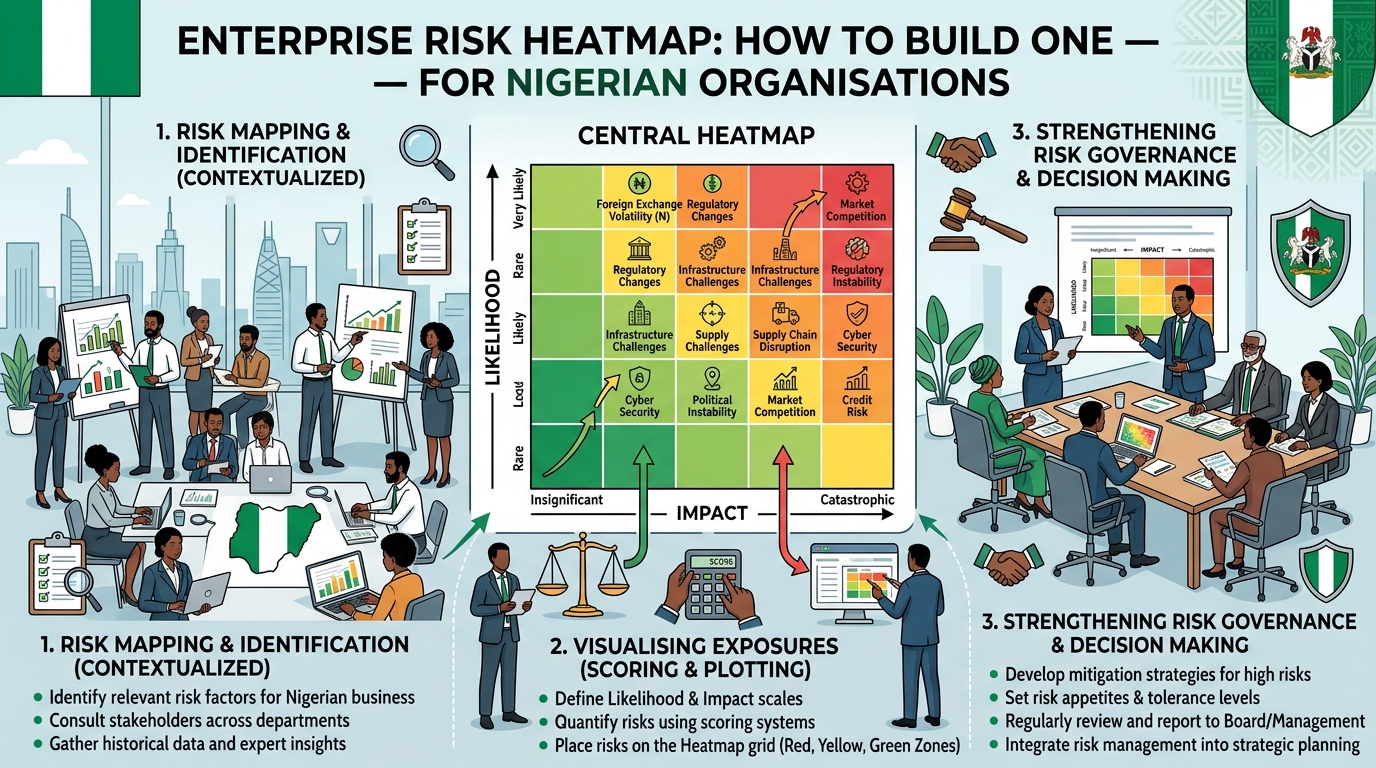
Definition — Enterprise Risk Heatmap: An Enterprise Risk Heatmap is a visual risk management tool that plots an organisation’s identified risks on a two-dimensional matrix — typically with likelihood or probability of occurrence on one axis and impact or consequence on the other — using a colour-coded display that immediately communicates the relative severity of each risk. Risks that combine high likelihood with high impact are displayed in a high-severity zone, typically red, requiring immediate management attention and escalation. Risks that combine low likelihood with low impact appear in a low-severity zone, typically green, requiring monitoring but not immediate intervention.
This definition is adapted from the Institute of Risk Management (IRM) — Risk Management Standard and Guidance on Risk Appetite and Tolerance, a foundational educational resource for enterprise risk management practitioners globally.
The heatmap does not merely display risk severity. When properly constructed, it also communicates the direction of risk — whether each risk is increasing, stable, or decreasing in severity; the adequacy of current controls; and the ownership of each risk — which individual or function is accountable for managing it.

3. The components of a well-designed enterprise risk heatmap
A risk heatmap is only as valuable as the rigour of its underlying design. Understanding the key components ensures that your heatmap communicates genuine risk intelligence rather than a false sense of organised oversight.
3.1 The risk register: the foundation of the heatmap
A risk heatmap cannot be built without a risk register — the structured inventory of all material risks facing the organisation. The risk register is the database from which the heatmap is populated, and its quality determines the quality of the heatmap. A superficial risk register with generic risk descriptions produces a superficial heatmap that tells the board nothing useful. A rigorous, specific, well-maintained risk register produces a heatmap that genuinely informs governance.
For Nigerian organisations building their first risk register, the starting point is a structured risk identification process — typically a combination of facilitated risk workshops with senior management and subject matter experts, review of historical loss events and near-misses, analysis of the external environment including regulatory developments and industry trends, and benchmarking against the risk registers of comparable organisations in the same sector.
3.2 The likelihood scale
The likelihood axis of the risk heatmap measures how probable it is that each identified risk will materialise within a defined time horizon — typically one year for operational risks and three to five years for strategic risks. Likelihood should be defined on a consistent, clearly specified scale — typically with three, four, or five levels — and each level should be anchored to objective criteria.
A typical five-level likelihood scale for a Nigerian organisation might define the levels as: rare (less than 10% probability), unlikely (10% to 30%), possible (30% to 50%), likely (50% to 70%), and almost certain (greater than 70%).
3.3 The impact scale
The impact axis measures the consequences to the organisation if the risk materialises across financial, operational, reputational, regulatory, and strategic dimensions. Like the likelihood scale, the impact scale should be defined on a consistent, anchored basis specifying in concrete terms what each impact level means.
For a Nigerian financial institution, a severe financial impact might be defined as a loss exceeding a specified percentage of regulatory capital. For a Nigerian manufacturing company, it might be defined as a revenue loss exceeding a defined percentage of annual turnover. The specificity of these definitions is what enables meaningful, consistent impact assessment.
3.4 The risk appetite framework
The risk appetite framework defines the level and type of risk the organisation’s board is willing to accept in pursuit of its strategic objectives. In the context of the risk heatmap, the risk appetite is typically visualised as a tolerance line or boundary on the heatmap — a defined zone beyond which risks are considered outside appetite and require immediate escalation.
Without a defined risk appetite framework, the risk heatmap shows where risks sit but not whether their position is acceptable. The Committee of Sponsoring Organizations of the Treadway Commission (COSO) provides guidance on integrating risk appetite into enterprise risk management frameworks.
3.5 Inherent versus residual risk assessment
A sophisticated risk heatmap distinguishes between inherent risk — the risk that would exist in the absence of any controls — and residual risk — the risk that remains after existing controls are taken into account. Plotting both on the heatmap immediately communicates the control effectiveness story: how much the organisation’s current controls are reducing the raw risk exposure.
This inherent-to-residual journey is one of the most valuable pieces of risk intelligence the heatmap provides. A risk with very high inherent severity but low residual severity demonstrates effective controls. A risk where inherent and residual severity are similar demonstrates a control gap that warrants management attention.
3.6 Risk velocity and direction indicators
A static heatmap shows where risks sit at a point in time. A dynamic heatmap — the standard to which Nigerian organisations should aspire — also shows how risks are moving. Risk velocity indicators, such as arrows showing whether each risk is increasing, stable, or decreasing in severity, transform the heatmap from a snapshot into a governance intelligence tool that enables boards to track the trajectory of the risk landscape over time.
4. Step-by-step: how to build an enterprise risk heatmap for a Nigerian organisation
Step 1: Define the heatmap architecture and scales
Before gathering any risk data, define the architecture of your heatmap. Decide on the number of levels in your likelihood and impact scales — typically four or five for organisations of meaningful complexity. Define precisely what each level means in terms that are specific to your organisation, your sector, and your regulatory environment. Specify the time horizon over which risks will be assessed. And establish the colour coding — typically a traffic light system moving from green through yellow and amber to red — that will communicate severity immediately to a non-technical board audience.
Step 2: Facilitate a structured risk identification process
Convene facilitated risk identification workshops with your senior management team, covering all major business functions and risk categories. Use a structured risk category framework — such as the COSO ERM categories of strategic, operational, financial reporting, and compliance risks — to ensure comprehensive coverage.
In the Nigerian context, ensure that your risk identification process specifically considers currency and foreign exchange risks, energy and infrastructure risks, cybercrime and technology risks, regulatory and compliance risks across applicable Nigerian regulatory frameworks, talent and human capital risks, and political and policy risks.
Step 3: Assess likelihood and impact for each identified risk
For each risk identified, facilitate a structured assessment of both likelihood and impact using the scales defined in Step 1. Involve the relevant risk owners — the senior managers with the closest operational knowledge of each risk — in the assessment, but ensure that the assessment process is facilitated independently to reduce the anchoring and optimism biases that frequently distort self-assessed risk ratings. Document the rationale for each assessment.
Step 4: Plot risks on the heatmap matrix
Plot each assessed risk on the likelihood-impact matrix using the scores assigned in Step 3. Where you are plotting both inherent and residual risk, use a consistent visual convention — such as open circles for inherent risk and filled circles for residual risk, connected by an arrow showing the control-driven reduction — to make the relationship between the two immediately apparent.
Step 5: Apply the risk appetite overlay
Mark your organisation’s risk appetite boundary on the completed heatmap — the threshold beyond which risks are considered outside appetite and require escalated response. Identify and highlight all risks that currently fall outside the appetite boundary — these are the risks that require immediate board attention, enhanced management action plans, or explicit board-level acceptance decisions. The Central Bank of Nigeria’s risk governance guidelines provide specific requirements for financial institutions.
Step 6: Assign risk owners and management actions
For every risk on the heatmap — and particularly for those in the high-severity and outside-appetite zones — confirm the named risk owner, document the current risk management actions and controls, assess the adequacy of those actions, and define any additional management actions required. Link these actions to specific timelines, responsible individuals, and measurable success criteria.
Step 7: Present to the board and embed in the governance cycle
Present the completed heatmap to the board and audit committee as part of the regular risk reporting cycle — at minimum quarterly, and more frequently for material risk developments. Establish a clear protocol for how the heatmap is updated between presentations who is responsible for updating risk assessments, what triggers an out-of-cycle escalation, and how the heatmap evolves as the risk environment changes.
5. Common mistakes in risk heatmap design and use by Nigerian organisations
Even well-intentioned risk heatmap programmes frequently fail to deliver their potential value because of avoidable design and usage mistakes.
The heatmap as compliance decoration is the most common and consequential mistake. A document produced to satisfy a regulatory or audit committee expectation, with generic risk descriptions and unsupported assessments, that does not reflect genuine organisational risk intelligence and does not inform any actual management decision provides no governance value.
The static heatmap is the second most common mistake. A heatmap that accurately reflected an organisation’s risk landscape eighteen months ago tells the board almost nothing about where they are today. Risk heatmaps must be living documents, updated at least quarterly and immediately when material risk events occur.
The absence of risk appetite calibration is the third common mistake. Plotting risks without any defined boundary that communicates whether their position is acceptable or not leaves the board with no basis for determining which require an immediate response.
The overloaded heatmap is the fourth mistake. Attempting to display every identified risk on a single visual produces a cluttered and unreadable display. Board-level heatmaps should focus on the most material risks — typically the 15 to 25 highest-priority risks — with the full risk inventory maintained in the supporting risk register.
For guidance on risk governance, see Board Evaluation: Why It Matters – Board Assessment Nigeria – Stronger Oversight.
6. Risk heatmap and enterprise risk management developments
The practice of enterprise risk management and risk visualisation is evolving rapidly. These developments are directly relevant to Nigerian organisations building or refreshing their risk heatmap programmes.
6.1 Dynamic digital risk heatmaps are replacing static presentations
In 2025, leading enterprise risk management platforms released significantly enhanced risk visualisation capabilities that enable risk heatmaps to be updated in real time as risk assessments are refreshed, linked directly to the underlying risk register data, and accessed by board members through secure digital dashboards. Nigerian organisations that are still producing risk heatmaps in PowerPoint and Excel are operating with tools that are significantly less efficient, less accurate, and less useful.
6.2 Climate and ESG risks are being integrated into Nigerian risk heatmaps
The integration of climate-related and broader ESG risks into enterprise risk heatmaps has moved from an international best practice aspiration to a practical implementation priority. The Task Force on Climate-Related Financial Disclosures (TCFD) framework provides the methodology for climate risk scenario analysis that feeds these heatmap updates. The Financial Reporting Council of Nigeria and the Nigerian Exchange Group have been strengthening ESG disclosure requirements for listed companies.
6.3 Cybersecurity risk has moved to the top of Nigerian risk heatmaps
The Interpol Africa Cyberthreat Assessment documented dramatic increases in cyberattack frequency and sophistication targeting Nigerian organisations. In the risk heatmaps of well-governed Nigerian financial institutions and manufacturing companies, cybersecurity risk has moved from a moderate-impact, moderate-likelihood position to a high-impact, high-likelihood position. Organisations whose risk heatmaps still display cybersecurity risk in low-to-moderate positions are either maintaining outdated assessments or actively underestimating a clearly documented exposure.
6.4 The CBN’s enhanced risk appetite and reporting requirements
The CBN’s updated risk governance guidelines for Nigerian banks and financial institutions, released in stages during 2024 and 2025, include specific requirements for the quality and frequency of risk reporting to boards. For Nigerian financial institutions that have not yet implemented structured risk heatmap reporting, the CBN’s updated guidance creates a direct regulatory compliance imperative alongside the governance case. See Corporate Governance Lessons from Nigerian Bank Failures for historical context.
6.5 Scenario analysis is becoming an integral heatmap supplement
Leading risk management practitioners are increasingly requiring that risk heatmaps be accompanied by scenario analyses — structured explorations of how the organisation’s risk position would change under defined adverse conditions. For Nigerian organisations, relevant scenarios include a further significant naira devaluation, a major cybersecurity breach, a key customer or supplier failure, a significant regulatory enforcement action, or a political disruption affecting the operating environment.
7. Key risk heatmap terms every Nigerian business leader should know
Enterprise Risk Heatmap. A visual risk management tool that plots identified risks on a likelihood-impact matrix using colour-coding to communicate severity immediately to boards and management.
Risk Register. A structured inventory of all material risks facing the organisation, serving as the database from which the risk heatmap is populated.
Likelihood Scale. A defined scale measuring how probable it is that each identified risk will materialise, typically with three to five levels anchored to objective probability criteria.
Impact Scale. A defined scale measuring the consequences to the organisation if the risk materialises across financial, operational, reputational, regulatory, and strategic dimensions.
Risk Appetite Framework. A board-defined framework specifying the level and type of risk the organisation is willing to accept, visualised on the heatmap as a tolerance boundary.
Inherent Risk. The risk that would exist in the absence of any controls, representing the raw exposure before mitigation.
Residual Risk. The risk that remains after existing controls are taken into account, representing the actual exposure management is responsible for.
Risk Velocity. The rate at which a risk is increasing, stable, or decreasing in severity, typically displayed on dynamic heatmaps using directional arrows.
Risk Owner. The named individual or function accountable for managing a specific risk and reporting on its status to the board and audit committee.
Scenario Analysis. A structured exploration of how the organisation’s risk position would change under defined adverse conditions, supplementing the point-in-time heatmap with forward-looking resilience assessment.
8. The bottom line
A board that cannot see its organisation’s risk landscape clearly is a board that cannot govern it effectively. In Nigeria’s current operating environment — where currency, cyber, regulatory, and operational risks are escalating simultaneously — the absence of structured, visual, regularly updated risk intelligence at board level is not a minor governance gap. It is a fundamental vulnerability that is costing Nigerian organisations in avoidable losses, regulatory sanctions, missed strategic opportunities, and the destruction of value that poor risk decisions produce.
The enterprise risk heatmap is the governance tool that gives your board the visibility it needs. Building it properly — with rigorous risk identification, calibrated scales, a defined risk appetite framework, and a dynamic update process that keeps it current — requires professional expertise, structured methodology, and an understanding of both enterprise risk management best practice and the specific risk landscape that Nigerian organisations navigate.
The risks that will define your organisation’s future are identifiable today. The question is whether you will see them clearly and manage them deliberately.
Related services from Business Cardinal
Enterprise Risk Assessment and Risk Register Development – Building the foundation for effective risk heatmaps through structured risk identification. Learn more about Enterprise Risk Assessment
Risk Heatmap Design and Implementation – Creating dynamic, board-ready risk visualisation tools for Nigerian organisations. Explore Risk Heatmap Services
Risk Appetite Framework Development – Defining board-approved risk boundaries that make heatmaps genuinely actionable. View Risk Appetite Services
Recommended reading from the Business Cardinal blog
Building a Risk-Aware Culture in Your Organization – Embedding risk thinking across all levels of the organisation. Read the Guide
Board Evaluation: Why It Matters – Board Assessment Nigeria – Stronger Oversight – Strengthening governance through board effectiveness assessment. Read the Article
Corporate Governance Lessons from Nigerian Bank Failures – Historical context for risk governance failures in Nigerian financial institutions. Read the Guide
Let’s work together
Does your board have the risk visibility it needs to govern your organisation effectively? At Business Cardinal, we help Nigerian organisations build, implement, and maintain enterprise risk heatmaps and the broader risk management frameworks that make them genuinely useful — not compliance decorations but genuine governance intelligence tools that inform better decisions at every level of the organisation.
Contact us today:
📧 Email: hello@businesscardinal.com
📞 Phone: +234 802 320 0801
📍 Address: 5, Ishola Bello Close, Off Iyalla Street, Alausa, Ikeja, Lagos, Nigeria
Contact Business Cardinal to discuss your enterprise risk management needs.
The risks that will define your organisation’s future are identifiable today. Let Business Cardinal help you see them clearly — and manage them deliberately.
Business Cardinal – Your Partner in Risk Intelligence
References
-
Institute of Risk Management (IRM). Risk Management Standard and Guidance on Risk Appetite and Tolerance. Available at: https://www.theirm.org/what-we-do/what-is-enterprise-risk-management/
-
Committee of Sponsoring Organizations of the Treadway Commission (COSO). Enterprise Risk Management: Integrating with Strategy and Performance. Available at: https://www.coso.org/guidance-on-erm
-
Central Bank of Nigeria. Risk Governance and Reporting Guidelines for Financial Institutions. Available at: https://www.cbn.gov.ng
-
Financial Reporting Council of Nigeria. Corporate Governance Code. Available at: https://www.financialreportingcouncil.gov.ng
-
Nigerian Exchange Group. ESG and Risk Disclosure Requirements for Listed Companies. Available at: https://www.ngxgroup.com
-
Interpol. Africa Cyberthreat Assessment Report. Available at: https://www.interpol.int/en/Crimes/Cybercrime
-
Task Force on Climate-Related Financial Disclosures (TCFD). Recommendations and Guidance. Available at: https://www.fsb-tcfd.org
-
MetricStream. Enterprise Risk Management and Risk Heatmap Platform. Available at: https://www.metricstream.com
-
AuditBoard. Risk Management and Heatmap Visualisation. Available at: https://www.auditboard.com
-
The Institute of Internal Auditors. International Standards for the Professional Practice of Internal Auditing (2025). Available at: https://www.theiia.org/en/standards/
Related Post

Best Practices in Third-Party Risk Management: Vendor Risk, Supplier Fraud Prevention, and Protecting Nigerian Organisations from Third-Party Exposure
Print 🖨 PDF 📄 eBook 📱Best Practices in Third-Party Risk Management: Vendor Risk, Supplier Fraud…
Why Nigerian Startups Fail Financially: An Accountant’s View
Print 🖨 PDF 📄 eBook 📱Why Nigerian Startups Fail Financially: An Accountant’s View Let me…
Audit Quality in Nigeria: Strengthening Auditor Independence for Accurate Financial Reporting
Print 🖨 PDF 📄 eBook 📱Audit Quality in Nigeria: Strengthening Auditor Independence for Accurate Financial…

There are no comments