


Compliance Checklist for Listed Companies in Nigeria – Compliance Nigeria – NSE Rules Simplified
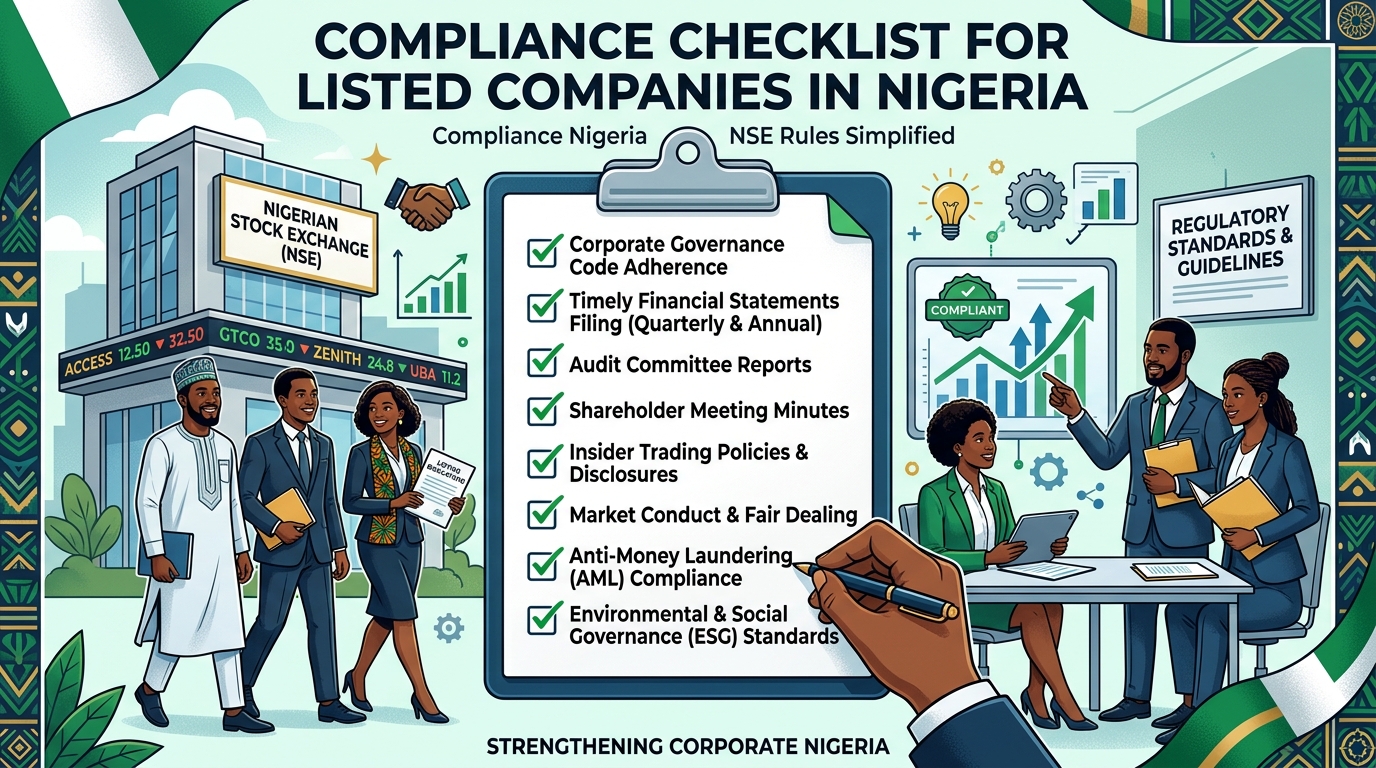
Compliance Checklist for Listed Companies in Nigeria – Compliance Nigeria – NSE Rules Simplified
Being listed on the Nigerian Exchange Group is a significant milestone for any Nigerian company. It signals scale, credibility, and access to public capital.
But with that listing comes a substantial and ongoing compliance obligation that many companies underestimate when they first pursue a public listing.
Regulatory requirements from the Nigerian Exchange Group, the Securities and Exchange Commission Nigeria, the Financial Reporting Council of Nigeria, and other sector regulators create a complex web of deadlines, disclosures, filings, and governance obligations that listed companies must meet continuously, not just at the point of listing.
This article provides a structured compliance checklist, explains what each requirement means in plain terms, and helps listed companies and their boards understand what is required, when it is required, and what happens when it is not delivered.
Business Cardinal provides Compliance Gap Assessments to help listed companies understand their obligations and build sustainable compliance systems.
What does compliance mean for a listed company in Nigeria?
Compliance for a listed Nigerian company is not a single obligation. It is a continuous, multi-layered set of responsibilities that spans financial reporting, governance, disclosure, shareholder communication, and regulatory engagement across multiple bodies simultaneously.
Definition — Regulatory Compliance: According to Investopedia, regulatory compliance is defined as “a company’s adherence to laws, regulations, guidelines, and specifications relevant to its business operations. Violations of regulatory compliance regulations often result in legal punishment, including federal fines. The goal of compliance is to prevent and detect violations of rules, which protects the organization from fines and lawsuits.”

For Nigerian listed companies, the primary regulatory bodies whose requirements must be met simultaneously are the Nigerian Exchange Group (NGX), which sets listing rules and continuous disclosure obligations; the Securities and Exchange Commission Nigeria (SEC), which oversees the capital market and investor protection rules; the Financial Reporting Council of Nigeria (FRCN), which sets financial reporting and corporate governance standards; the Corporate Affairs Commission (CAC), which administers company law obligations under the Companies and Allied Matters Act (CAMA) 2020; and sector-specific regulators including the CBN for banks, NAICOM for insurance companies, and PENCOM for pension-related entities.
Why compliance failures are more costly than compliance itself
The cost of non-compliance for a listed Nigerian company goes far beyond the fines and sanctions that regulators can impose, though those are significant. Non-compliance damages investor confidence, which affects share price and trading liquidity. It triggers regulatory scrutiny that consumes management time and attention. It creates reputational damage that affects relationships with lenders, customers, and partners. And in serious cases, it can result in suspension of trading in the company’s shares, which effectively cuts the company off from the equity capital market until compliance is restored.
The compliance framework described in this article is not designed to make life difficult for Nigerian businesses. It is designed to ensure that investors in those businesses have the information they need to make informed decisions, that minority shareholders are protected, and that the Nigerian capital market operates with the integrity that attracts domestic and international investment.
Read our Guide to Nigerian Capital Markets 2026 for market overview and trends.
The Nigerian Exchange Group listing rules — what every listed company must know
The NGX is your primary regulator as a listed company, and its rules are not optional.
The Nigerian Exchange Group operates under rules that all listed companies agree to comply with as a condition of their listing. These rules cover a wide range of continuous obligations that listed companies must meet throughout their time on the exchange, not just at the point of initial listing.
Understanding the different markets on the NGX
Before working through compliance obligations, it is important to understand that the NGX operates multiple market segments, each with slightly different requirements reflecting the different profiles of companies listed on each.
The Main Board is the primary listing market for large, established Nigerian companies. Companies on the Main Board face the most comprehensive disclosure and governance requirements.
The Premium Board is a higher-tier market for the largest and most liquid NGX-listed companies. Premium Board companies face enhanced governance requirements including stricter board composition standards, more detailed disclosure obligations, and higher free float requirements.
The Growth Board is designed for smaller, growing companies that meet lighter listing criteria. While Growth Board companies face less demanding requirements than Main Board or Premium Board companies, they are still subject to core continuous disclosure obligations.
The ASeM (Alternative Securities Market) caters to small and medium-sized enterprises seeking to raise capital from the public. ASeM companies operate under the lightest listing requirements but remain subject to fundamental disclosure and governance obligations.
Knowing which market segment your company is listed on is the starting point for understanding your specific compliance obligations.

Financial reporting compliance — the deadlines, the documents, and the standards
Financial reporting is the core of listed company compliance and the area where most failures occur.
Financial reporting compliance is the most fundamental obligation of any listed Nigerian company. Investors make decisions based on financial information, and the entire credibility of the capital market depends on that information being accurate, timely, and prepared to the required standard.
Audited annual financial statements
What Is Required. Every listed company must prepare and publish audited annual financial statements prepared in accordance with International Financial Reporting Standards (IFRS) as adopted in Nigeria. The financial statements must include a statement of financial position, statement of profit or loss and other comprehensive income, statement of changes in equity, statement of cash flows, and notes to the financial statements.
When It Is Required. The NGX requires listed companies to file their audited annual financial statements within three months of their financial year end for Main Board and Premium Board companies. Companies whose financial year ends on 31 December must therefore file their audited accounts by 31 March of the following year.
Who Must Sign Off. The financial statements must be approved by the board of directors, certified by the CEO and CFO, and audited by an external auditor registered with the FRCN. The audit report must express an opinion on whether the financial statements give a true and fair view.
Quarterly unaudited financial statements
What Is Required. In addition to annual audited statements, listed companies on the NGX Main Board and Premium Board are required to publish unaudited financial statements on a quarterly basis. These reports provide investors with more frequent updates on financial performance between annual audit cycles.
When It Is Required. Quarterly financial statements must be filed within 30 days of the end of each quarter. For a company with a December year end, this means filing Q1 results by 30 April, Q2 results by 31 July, Q3 results by 31 October, and Q4 results as part of the annual audited accounts.
What They Must Contain. Quarterly reports must include condensed financial statements covering the profit and loss account, balance sheet summary, and cash flow statement, along with management commentary on the key drivers of financial performance during the period.
Half-year financial statements
What Is Required. A half-year financial report, which is more detailed than the quarterly reports, is required for listed companies. The half-year report must be reviewed, though not fully audited, by the company’s external auditors.
When It Is Required. The half-year report must be filed within 60 days of the end of the first six months of the financial year.
Our Compliance Calendar Development and Management helps listed companies track all filing deadlines systematically.
Corporate governance compliance — what the board must do and document
Governance compliance is not just about having the right structures. It is about demonstrating that those structures are working.
Financial reporting compliance gets the most attention in most listed companies, but governance compliance is equally important and increasingly scrutinized by both the NGX and the SEC. The Nigerian Code of Corporate Governance 2018 establishes the governance standards that listed companies are expected to meet, and the annual report is the primary vehicle through which companies demonstrate compliance.
Board composition requirements
What Is Required. Listed companies must maintain a board that meets the composition requirements of the NCCG and the NGX listing rules. This includes having a majority of non-executive directors, with at least one-third of the board being independent non-executive directors. The roles of Chairman and CEO must be held by different individuals. The board must include at least one director with relevant financial expertise.
What Must Be Disclosed. The annual report must include a detailed board composition disclosure showing the name, role, professional background, committee memberships, date of appointment, and independence status of each director. Where a director is classified as independent, the basis for that classification must be explained.
Board and committee meeting requirements
What Is Required. The board must meet at least four times per year, with meetings properly convened, quorate, and minuted. The Audit Committee, Risk Committee, Remuneration Committee, and Nominations and Governance Committee must each meet at least twice per year with proper documentation.
What Must Be Disclosed. The annual report must include a table showing the number of board and committee meetings held during the year, the attendance record of each director, and a summary of the key matters considered by each committee.
Annual corporate governance report
What Is Required. Listed companies must include a comprehensive corporate governance report in their annual report. This report must address the company’s application of each principle of the NCCG, explain how the board has discharged its governance responsibilities, describe the work of each board committee, and identify any areas where the company has not applied a Code principle and explain why.
What the Report Must Cover. The governance report should include a statement from the Chairman on governance, a description of the board’s approach to strategy and risk oversight, a report on the activities of each board committee, a description of the director induction and ongoing development program, the results of the annual board performance evaluation, the company’s approach to stakeholder engagement, and the directors’ statement on the effectiveness of internal controls.
Disclosure and transparency obligations — what must be told to the market and when
Continuous disclosure is one of the most operationally demanding aspects of compliance for Nigerian listed companies. It requires companies to have internal systems and processes that identify, assess, and communicate material information to the market promptly and accurately.
Price-sensitive information disclosure
What Is Required. Listed companies must disclose any information that could reasonably be expected to have a material effect on the price of their shares as soon as that information becomes known to the company.
What Counts as Price-Sensitive Information. Examples include changes in earnings expectations, signing or termination of major contracts, discovery of fraud or material errors in previously published financial statements, changes in shareholding of major shareholders, resignation or appointment of directors or senior executives, mergers or acquisitions, regulatory investigations or sanctions, changes in dividend policy, and any event material to the company’s financial position or prospects.
When It Must Be Disclosed. Price-sensitive information must be disclosed to the NGX immediately upon the company becoming aware of it, which in practice means within 24 hours. Companies should not wait until the next scheduled filing or board meeting to disclose material information.
Material related party transactions
What Is Required. Transactions between the listed company and its directors, major shareholders, or entities connected to them must be disclosed to shareholders and, above certain size thresholds, require shareholder approval before they can proceed.
What Must Be Disclosed. The annual report must include a complete schedule of all related party transactions entered into during the year, identifying the nature of the relationship, the terms of the transaction, and the basis on which the board concluded that the transaction was on arm’s length terms and in the interest of the company.
Shareholder notifications and AGM requirements
What Is Required. Listed companies must hold an Annual General Meeting within six months of their financial year end. Shareholders must be given at least 21 days notice of the AGM. The notice must include the full agenda for the meeting, including all resolutions to be proposed, along with the explanatory notes shareholders need to understand the resolutions.
What Must Be Tabled at the AGM. The AGM must receive and consider the audited annual financial statements, the directors’ report, the audit committee report, and the auditor’s report. It must consider resolutions for the election or re-election of directors, the appointment of external auditors and approval of their remuneration, the approval of dividends, and any other matters requiring shareholder approval.
Our AGM Planning and Documentation Support helps listed companies ensure compliant shareholder meetings.
Shareholding structure and major shareholder disclosure
Investors have a right to know who controls the companies they invest in.
Transparency around shareholding structure is a fundamental investor protection requirement, and Nigerian listed companies have specific obligations around disclosing their major shareholders and any changes in their shareholding.
What is required
Listed companies must disclose in their annual report the names and shareholding percentages of all shareholders who hold five percent or more of the company’s issued share capital. They must also disclose the aggregate shareholding of all directors, the free float percentage of the company’s shares, and any shareholder agreements that affect voting rights or share transfers.
Notifiable transactions
Any shareholder who acquires or disposes of shares that result in their holding crossing a threshold of five percent, ten percent, fifteen percent, or any subsequent five percent increment must notify the company and the NGX of the transaction. The company must in turn disclose this notification to the market promptly.
Dividend policy and payment compliance
Dividend decisions are both governance and compliance matters that must be handled with care.
Dividends are one of the primary ways through which listed companies return value to shareholders, and the rules governing dividend declarations, approvals, and payments are an important part of the compliance framework.
What is required
Dividends must be declared by the board and, for final dividends, approved by shareholders at the Annual General Meeting. Interim dividends may be declared by the board without shareholder approval. Once approved, dividends must be paid within the timelines specified in the company’s articles of association and the NGX rules, typically within 30 days of approval.
Dividend policy disclosure
Listed companies are expected to have a documented dividend policy that sets out the basis on which dividends will be determined, the relationship between dividends and earnings, and the company’s approach to balancing dividend distributions against reinvestment needs. This policy must be disclosed to shareholders and consistently applied.
The compliance calendar: a practical timeline for Nigerian listed companies
Knowing what is due and when is the operational foundation of compliance management.
January to March
This is the most intensive compliance period for companies with a December financial year end. Priorities include completing the audit of annual financial statements, preparing the annual report, filing Q3 results, preparing the AGM notice and documentation, and finalizing the corporate governance report.
April to June
Annual audited financial statements must be filed by 31 March for most listed companies. Q1 unaudited financial statements must be filed by 30 April. The AGM must be held within six months of the year end, meaning by 30 June for December year-end companies.
July to September
Q2 unaudited financial statements must be filed by 31 July. The half-year financial report must be filed within 60 days of the end of the first six months. This is also a good time for the board to conduct its annual performance evaluation.
October to December
Q3 unaudited financial statements must be filed by 31 October. This period is also when listed companies should be reviewing their compliance posture ahead of the next financial year end, addressing any identified gaps, and preparing for the audit process.
Continuous throughout the year
Price-sensitive information must be disclosed immediately. Related party transactions must be disclosed as they occur. Director appointment and resignation notifications must be filed promptly. Major shareholder notifications must be processed and disclosed without delay.
Read Compliance Calendar Management for Nigerian Listed Companies for practical scheduling tools.
Common compliance failures and how to avoid them
Understanding where other companies have failed helps you build processes that prevent the same mistakes.
Late filing of financial statements is the most common compliance failure among Nigerian listed companies. It is typically caused by audit delays, inadequate financial reporting infrastructure, or poor coordination between management and external auditors. The solution is building an audit timeline that works backward from the filing deadline.
Inadequate price-sensitive information disclosure is a frequent source of regulatory concern. Companies often delay disclosing material developments because they are still assessing the full implications. The obligation to disclose arises when the information becomes known, not when management is comfortable with it.
Poor governance report quality is a governance compliance failure that many listed companies do not recognize as such. Annual reports that contain boilerplate governance language do not meet the spirit of the NCCG’s “apply and explain” requirements.
Related party transaction gaps arise when companies fail to maintain a comprehensive register and either miss disclosure obligations or fail to obtain required shareholder approvals. This is a high-risk area that attracts particular scrutiny from the SEC.
AGM procedural failures including inadequate notice periods, incomplete meeting documentation, failure to provide proxy voting facilities, and poor minute-keeping create legal and regulatory vulnerabilities.
Building a compliance function that works
Compliance is not an event. It is a system, and systems need to be designed, resourced, and managed.
What a listed company compliance function needs
A Dedicated Compliance Officer or Team. Compliance responsibilities for a listed company are too extensive and too important to be managed as a secondary responsibility.
A Compliance Calendar. A comprehensive, regularly updated calendar of all regulatory filing deadlines, AGM preparation milestones, and governance review timelines is the operational foundation of compliance management.
Board and Management Compliance Education. Directors and senior managers who understand their compliance obligations are better equipped to flag emerging compliance issues.
Regular Compliance Audits. An annual internal review of the company’s compliance posture against its regulatory obligations identifies gaps before they become failures.
The bottom line
Does your listed company have a complete picture of every compliance obligation it is required to meet this year?
Compliance gaps do not announce themselves in advance. They surface at the worst possible moments, during investor due diligence, regulatory reviews, or shareholder meetings, and the cost of addressing them reactively is almost always higher than the cost of preventing them through proactive compliance management.
The NGX has been investing in regulatory technology systems that monitor listed company filing compliance and automatically flag delinquent companies. The era in which compliance failures could go unnoticed for extended periods is ending. Real-time regulatory monitoring means that late filings and disclosure failures are identified and addressed more quickly than in the past.
Related services from Business Cardinal
-
Compliance Gap Assessments – Understanding obligations and building sustainable compliance systems.
-
Compliance Calendar Development and Management – Tracking all filing deadlines systematically.
-
AGM Planning and Documentation Support – Ensuring compliant shareholder meetings.
Recommended reading from the Business Cardinal blog
-
Guide to Nigerian Capital Markets 2026 – Market overview and trends.
-
Nigerian Code of Corporate Governance 2018: A Practical Guide – Detailed compliance insights.
-
Compliance Calendar Management for Nigerian Listed Companies – Practical scheduling tools.
Let’s work together
Stonehill Research helps Nigerian listed companies build the compliance systems that keep them ahead of their obligations and ahead of the regulator. We help companies move from reactive compliance management to proactive compliance governance.
Contact us today:
📧 Email: hello@businesscardinal.com
📞 Phone: +234 802 320 0801
📍 Address: 5, Ishola Bello Close, Off Iyalla Street, Alausa, Ikeja, Lagos, Nigeria
Contact Business Cardinal to request a compliance gap assessment.
Let Stonehill Research help your company meet every obligation, on time, every time.
Business Cardinal – Your Partner in Listed Company Compliance
References
-
Investopedia. Regulatory Compliance: Definition, Examples, and Importance.
-
Nigerian Exchange Group. NGX Listing Rules and Continuing Obligations.
-
Securities and Exchange Commission Nigeria. SEC Rules and Regulations.
-
Financial Reporting Council of Nigeria. Nigerian Code of Corporate Governance 2018.
-
Corporate Affairs Commission Nigeria. Companies and Allied Matters Act 2020.
-
International Financial Reporting Standards Foundation. IFRS Standards.
-
Institute of Directors Nigeria. Board Compliance and Governance Guidelines.
-
Nigerian Exchange Group. NGX Sustainability Disclosure Guidelines.
Related Post

From Feasibility to Financial Close: Why Many Projects Never Get Funded
Print 🖨 PDF 📄 eBook 📱From Feasibility to Financial Close: Why Many Projects Never Get…
Feasibility Study on a solar Power in Nigeria
Print 🖨 PDF 📄 eBook 📱Feasibility Study on a solar Power in Nigeria Get Started…
Enhancing Business Efficiency and Compliance Through Accurate Physical Stock Count
Print 🖨 PDF 📄 eBook 📱Enhancing Business Efficiency and Compliance Through Accurate Physical Stock Count Get Started…

There are no comments