


M&A Intelligence: What Drives Successful Acquisitions in Nigeria
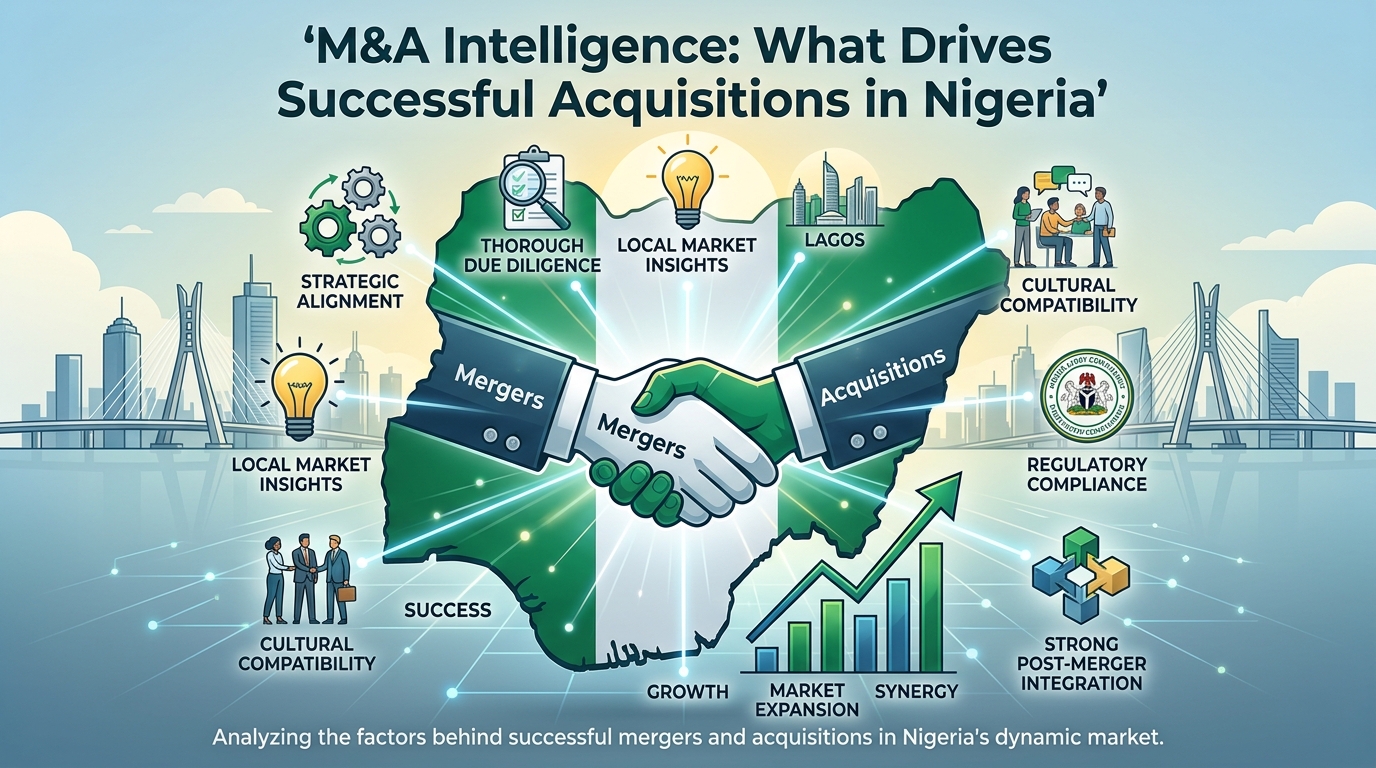
M&A Intelligence: What Drives Successful Acquisitions in Nigeria
Let me ask you a question that every strategic investor should be asking.
Is your company ready to navigate Nigeria’s booming M&A market?
Nigeria’s mergers and acquisitions landscape has grown rapidly. It is now Africa’s second-largest M&A market. Transaction values exceeded $3.8 billion in 2024, with a 198% year-over-year increase in capital importation during Q1 2024.
This surge is driven by banking recapitalization mandates, indigenous company empowerment, and sectoral diversification. The Nigerian M&A sector presents compelling opportunities for strategic investors and corporate players.
This article explores what drives successful acquisitions in Nigeria. You will learn about current market conditions, key success factors, and emerging trends.
If you need professional support, market research services can help you identify and evaluate M&A opportunities.
Understanding mergers and acquisitions: a definition
Before diving into Nigeria’s context, let us understand what mergers and acquisitions actually mean.
According to California State University Long Beach , “Mergers and Acquisitions (M&A) refers to various strategies in the business environment that enable the consolidation of companies into a single, larger entity.”
A merger typically occurs when two companies unite and merge into one, enhancing their market position and operational capabilities. An acquisition involves a company purchasing another company to expand its reach or resources.

These are not merely financial exercises but deliberate business strategies. They aim to create value, achieve synergies, and position companies for sustained competitive advantage.
The current state of Nigeria’s M&A market
Nigeria’s M&A sector has shown resilience and growth despite macroeconomic challenges.
Record-breaking transaction volumes
The first nine months of 2024 saw Nigeria record $3.8 billion in M&A transaction values. This is the highest figure on the continent outside South Africa.
This represents a dramatic increase from the $751 million recorded across 40 deals in H1 2023 to $2.89 billion across 38 deals in H1 2024. The market recorded 48 M&A transactions during the first nine months of 2024. Sixty-five mergers were notified to the FCCPC by year-end, representing the highest volume since 2014.
Sectoral distribution
While oil and gas dominated transaction values, significant activity emerged across multiple sectors.
Banking and financial services are being driven by the Central Bank of Nigeria’s recapitalization mandate. Banks must meet new capital requirements by March 31, 2026.
Technology and fintech saw notable acquisitions in digital innovation spaces, including the entertainment sector (Universal Music Holdings’ acquisition of Mavin Global Holdings).
Oil and gas featured indigenous companies increasingly acquiring assets from divesting international oil companies (IOCs).
Consumer goods saw major transactions including Tolaram’s ₦104 billion acquisition of Diageo’s 58% stake in Guinness Nigeria.
Agriculture featured strategic acquisitions such as Oak and Saffron’s takeover of Presco Plc.
Capital market performance
Nigeria’s capital markets thrived in 2024. ₦3.68 trillion was raised (₦59.8 billion in fixed income and ₦3.62 trillion in equities). ₦446 billion was filed for in early 2025, demonstrating sustained investor confidence.
Key drivers of successful acquisitions in Nigeria
Understanding what drives successful M&A transactions requires examining both macroeconomic catalysts and strategic considerations.
1. Banking sector recapitalization
The Central Bank of Nigeria’s recapitalization directive has become the most significant driver of M&A activity in the financial services sector. Banks must meet new capital requirements through fresh equity injections, excluding retained earnings or debt instruments.
This has spurred strategic mergers like the Unity Bank and Providus Bank merger (August 2024), backed by a ₦700 billion CBN facility. This represents Nigeria’s first banking sector merger in five years.
Portfolio restructuring includes FBN Holdings’ divestment of FBNQuest Merchant Bank to EverQuest Acquisition LLP for assets valued at ₦465 billion. Major banks like GTCO, Fidelity Bank, and FCMB have met requirements through share issuance.
Smaller banks face consolidation pressure. Industry analysts predict increased M&A activity as the March 2026 deadline approaches.
2. Economic diversification beyond oil
Nigeria’s strategic push to diversify beyond oil dependency has opened new avenues for M&A transactions.
Technology sector growth has seen acquisitions targeting fintech, healthtech, and agritech companies. Entertainment industry deals feature international players acquiring Nigerian entertainment assets to access Africa’s largest consumer market.
Manufacturing and consumer goods attract both domestic and international investors positioning for long-term growth in Nigeria’s 220+ million population market.
3. Indigenous company empowerment in oil and gas
A defining trend is the transfer of oil and gas assets from international oil companies to indigenous Nigerian firms.
The Renaissance Consortium’s $2.4 billion acquisition of Shell Petroleum Development Company (SPDC) is the largest single M&A deal in Nigeria in over a decade (approved December 2024).
Chappal Energies’ $860 million acquisition of TotalEnergies’ onshore assets is pending regulatory approval. Oando’s $783 million acquisition of Eni’s NAOC was recognized as “Deal of the Year.” Equinor’s $1.2 billion divestment of Agbami interests went to Chappal Energies.
This shift reflects both IOC risk mitigation strategies and the growing capability of Nigerian energy companies.
4. Regional expansion strategies
Companies are using M&A to expand geographic footprints and access new customer bases. Market extension acquisitions enable firms to enter new African markets efficiently, leverage existing distribution networks, gain local market knowledge, and achieve economies of scale.
5. Digital innovation and technology integration
The acceleration of digital adoption across sectors has made technology companies attractive M&A targets. Drivers include acquiring digital capabilities and platforms, accessing proprietary technologies, integrating fintech solutions into traditional business models, and building data analytics capabilities.
High Performance Selling (HPS) sales training programme can help your M&A integration teams align sales forces effectively.
Critical success factors for M&A in Nigeria
Beyond identifying strategic rationale, successful M&A transactions require attention to execution fundamentals.
1. Comprehensive due diligence
Due diligence remains the most critical phase for avoiding costly mistakes.
Financial due diligence includes accurate business valuations, verification of financial statements, and assessment of revenue quality and sustainability.
Legal due diligence covers title verification for assets, identification of contingent liabilities, and review of existing contracts and obligations.
Operational due diligence assesses business processes, supply chain robustness, technology systems, and human capital.
Tax due diligence evaluates tax compliance history, potential tax exposures, and optimization opportunities.
Without thorough due diligence, companies risk overpaying, inheriting hidden liabilities, or discovering incompatible business models post-transaction.
2. Regulatory navigation and compliance
Nigeria’s regulatory environment requires engagement with multiple authorities.
Key regulators include the Federal Competition and Consumer Protection Commission (FCCPC) for merger notifications, the Securities and Exchange Commission (SEC) for public company transactions, the Central Bank of Nigeria (CBN) for banking transactions, the Corporate Affairs Commission (CAC) for corporate registration, and the Federal Inland Revenue Service (FIRS) for tax clearances.
Sector-specific regulators include the Department of Petroleum Resources (DPR) for oil and gas and the Nigerian Communications Commission (NCC) for telecom.
The FCCPC has intensified scrutiny, with notable penalties (Meta Inc. fined $220 million) signaling stricter enforcement. Early engagement with legal experts and regulatory consultants significantly improves approval timelines.
Regulatory compliance and governance advisory for Nigerian businesses can help you navigate these regulatory requirements.
3. Currency risk management
Despite capital importation rising 198% YoY in Q1 2024, a sharp 51.9% drop in Q3 shows foreign exchange instability as a key risk.
Successful acquirers implement natural hedging strategies matching revenue and cost currencies. They use financial hedging instruments like forward contracts and options where available. They optimize deal structures with naira-denominated transactions where possible and earn-out provisions linked to forex-adjusted performance.
CBN guidelines compliance requires adherence to the Revised Guidelines for the Nigerian Foreign Exchange Market (November 2024). All FX transactions must go through the Electronic Foreign Exchange Matching System.
4. Post-merger integration planning
Most M&A transactions fail to deliver expected value due to poor post-merger integration.
Critical success factors include cultural integration addressing differences in organizational culture and management styles. Operational integration consolidates systems, processes, and supply chains while maintaining business continuity.
Talent retention secures key personnel through retention incentives and clear career pathways. Synergy realization tracks cost savings and revenue enhancements against initial projections.
Communication strategy provides transparent, consistent messaging to employees, customers, suppliers, and other stakeholders.
Integration planning should begin during due diligence, not after transaction closing.
5. Strategic alignment and clear objectives
The most successful acquisitions stem from clear strategic rationale.
Market position enhancement consolidates market share and competitive positioning. Capability acquisition accesses technologies, expertise, or assets unavailable through organic development.
Efficiency gains achieve economies of scale, eliminate redundancies, and optimize supply chains. Diversification reduces concentration risk through portfolio expansion.
Regulatory compliance meets recapitalization or other regulatory requirements.
Acquisitions driven purely by opportunism or ego typically underperform or destroy value.
Emerging trends shaping Nigeria’s M&A landscape
Several evolving trends will define Nigeria’s M&A market through 2025 and beyond.
1. Sustainability and ESG considerations
Environmental, Social, and Governance (ESG) factors increasingly influence M&A decisions. Companies now evaluate target companies’ environmental compliance and carbon footprint, social impact and labor practices, corporate governance standards, and alignment with sustainability commitments.
ESG due diligence has become integral to risk assessment. Poor ESG performance may signal regulatory, reputational, or operational risks.
2. ECOWAS regional competition framework
Formal constitution of the ECOWAS Regional Competition Authority (ERCA) Council in October 2024 marks a critical development. The regional merger control regime now applies to transactions involving undertakings operating in at least two ECOWAS Member States.
Implications include dual notification requirements (national and regional), longer approval timelines, harmonized competition standards across West Africa, and enhanced scrutiny of market concentration at the regional level.
3. Technology-driven due diligence and deal execution
Advanced analytics, artificial intelligence, and digital platforms are transforming M&A processes.
Data analytics for target screening uses sophisticated algorithms to identify targets with high earning potential. Virtual data rooms enable secure, efficient document sharing. AI-powered contract review automates analysis of legal documents and identifies risk factors.
Integration management platforms enable technology-enabled monitoring of integration progress and synergy realization.
4. Increased private equity activity
Private equity firms are increasingly active in Nigeria’s M&A market. They bring patient capital for long-term value creation, operational expertise, professional governance standards, and exit pathways through strategic sales or public offerings.
5. Consolidation across multiple sectors
Beyond banking, expect consolidation in insurance (potential recapitalization requirements), telecommunications (network infrastructure sharing), power and energy (restructuring in the electricity distribution sector), and healthcare (consolidation of hospital chains).
Debt collection and commercial debt recovery services can help manage payment integration during post-merger consolidation.
Navigating common M&A pitfalls in Nigeria
Understanding common failure modes helps companies structure transactions for success.
Pitfall 1: Inadequate valuation
Without rigorous valuation methodology, companies risk overpaying based on optimistic growth assumptions, failing to account for hidden liabilities, misjudging market conditions, and underestimating integration costs.
Mitigation – Employ multiple valuation methodologies (DCF, comparable transactions, market multiples). Conduct sensitivity analysis. Engage independent valuation experts.
Pitfall 2: Regulatory delays and non-compliance
Missing regulatory requirements can result in deal collapse after significant investment, regulatory fines and penalties, reputational damage, and legal disputes.
Mitigation – Engage regulatory consultants early. Maintain proactive communication with relevant authorities. Build regulatory approval timelines into deal schedules with appropriate contingencies.
Pitfall 3: Cultural incompatibility
Incompatible organizational cultures manifest as high employee turnover, internal conflict, failure to realize operational synergies, and customer dissatisfaction due to service disruption.
Mitigation – Conduct cultural due diligence. Develop comprehensive change management plans. Invest in leadership alignment. Establish clear integration governance structures.
Pitfall 4: Underestimating integration complexity
Common integration challenges include technology systems incompatibility, process standardization difficulties, customer confusion, and supplier relationship disruption.
Mitigation – Develop detailed integration plans during due diligence. Allocate sufficient resources. Appoint dedicated integration management teams. Establish clear accountability for synergy realization.
Pitfall 5: Inadequate stakeholder communication
Poor communication creates employee uncertainty, customer anxiety, supplier relationship strain, and regulatory concerns.
Mitigation – Develop comprehensive stakeholder communication strategies. Maintain transparency within confidentiality constraints. Establish feedback mechanisms. Address concerns proactively.
The role of advisory services in M&A success
Given the complexity of Nigeria’s M&A environment, specialized advisory services significantly enhance transaction success.
Strategic advisory helps with target identification, strategic rationale development, transaction structuring, and negotiation support.
Financial advisory provides valuation services, financing arrangements, financial modeling, and fairness opinions.
Legal and regulatory advisory ensures due diligence coordination, documentation, regulatory navigation, and post-closing support.
Operational integration advisory facilitates integration planning, change management, synergy realization, and cultural integration.
Tax advisory and tax consulting services can help optimize transaction structures and ensure tax compliance.
2025 outlook: what to expect
Several factors will shape Nigeria’s M&A market in 2025 and beyond.
Continued banking sector activity – As the March 2026 recapitalization deadline approaches, expect additional bank mergers among smaller institutions, strategic capital raises, potential entry of international banking groups, and increased M&A advisory activity.
Oil and gas sector transformation – The trend of IOC divestment and indigenous acquisition will continue with completion of pending megadeals, additional IOC asset sales, indigenous company consolidation, and increased investment in marginal field development.
Technology sector consolidation – Nigeria’s tech ecosystem will see international acquirers targeting fintech and tech startups, regional expansion through acquisitions, strategic partnerships between traditional companies and tech firms, and private equity-backed growth.
Regulatory evolution – Expect enhanced FCCPC scrutiny and enforcement, potential sectoral recapitalization requirements (insurance, others), ECOWAS regional competition framework operationalization, and refinement of foreign exchange regulations.
Conclusion: seizing Nigeria’s M&A opportunity
Nigeria’s M&A market presents opportunities for strategic and financial investors who approach transactions with appropriate diligence, expertise, and patience.
Success requires strategic clarity (clear rationale for why acquisition creates value), rigorous execution (comprehensive due diligence and professional advisory support), regulatory sophistication (proactive engagement with Nigeria’s regulatory environment), integration excellence (detailed planning and disciplined execution), and cultural sensitivity (recognition of organizational and stakeholder dynamics).
The companies and investors who master these elements will be best positioned to capitalize on Nigeria’s M&A momentum, building market-leading positions and delivering sustainable value.
Recommended reading from our blog
If you want to strengthen your M&A strategy and execution capabilities, these related articles will help.
Building a Risk-Aware Culture in Your Organization – Managing M&A risks starts with organizational culture.
Board Evaluation: Why It Matters for Nigerian Businesses – Stronger oversight leads to better M&A decisions.
Recommended services
Ready to navigate Nigeria’s M&A market? These services are designed to help.
Market research services – Identify and evaluate M&A targets.
Due diligence and background verification – Thorough target assessment and risk evaluation.
Contract documentation and review support – Ensure your transaction agreements are sound.
Reference Links
The following authoritative sources were cited in this article:
-
California State University Long Beach – Mergers and Acquisitions 101 (2025)
-
Business Cardinal – Research-based sales training, sales coaching and sales consulting firm in Lagos, Nigeria
Where to go from here
Nigeria’s M&A market presents opportunities for strategic and financial investors who approach transactions with appropriate diligence, expertise, and patience.
Whether you are a corporate executive planning an acquisition, a private equity firm evaluating targets, or a business owner considering exit options, understanding the drivers of success is essential.
At Business Cardinal, we provide M&A intelligence and advisory services, offering support across the entire transaction lifecycle. Our team combines sector expertise, regulatory knowledge, and proven methodologies to help clients achieve their strategic objectives.
Contact us today to discuss how we can help you succeed in Nigeria’s M&A market.
📧 Email: hello@businesscardinal.com
📞 Phone: +234 802 320 0801
📍 Address: 5, Ishola Bello Close, Off Iyalla Street, Alausa, Ikeja, Lagos, Nigeria
Related Post

Sector Prioritization Frameworks: How to Identify High-Return Industries in Nigeria
Print 🖨 PDF 📄 eBook 📱Sector Prioritization Frameworks: How to Identify High-Return Industries in Nigeria…

Board Evaluation
Print 🖨 PDF 📄 eBook 📱CONDUCTING BOARD EVALUATION Board Evaluation refers to the method(s), processes…
Streamlining Year-End Audits for a Medium-sized Business in Nigeria
Print 🖨 PDF 📄 eBook 📱Streamlining Year-End Audits for a Medium-sized Business in Nigeria Get…

There are no comments