


How Fintech Is Expanding Access to Investment Opportunities in Nigeria
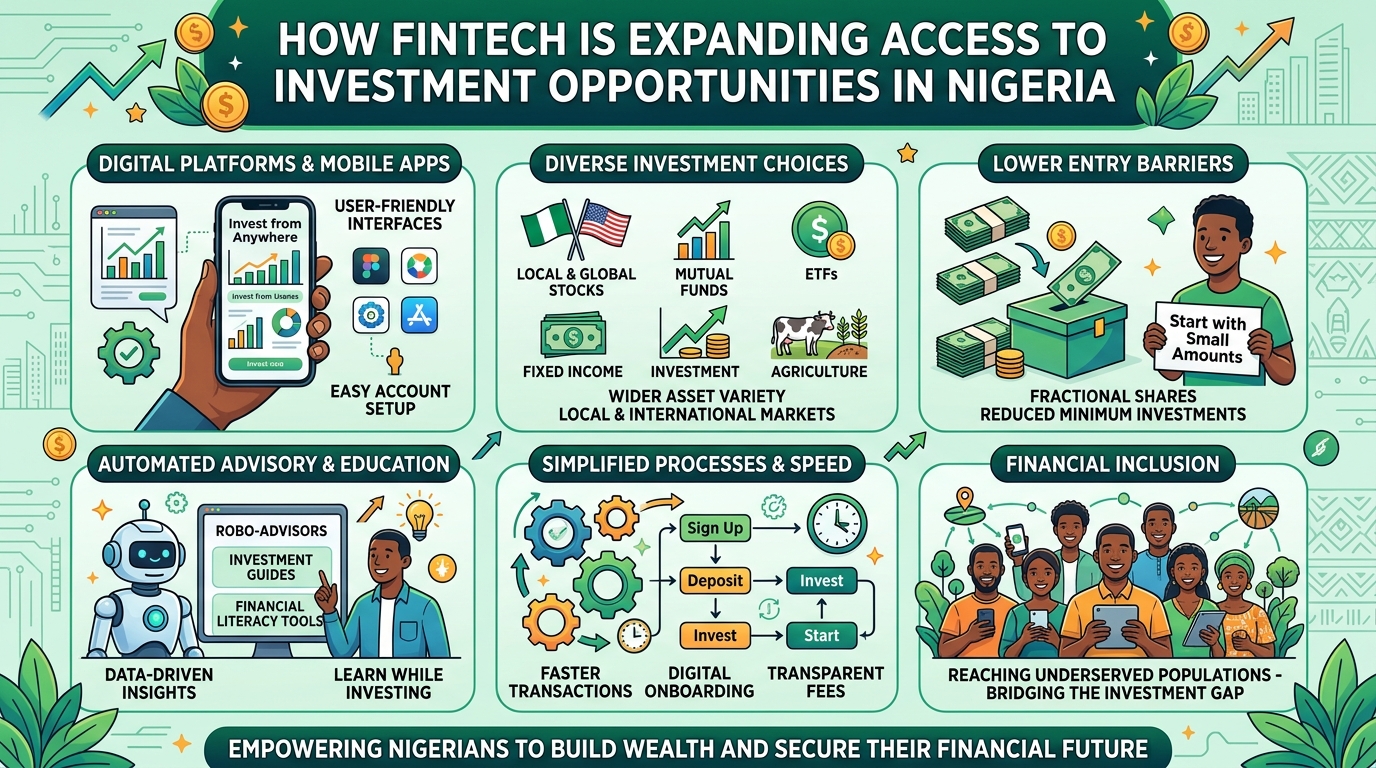
How Fintech Is Expanding Access to Investment Opportunities in Nigeria
Let me ask you a question that affects millions of Nigerians.
Can the average person on the street access wealth-building investment opportunities?
Just a few years ago, the answer was mostly no. Traditional investments required large sums of money, complex processes, and connections that most people simply did not have.
Today, the answer is changing rapidly. Nigeria’s financial landscape is transforming. Financial technology is leading this change. Investment platforms are revolutionizing how ordinary citizens access wealth-building opportunities.
From micro-savings apps to global stock trading platforms, fintech is breaking down traditional barriers. Millions of Nigerians who were previously excluded from formal financial markets can now invest.
This report examines how fintech innovations are expanding investment opportunities across Nigeria. You will learn about the key players driving this transformation, emerging trends in 2025, and the challenges that remain.
If you need professional support, market research services can help you understand fintech trends and investment opportunities.
Understanding fintech: a foundation
Before exploring Nigeria’s fintech revolution, let us understand what fintech actually means.
According to the Corporate Finance Institute , fintech is a combination of the words “finance” and “technology.” It refers to the integration of technology into financial services to enhance efficiency, accessibility, and user experience.
This broad term encompasses mobile banking, digital payment systems, online lending platforms, investment applications, and blockchain-based solutions.
The concept has evolved significantly over the past decade. Originally, the term applied to technology used in the back-end operations of established financial institutions. It has since expanded to include any technological innovation in the financial sector, including innovations in financial literacy, retail banking, investment, and cryptocurrencies.

The Nigerian fintech ecosystem: current state and growth
Nigeria’s fintech sector has experienced extraordinary growth. The country has positioned itself as Africa’s undisputed fintech leader.
Market size and growth trajectory
By February 2025, Nigeria had over 430 fintech companies. This is a sharp increase from 255 companies in January 2024. This explosive growth reflects both investor confidence and market demand.
A McKinsey report projects that Africa’s financial services market could reach around $230 billion in revenues by 2025. Nigeria’s fintech sector comprises about one-third of Africa’s fintech market.
In 2024 alone, Nigeria recorded over 108 billion mobile money transactions. This amounted to an impressive $1.68 trillion.
Regional dominance and investment activity
According to Tracxn , Nigeria remained the most active hub for fintech deals in Africa. It accounted for 47% of all fintech transactions on the continent.
Lagos has produced 3 unicorns in the fintech sector. As of August 2025, 213 companies have received funding in this sector. Total funding has exceeded $2.56 billion over the last 10 years.
The year 2021 marked a peak period for Nigerian fintech. More than $861 million was raised, the highest amount in any single year over the past decade.
How fintech is expanding investment access
The traditional Nigerian investment landscape had high entry barriers. Complex processes and limited accessibility kept the average citizen out. Fintech has fundamentally changed this through several approaches.
Lowering entry barriers
One of fintech’s most significant contributions has been reducing the minimum capital required to start investing. Traditional investment vehicles often required substantial initial deposits. This effectively excluded millions of potential investors.
Platforms like Cowrywise allow users to invest in mutual funds, treasury bills, and other low-risk assets with minimal capital. Bamboo provides access to U.S. stocks and exchange-traded funds (ETFs) with low entry requirements through a simple app interface. Everyday Nigerians can now invest in companies like Apple, Tesla, and Amazon.
Simplified investment processes
Investech startups are leveraging technology to allow Nigerians to grow their funds through various opportunities. These range from real estate to agriculture and the money market.
Chaka facilitates Nigerians’ access to global investment opportunities. Users can buy and sell stocks of international companies from the comfort of their homes. User-friendly interfaces and educational resources make it ideal for exploring global markets.
Automated savings and goal-based investing
Savings-focused platforms have introduced automated features that help users build investment capital over time. PiggyVest offers a range of financial tools including automated savings, fixed savings, target-based savings, Flex Naira/Dollar accounts, and group savings for rent and household expenses.
In January 2025, PiggyVest hit a major milestone. It reached NGN 2 trillion (US1.25billion)intotalpayoutstouserssinceinception.NGN835billion(US547.3 million) was paid out in 2024 alone.
Leading investment-focused fintech companies in Nigeria
Several companies have emerged as market leaders in expanding investment access for Nigerian citizens.
PiggyVest: building a savings culture
Originally launched as Piggybank.ng in 2016, PiggyVest rebranded in April 2019 to offer direct investment opportunities to users in addition to savings. With features like “Safelock” and “Target Savings,” PiggyVest has encouraged millions of Nigerians to save consistently and build wealth. The platform now claims 5 million users.
Cowrywise: making mutual funds accessible
Cowrywise is transforming how people invest by allowing users to invest in mutual funds, treasury bills, and other low-risk assets with minimal capital. The platform partners with licensed fund managers. Its emphasis on financial education has made it particularly popular among young Nigerians.
Bamboo and Chaka: global market access
These platforms have opened international markets to Nigerian investors who previously had no practical way to invest abroad. Bamboo’s simple app interface enables everyday Nigerians to invest in U.S. stocks and ETFs. Chaka allows users to access stocks listed on international exchanges, diversifying their investment portfolios.
Moniepoint: business financial services
While primarily focused on business banking, Moniepoint has become one of the biggest names in African fintech. It made TIME’s 100 Most Influential Companies list and achieved unicorn status in late 2024 after raising over 120millioninSeriesCfunding,includinga10 million investment from Visa.
The platform serves over 10 million users. It processes over 1 billion transactions monthly and processed over $100 billion in payments in 2024.
Trends and recent developments
The Nigerian fintech landscape continues to evolve rapidly in 2025.
Cryptocurrency and Web3 expansion
In 2025, cryptocurrency and Web3.0 are expected to flourish. Nigeria already leads Africa in digital currency adoption. The relaxation of cryptocurrency transaction restrictions is set to further solidify growth. This regulatory evolution is creating new investment avenues for tech-savvy Nigerians.
International expansion and partnerships
Nigerian fintech companies are increasingly looking beyond domestic borders. Moniepoint recently secured US$110 million in funding from investors including Google and Visa. The company has announced plans to expand into East Africa.
In January 2025, Moniepoint secured an additional investment from Visa to accelerate its growth across the continent. In 2025, Moniepoint received approval to acquire a majority stake in Kenya’s Sumac Bank and launched MonieWorld for international remittances.
Embedded finance growth
According to Globe Newswire , Africa’s embedded finance market experienced robust growth during 2021-2025. It achieved a CAGR of 15.7% and is expected to continue growing at a CAGR of 8.1% from 2026 to 2030.
Fintech-focused investment in Nigeria has intensified competitive pressures. Insurtechs and B2B credit enablers are embedding working capital tools across retail networks.
Digital lending and BNPL services
Digital lending applications and Buy Now, Pay Later (BNPL) services have proliferated in Nigeria. Their ability to provide quicker loans through a simplified lending process gives them a competitive advantage over traditional lending.
Fastest growing companies
The Financial Times’ 2025 list of Africa’s Fastest-Growth Companies highlighted three Nigerian fintech companies. Moniepoint, PalmPay, and Paga recorded the most significant revenue growth between 2020 and 2023. They showed resilience in navigating currency fluctuations, inflation, and a more cautious investment landscape.
Impact on financial inclusion
The transformation driven by fintech extends far beyond convenience. It represents a fundamental shift in financial inclusion across Nigeria.
Reaching the unbanked population
About half of Nigeria’s adults remain unbanked or underserved. This is primarily due to the limitations of traditional banking infrastructure, especially in rural and underserved areas where physical bank branches are scarce.
Fintech platforms have begun bridging this gap by offering mobile-first solutions that do not require physical branch visits. Through mobile banking, digital payments, and other innovations, fintech is extending financial services to previously underserved communities.
Increasing transaction volumes
The sheer volume of digital financial activity demonstrates widespread adoption. Nigeria recorded over 108 billion mobile money transactions in 2024. This clearly reflects its thriving financial ecosystem.
Profitability and sustainability
As platforms mature, they are demonstrating sustainable business models. Kuda processed over 300 million transactions worth ₦14.3 trillion in Q1 2025. It issued ₦16.4 billion in overdrafts profitably and successfully relaunched its remittance service targeting users outside Nigeria.
Challenges and regulatory environment
Despite remarkable progress, Nigeria’s fintech sector faces several significant challenges.
Regulatory hurdles and compliance
According to Chambers and Partners , the Central Bank of Nigeria (CBN) played a central role in regulating the fintech industry in 2024. It implemented notable actions including temporarily banning key fintech players from onboarding new customers in April due to alleged foreign exchange violations.
If a fintech service provider offers misleading information that leads customers to make poor financial decisions, the company may be held liable. One significant obstacle lies in regulatory requirements, particularly around anti-money laundering (AML) and counter-terrorism financing (CTF) laws.
Infrastructure challenges
Gaps in digital and physical infrastructure limit the potential of fintech solutions to scale. Regulatory inconsistencies can delay the timely licensing of innovative solutions. Reliable internet infrastructure and services are essential for fintech products.
Economic pressures
Macroeconomic pressures like rising living expenses and a sluggish economy might dampen both investment inflows and consumer adoption of fintech services.
Cybersecurity and consumer protection
If a fintech platform negligently fails to secure customers’ funds or personal data, leading to fraud or theft, it would be responsible for those losses. This includes failure to implement robust cybersecurity measures.
Regulatory compliance and governance advisory for Nigerian businesses can help fintech companies navigate these complex requirements.
The role of foreign investment
International capital and expertise have been crucial accelerators for Nigeria’s fintech ecosystem.
Strategic investments
Foreign investors provide startups with capital, knowledge, technologies, and associations they need to grow rapidly. The involvement of international parties makes regulatory authorities provide more conducive conditions.
Major international investors have taken significant stakes in Nigerian fintechs. Moniepoint secured funding from prominent investors including Google and Visa.
Notable acquisitions
Stripe’s acquisition of Paystack for over $200 million stands as one of the hallmark deals in Nigerian fintech. Paystack became one of Africa’s most important players in the online payments ecosystem. This acquisition attests to Nigeria’s ability to create globally competitive startups.
Cross-border partnerships
Fintech companies are collaborating with traditional banks to tailor services to evolving consumer needs. They are pairing traditional banking products with innovative tech solutions such as lending platforms, virtual investment advisors, digital insurance products, and digital remittance solutions.

Future outlook and opportunities
Looking ahead, Nigeria’s investment fintech sector presents numerous opportunities for continued growth.
Untapped market potential
According to the World Bank , over 36 percent of Nigerians do not have a bank account. This means there is significant possibility for further growth in fintech services, especially for clients in rural areas.
Emerging investment verticals
Investment opportunities range from real estate to agriculture and the money market. Fintech companies are focusing on deploying solutions to improve and expand investment and wealth management.
Technology integration
AI integration and embedded finance are expected to expand. These growth areas are positioned to transform how Nigerians interact with investment platforms.
Ecosystem collaboration
More collaboration between fintechs, traditional banks, and telecom providers will unlock broader opportunities for the sector. Competition is emerging between telcos, fintechs, banks, and B2B enablers vying for control of distribution layers.
Education and user adoption
Unlocking untapped potential requires time, investment, regulatory support, and increased focus on user education to drive adoption.
High Performance Selling (HPS) sales training programme can help fintech companies educate users and drive adoption of investment products.
Conclusion
Nigeria’s fintech revolution has fundamentally transformed investment accessibility. Wealth-building opportunities now reach millions who were previously excluded from formal financial markets.
Through innovative platforms that lower entry barriers, simplify investment processes, and provide access to both local and global markets, fintech companies have changed finance in ways that traditional institutions never achieved.
The sector’s growth trajectory remains strong despite challenges. With over 430 fintech companies operating as of early 2025, billions in processed transactions, and continued international investment, Nigeria’s position as Africa’s fintech leader appears secure.
However, realizing the full potential of fintech-enabled investment access requires addressing persistent challenges around infrastructure, regulation, financial literacy, and cybersecurity. Success will depend on continued collaboration among fintech innovators, regulatory authorities, traditional financial institutions, and technology providers.
For ordinary Nigerians, the fintech revolution means investment opportunities that were once the preserve of the wealthy are now accessible through mobile phones. Millions of citizens are now active participants in wealth creation.
Recommended reading from our blog
If you want to strengthen your understanding of fintech and investment trends, these related articles will help.
Building a Risk-Aware Culture in Your Organization – Managing fintech risks starts with organizational culture.
Board Evaluation: Why It Matters for Nigerian Businesses – Stronger oversight leads to better fintech governance.
Recommended services
Ready to navigate Nigeria’s fintech investment landscape? These services are designed to help.
Market research services – Understand fintech trends and investment opportunities.
Due diligence and background verification – Assess potential fintech partners and platforms.
Contract documentation and review support – Ensure your fintech agreements and terms are sound.
Reference Links
The following authoritative sources were cited in this article:
-
Corporate Finance Institute – What is Fintech? Overview of the Financial Technology Industry (2025)
-
Chambers and Partners – Fintech 2025 – Nigeria Global Practice Guides
-
Fintech News Africa – Nigeria’s Three Fastest Growing Fintechs in 2025
-
Fintech News Africa – Top Fintechs in Nigeria
-
Globe Newswire – Africa Embedded Finance Business Report 2025-2030
-
Matthew Ogagavworia & Co – The future of fintech in Nigeria and investment opportunities for foreign investors
-
Tech In Africa – Nigeria Fintech Funding Trends 2025
-
TechCabal – The biggest fintech companies in Nigeria (2025)
-
Tracxn – FinTech in Lagos, Nigeria – 2025 Market & Investments Trends
-
TransferXO – Top 50 Fintech Companies In Nigeria In 2025
-
World Bank – How Nigeria can leverage the rise of fintech for economic progress
-
Business Cardinal – Research-based sales training, sales coaching and sales consulting firm in Lagos, Nigeria
Where to go from here
Nigeria’s fintech revolution has fundamentally transformed investment accessibility. Wealth-building opportunities now reach millions who were previously excluded from formal financial markets.
At Business Cardinal, we provide comprehensive analysis of emerging markets, technology trends, and economic development across Africa. Our reports combine rigorous data analysis with practical insights to help businesses, investors, and policymakers make informed decisions.
Contact us today to discuss how we can help you navigate Nigeria’s fintech investment landscape.
📧 Email: hello@businesscardinal.com
📞 Phone: +234 802 320 0801
📍 Address: 5, Ishola Bello Close, Off Iyalla Street, Alausa, Ikeja, Lagos, Nigeria
Related Post

The Creator Economy in Nigeria: Economic Value and Growth Outlook
Print 🖨 PDF 📄 eBook 📱The Creator Economy in Nigeria: Economic Value and Growth Outlook…

Land Use, Property Rights & Investment Risk: The Untold Issues
Print 🖨 PDF 📄 eBook 📱Land Use, Property Rights & Investment Risk: The Untold Issues…
Health & Safety Compliance Checklist for Businesses in Nigeria
Print 🖨 PDF 📄 eBook 📱Health & Safety Compliance Checklist for Businesses in Nigeria Get…

There are no comments