


The Role of Data Analytics in Predicting Market Entry Success
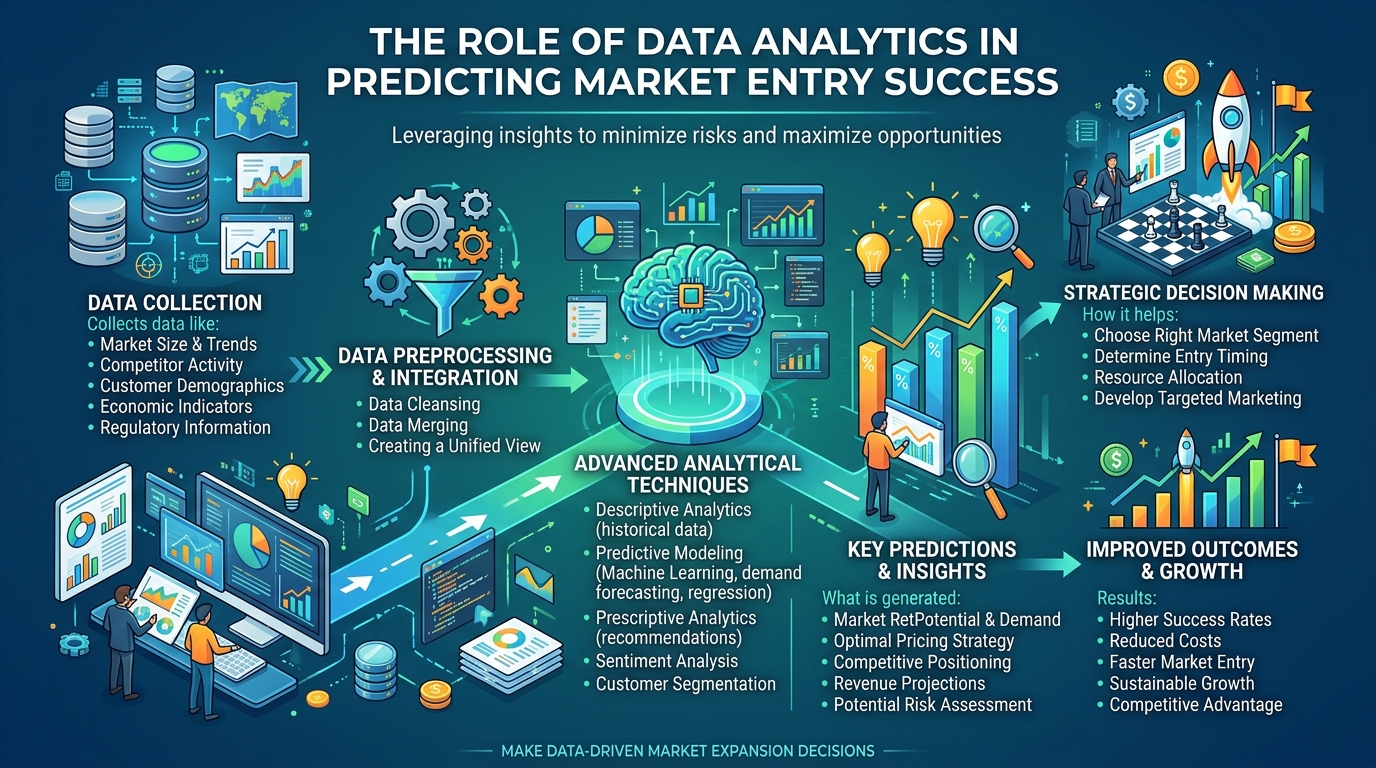
The Role of Data Analytics in Predicting Market Entry Success
Let me ask you a question that keeps many business leaders awake at night.
Is your next market entry an educated guess or a data-driven decision?
Entering a new market represents both an exciting opportunity and a significant risk. Companies invest substantial resources, financial, human, and temporal, when expanding into unfamiliar territories.
The difference between success and failure often hinges on the quality of insights that inform strategic decisions. Data analytics transforms market entry from educated guesswork into data-driven strategic planning.
As businesses navigate increasingly complex global markets in 2025, the ability to harness data analytics has become not just advantageous but essential.
This article explores how organizations can leverage sophisticated analytical tools and methodologies to predict market entry success, minimize risks, and maximize returns on investment.
If you need professional support, market research services can help you leverage data analytics for better market entry decisions.
What is data analytics?
Before we go further, let us establish a clear understanding of what data analytics actually means.
According to IBM Cloud Education , data analytics is “the process of examining, cleaning, transforming, and modeling data to discover useful information, draw conclusions, and support decision-making.”
It encompasses a range of techniques from basic statistical analysis to advanced machine learning algorithms. All of these methods aim to extract actionable insights from raw data.
In simple terms, data analytics turns raw numbers into strategic wisdom.

Understanding market entry challenges
Market entry decisions are inherently complex. They involve multiple stakeholders and countless variables that can influence outcomes.
Traditional market entry strategies often relied on intuition, limited market surveys, and historical precedents. However, this approach leaves businesses vulnerable to several critical challenges.
Information asymmetry is a major issue. New entrants typically possess less market knowledge than established competitors.
Resource allocation uncertainty creates problems. Without clear insights, companies struggle to determine optimal investment levels.
Cultural and regulatory unknowns can derail even well-planned strategies. Local market nuances are often hidden to outsiders.
Competitive landscape dynamics are tricky to predict. Underestimating competitor responses can lead to costly miscalculations.
Consumer behavior complexity adds another layer of difficulty. Preferences vary significantly across demographics and geographies.
These challenges explain why data analytics has become indispensable for modern market entry planning.
How data analytics transforms market entry strategy
Data analytics fundamentally reshapes how organizations approach new markets by replacing assumptions with evidence.
Predictive modeling
Advanced analytics enable companies to build sophisticated predictive models that forecast market performance based on multiple variables. These models analyze historical data from similar markets, economic indicators, demographic trends, and competitive behaviors to generate probability-based success scenarios.
Real-time market intelligence
Modern analytics platforms provide continuous monitoring of market conditions. They allow companies to track changes in consumer sentiment, regulatory environments, and competitive activities. This real-time intelligence enables agile strategy adjustments before full market commitment.
Customer segmentation and targeting
Data analytics reveals granular customer segments within target markets. It identifies which groups are most likely to adopt new products or services. This precision targeting optimizes marketing spend and accelerates market penetration.
Risk assessment and mitigation
By quantifying various risk factors from political instability to currency fluctuations, analytics helps organizations develop comprehensive risk mitigation strategies and contingency plans.
Key data sources for market entry analysis
The quality of market entry predictions depends heavily on the diversity and reliability of data sources utilized. Successful market entry analytics draws from multiple data streams.
Primary data sources
Consumer surveys and focus groups provide direct feedback from potential customers in target markets.
Pilot programs and test markets generate real-world performance data through small-scale launches.
Proprietary sales data offers historical performance metrics from similar products or markets.
Secondary data sources
Government statistical agencies provide economic indicators, demographic data, and trade statistics.
Industry reports and market research offer third-party analyses providing market size and trend insights.
Social media and digital footprints reveal consumer sentiment, behavior patterns, and emerging trends.
Competitor financial filings expose competitor strategies and performance through public information.
Emerging data sources (2025 update)
AI-powered web scraping enables automated collection of pricing, product, and review data from digital channels.
IoT and connected device data provides real-time usage patterns and consumer behavior insights.
Blockchain transaction data offers transparent supply chain and payment flow information in certain markets.
Satellite and geospatial data reveals physical infrastructure development and economic activity indicators.
Essential analytical techniques for market entry
Different analytical approaches serve distinct purposes in market entry planning. Savvy organizations employ a combination of techniques.
Descriptive analytics
This approach focuses on understanding what has happened in similar markets through statistical summaries, data visualization, and trend analysis. This foundation informs baseline expectations.
Diagnostic analytics
This technique investigates why certain market entries succeeded or failed by examining correlations, causal relationships, and contributing factors. These insights prevent repeating past mistakes.
Predictive analytics
This forward-looking analysis forecasts future market performance using regression models, machine learning algorithms, and scenario planning. It guides resource allocation decisions.
Prescriptive analytics
This highest level of analytics recommends specific actions based on predictive insights, optimization algorithms, and simulation models. It directly informs strategy execution.
2025 advanced techniques
Generative AI for scenario planning uses large language models to create detailed market entry scenarios based on vast data synthesis.
Natural language processing (NLP) analyzes consumer reviews, social media, and news in local languages for sentiment and trend detection.
Graph analytics maps relationship networks between consumers, influencers, and distribution channels.
Causal AI moves beyond correlation to understand true cause-and-effect relationships in market dynamics.
High Performance Selling (HPS) sales training programme can help your sales teams leverage these analytical insights for better market entry execution.
Building a data-driven market entry framework
Implementing data analytics for market entry success requires a structured, systematic approach rather than ad-hoc analysis.
Step 1: Define clear objectives
Establish specific, measurable goals for market entry, such as target market share, revenue projections, or customer acquisition targets. These objectives guide the entire analytical process.
Step 2: Assemble the right team
Combine domain expertise (market knowledge, industry experience) with technical capabilities (data scientists, analysts). This ensures both analytical rigor and practical applicability.
Step 3: Develop data infrastructure
Invest in appropriate technology platforms that can collect, store, process, and visualize relevant data. Cloud-based solutions offer scalability and accessibility for distributed teams.
Step 4: Create analytical models
Build customized models that reflect your specific market entry context. Incorporate relevant variables and test assumptions against historical data.
Step 5: Validate and iterate
Test predictions against real-world outcomes. Refine models based on performance. Continuously improve analytical accuracy through feedback loops.
Step 6: Integrate insights into decision-making
Ensure analytical findings directly inform strategic discussions and operational plans. Do not let them remain isolated reports.
Case applications and industry examples
Real-world applications demonstrate the tangible value of data analytics in market entry success.
Retail and e-commerce
Companies analyze consumer purchasing patterns, logistics infrastructure, and local competition to optimize store locations and product assortments. Data analytics has enabled major retailers to successfully enter emerging markets by identifying underserved customer segments and ideal entry timing.
Technology and software
Tech companies leverage usage data, app store analytics, and digital infrastructure assessments to tailor products for local markets. Analytics reveals which features resonate with different cultural contexts and guides localization priorities.
Financial services
Banks and fintech firms use credit behavior data, regulatory analytics, and digital adoption metrics to design appropriate products and assess market readiness for new financial services.
Pharmaceuticals and healthcare
Pharmaceutical companies analyze disease prevalence data, healthcare infrastructure, regulatory pathways, and reimbursement landscapes to prioritize market entry and clinical development strategies.
2025 emerging trend: sustainability analytics
Companies now incorporate environmental, social, and governance (ESG) data into market entry decisions. Sustainability considerations increasingly influence regulatory approval, consumer acceptance, and long-term viability in many markets.
Tax advisory and tax consulting services can help you understand the tax implications of market entry strategies across different jurisdictions.

Overcoming common challenges
While data analytics offers tremendous advantages, organizations must navigate several implementation challenges.
Data quality and availability
Not all markets offer equally robust data infrastructure. Companies entering emerging markets may face data gaps, reliability issues, or accessibility challenges.
Solutions include partnering with local research firms, conducting proprietary primary research, and using proxy indicators from comparable markets.
Analytical skill gaps
Many organizations lack sufficient in-house expertise to conduct sophisticated analytics. Addressing this requires strategic hiring, partnerships with specialized consultancies, or investment in training programs.
Integration with existing decision processes
Analytics initiatives sometimes operate in silos, disconnected from actual strategy development. Success requires embedding data scientists within strategy teams and fostering data literacy across the organization.
Balancing speed and accuracy
Market opportunities sometimes demand rapid decisions, creating tension with thorough analytical processes. Organizations must develop rapid assessment frameworks for time-sensitive situations while maintaining analytical rigor for major commitments.
Ethical and privacy considerations
Data collection and analysis must respect privacy regulations, cultural norms, and ethical standards. This is particularly important when entering markets with different legal frameworks or consumer expectations regarding data usage.
Regulatory compliance and governance advisory for Nigerian businesses can help you navigate data privacy and ethical requirements in new markets.
The future of market entry analytics (2025 and beyond)
The field of market entry analytics continues evolving rapidly, with several trends shaping its future trajectory.
Artificial intelligence integration
AI and machine learning are moving from specialized applications to core components of market entry analysis. Generative AI models can now synthesize vast amounts of market intelligence, identify non-obvious patterns, and even simulate consumer responses to new products.
Real-time adaptive strategies
Rather than static entry plans, companies are developing dynamic strategies that adjust automatically based on real-time market feedback and changing conditions. This agility reduces risk and accelerates learning.
Democratization of analytics
User-friendly analytics platforms are making sophisticated techniques accessible to smaller companies and non-technical users. This levels the playing field and enables more evidence-based market entry decisions across organizations of all sizes.
Cross-market learning networks
Organizations are building knowledge repositories that capture learnings across multiple market entries. This enables pattern recognition and best practice transfer that continuously improves prediction accuracy.
Quantum computing potential
While still emerging, quantum computing promises to revolutionize market entry analytics. It will solve complex optimization problems and process massive datasets at unprecedented speeds, enabling even more accurate predictions.
Conclusion
Data analytics has fundamentally transformed market entry from an intuition-based gamble to a calculated, evidence-driven strategic initiative. By leveraging diverse data sources, employing sophisticated analytical techniques, and building robust decision frameworks, organizations can significantly improve their market entry success rates while minimizing costly failures.
As we progress through 2025, the competitive advantage increasingly belongs to companies that not only collect data but transform it into actionable intelligence. Market entry success now depends on an organization’s ability to ask the right questions, access relevant data, apply appropriate analytical methods, and translate insights into effective strategies.
For businesses considering new market opportunities, the message is clear. Data analytics is no longer optional. It is essential. The companies that master this capability will be best positioned to identify, evaluate, and capitalize on growth opportunities in an increasingly complex global marketplace.
Recommended reading from our blog
If you want to strengthen your data analytics and market entry capabilities, these related articles will help.
Building a Risk-Aware Culture in Your Organization – Data-driven decision-making starts with organizational culture.
Board Evaluation: Why It Matters for Nigerian Businesses – Stronger oversight leads to better strategic analytics.
Recommended services
Ready to leverage data analytics for your market entry strategy? These services are designed to help.
Market research services – Data-driven consumer insights and market analysis.
Due diligence and background verification – Thorough market and competitor assessment.
Contract documentation and review support – Ensure your market entry agreements are sound.
Reference Links
The following authoritative sources were cited in this article:
-
IBM Cloud Education – What is Data Analytics? (2021)
-
Business Cardinal – Research-based sales training, sales coaching and sales consulting firm in Lagos, Nigeria
Where to go from here
Data analytics has fundamentally transformed market entry from an intuition-based gamble to a calculated, evidence-driven strategic initiative.
At Business Cardinal, we specialize in helping organizations harness the power of data analytics for strategic market decisions. Whether you are exploring your first expansion or optimizing your multi-market portfolio, our team combines deep analytical expertise with practical market knowledge to guide your success.
Contact us today to discuss how we can help you leverage data analytics for your market entry strategy.
📧 Email: hello@businesscardinal.com
📞 Phone: +234 802 320 0801
📍 Address: 5, Ishola Bello Close, Off Iyalla Street, Alausa, Ikeja, Lagos, Nigeria
Related Post
Starting a Ceramics Manufacturing Business in Nigeria
Print 🖨 PDF 📄 eBook 📱Starting a Ceramics Manufacturing Business in Nigeria Get Started Call-to-action…

Sector Prioritization Frameworks: How to Identify High-Return Industries in Nigeria
Print 🖨 PDF 📄 eBook 📱Sector Prioritization Frameworks: How to Identify High-Return Industries in Nigeria…

The Role of Company Secretaries in Governance: Strategic Insights for Nigerian Businesses
Print 🖨 PDF 📄 eBook 📱The Role of Company Secretaries in Governance: Strategic Insights for…

There are no comments