


Using CRM Systems to Improve Customer Retention in Nigeria
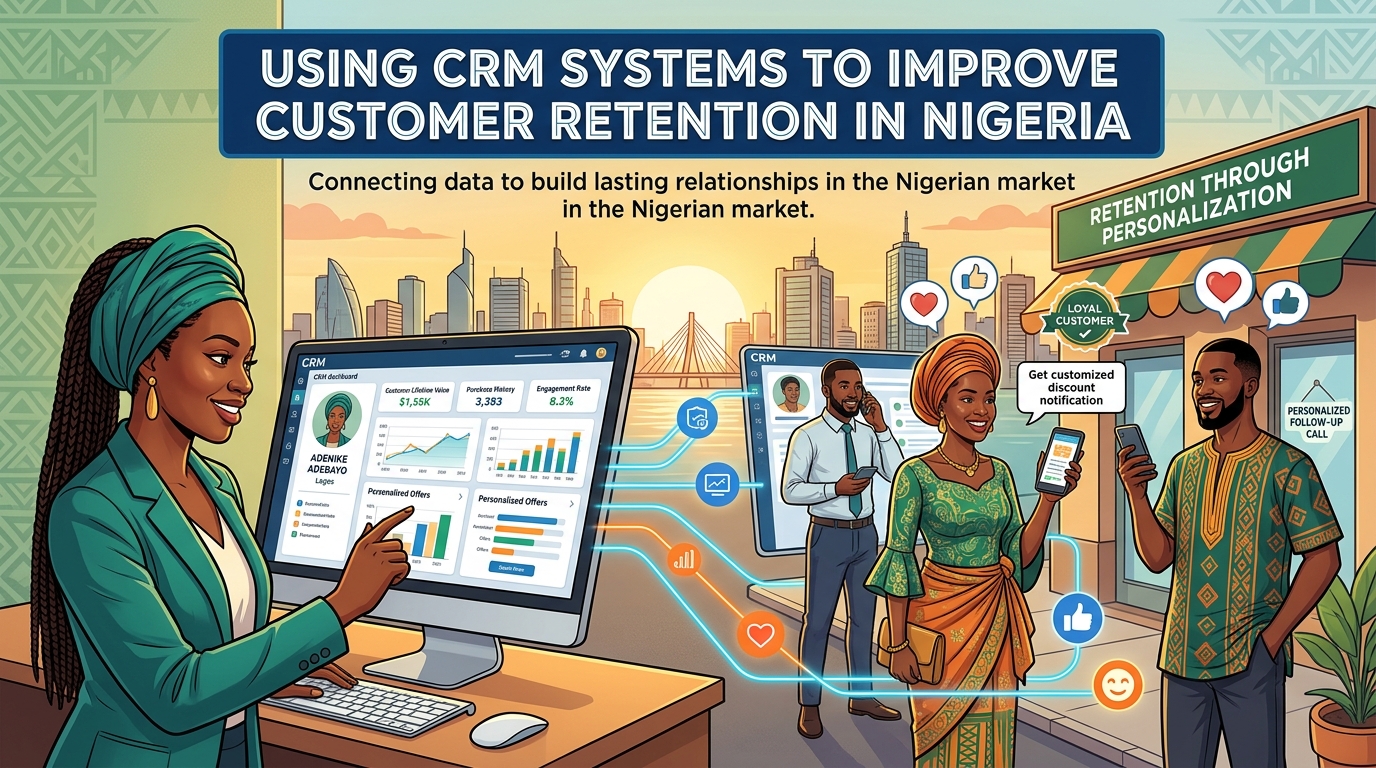
Using CRM Systems to Improve Customer Retention in Nigeria
Let me ask you something that troubles many business owners.
How much money do you spend to bring in a new customer versus keeping someone who already buys from you?
Most companies pour resources into advertising and promotions to attract fresh faces. But once a sale is made, the follow-up stops. No check-ins. No tailored offers. No real reason for the customer to return.
Here is the hard truth. Finding new customers costs more than ever. Rivals are everywhere. And your buyers have endless options.
The businesses that win in Nigeria’s competitive market are not necessarily the ones with the flashiest products. They are the ones that make people want to come back again and again.
This is where Customer Relationship Management (CRM) software becomes vital. It helps you organise customer information, send timely messages, personalise interactions, and build lasting loyalty.
If you need expert guidance, our CRM strategy and implementation advisory for Nigerian businesses can help you get on the right track.
What is CRM and why should you care?
Before we look at how CRM boosts retention, let us clarify what it actually means.
According to Salesforce, Customer Relationship Management (CRM) is “a technology for managing all your company’s relationships and interactions with customers and potential customers, with the goal of improving business relationships, assisting in customer retention, and driving sales growth.”
CRM is not just a piece of software. It is a way of doing business that puts the customer at the centre of everything. Technology supports this mindset, but the mindset itself drives success.
In everyday terms, a CRM system lets you:
-
See the full picture of each customer
-
Track every conversation across different channels
-
Spot patterns in buying behaviour
-
Send relevant messages to large groups automatically
-
Measure what is working and what is not
For Nigerian businesses, this capability solves a huge problem: the inability to truly know and respond to what customers need.

Why keeping customers is so hard in Nigeria
To understand why CRM matters, you must first grasp the real difficulties Nigerian companies face in holding onto their customers.
The cost of finding new buyers keeps climbing.
Running ads on social media, paying influencers, and bidding on search keywords all cost serious money. Without a plan to keep customers, you end up spending endlessly just to stay in the same place.
Loyalty is fragile and switching is easy.
Nigerian shoppers are savvy. They chase value, ease, and price. That means they jump from one brand to another without much thought. In sectors like banking and telecoms, moving to a competitor takes almost no effort.
Customer information is scattered everywhere.
Many businesses keep client details in spreadsheets, paper files, WhatsApp chats, and email threads. This mess makes it almost impossible to see the full picture of any customer, leading to hit-or-miss service and lost chances to connect.
Service quality is all over the place.
Without standard systems, how a customer is treated can change depending on which staff member they speak to, which channel they use, or what time of day they reach out. This uneven experience chips away at trust and pushes people away.
Decisions are based on gut feeling, not facts.
Too many Nigerian businesses still guess what customers want instead of using real data. This leads to missed trends, weak marketing, and poor targeting of valuable clients.
According to a McKinsey & Company report, companies that excel at keeping customers grow their revenue far faster than those that only chase new ones. The gap is huge.
How CRM software helps you hold onto customers
A properly used CRM system changes the game in several concrete ways.
1. Bringing all customer data together in one place.
A CRM platform pulls every piece of customer information into a single dashboard. Sales, support, and marketing teams all see the same data. No more silos. No more confusion. When everyone knows the customer, service improves instantly.
2. Making every interaction feel personal.
People expect to be treated as individuals, not numbers. A CRM lets you tailor your messages based on what someone bought before, what they looked at online, and how they have behaved. A customer who feels recognised is a customer who stays.
3. Automating follow-ups so nothing falls through the cracks.
Timely communication matters. A CRM can send welcome sequences for new buyers, check-in messages after a purchase, birthday wishes, and reminders about abandoned shopping carts. Automation saves your team hours while keeping customers engaged.
4. Improving how you handle problems and questions.
A CRM links all support channels into one system. You can track every issue from start to finish, see the full history of each customer, and respond faster and more accurately. When people know you will solve their problems quickly, they trust you more. Trust keeps them around.
5. Giving you clear insights into what is happening.
CRM analytics tools help you spot which customers are about to leave, measure how much each buyer is worth over time, and see which campaigns actually work. According to a Harvard Business School study, raising customer retention by just 5 percent can boost profits by 25 to 95 percent. Those numbers speak for themselves.
New trends shaping CRM in Nigeria
The CRM world is changing fast. Here is what Nigerian businesses need to watch.
Cloud-based platforms are taking over.
Services like Salesforce, HubSpot, and Zoho now offer cloud CRM that works from anywhere. You pay as you go. No huge upfront costs. Perfect for Nigerian businesses that want flexibility.
Integration with local messaging apps.
More CRM systems now connect directly with WhatsApp Business, SMS gateways, and social media. This matters because Nigerian consumers live on their phones and messaging apps.
Artificial intelligence is adding brainpower.
AI helps predict which customers might leave, suggests what to offer them next, and automatically sorts people into groups based on behaviour. The World Bank notes that Nigeria’s growing digital adoption creates a massive chance for businesses that use data wisely.
Mobile-first tools are essential.
Your team needs access to customer data on the go. Mobile CRM apps let sales and support staff check information, log interactions, and respond from anywhere.
Tailored solutions for different industries.
CRM systems are now being built specifically for banking, retail, telecoms, hospitality, and other sectors. This makes them more useful and easier to adopt.
How to put a CRM system in place
Rolling out a CRM takes careful planning. Here is a simple roadmap.
Step one: decide what you want to achieve.
Set clear goals. Do you want to cut how many customers you lose? Increase how often people buy from you? Improve satisfaction scores? Know what success looks like before you start.
Step two: pick the right tool.
Compare platforms based on features, ability to grow with you, how well they connect to other systems you use, and your budget. Salesforce works for large enterprises. HubSpot suits growing companies. Zoho fits small to medium businesses.
Step three: clean up your existing customer data.
Good data is the fuel for any CRM. Go through your current records. Remove duplicates. Fix errors. Fill in missing pieces. Set up rules to keep data clean over time.
Step four: teach your team how to use it.
Training is not optional. When your people understand how the CRM helps them do their jobs better, they will actually use it. And when they use it, your customers benefit.
Step five: start small with automation.
Do not try to automate everything at once. Begin with simple tasks like sending a welcome email to new customers or a thank-you message after a purchase. Then add more complex workflows as you learn.
Step six: track your results and adjust.
Keep an eye on your retention rate, customer lifetime value, and engagement metrics. Use what you learn to tweak your approach. A CRM is not a set-it-and-forget-it tool. It needs ongoing attention.
For hands-on help, our CRM selection and deployment advisory for Nigerian companies can guide you through every step.
Common problems and how to solve them
Problem: people resist using the new system.
Some employees will push back. The fix is strong leadership, hands-on training, and clear communication about how the CRM makes their daily work easier, not harder.
Problem: the data inside the CRM is unreliable.
Bad data leads to bad decisions. Set up clear rules for how data should be entered. Run regular checks to catch errors. Train everyone who touches the system.
Problem: you only use basic features.
Many companies never move beyond simple contact storage. Schedule regular reviews of what the CRM can do. Explore new features step by step. Keep learning.
Problem: the CRM does not play well with your other tools.
Check integration capabilities before you buy. Work with technical experts to connect systems properly. Plan for a gradual rollout, not a big bang.

Key CRM words every leader should know
Customer Relationship Management (CRM). Technology that manages all interactions between a company and its customers.
Customer Lifetime Value (CLV). The total profit a customer brings over the entire time they do business with you.
Churn Rate. The percentage of customers who stop buying from you in a given period.
Customer Acquisition Cost (CAC). What you spend to convince someone to buy from you for the first time.
Sales Pipeline. A step-by-step view of where each prospect is in the buying process.
Lead Scoring. A way to rank prospects based on how likely they are to become paying customers.
Automation. Using software to handle repetitive tasks without human effort.
Personalisation. Crafting messages and offers specifically for one person based on what you know about them.
Dashboard. A screen that shows key numbers and charts so you can monitor performance at a glance.
Integration. Connecting your CRM with other business tools like email, accounting, and online store platforms.
Recommended reading from the Business Cardinal blog
If you want to sharpen your customer strategy and business oversight, these related pieces will help.
Building a Risk-Aware Culture in Your Organization – Keeping customers starts with knowing why they might leave. Read the Guide.
Board Evaluation: Why It Matters – Board Assessment Nigeria – Stronger Oversight – Good governance supports smart customer strategy. Read the Article.
Corporate Governance Lessons from Nigerian Bank Failures – Some failures trace back to poor customer retention. Learn from the past. Read the Guide.
Recommended services from Business Cardinal
Ready to transform how you keep customers using CRM? These offerings are designed to help Nigerian businesses build lasting relationships.
CRM Strategy and Implementation Advisory for Nigerian Businesses – Full-service CRM planning and roll-out support.
Customer Experience and Retention Strategy Advisory – Plans to boost satisfaction and loyalty.
CRM Selection and Deployment Advisory for Nigerian Companies – Help choosing and launching the right platform.
Customer Data Analytics and Insights Services – Turning raw data into action that keeps customers.
Sales and Marketing Automation Advisory – Setting up automated workflows for consistent follow-up.
Where to go from here
CRM is not magic. It is a tool. But used well, it transforms how you connect with the people who buy from you. The businesses that adopt CRM early will build an edge that rivals cannot easily copy.
Start by looking at your current customer data. Then decide what you want to achieve. Then pick a platform. Then train your people. Then measure and improve.
The companies that keep their customers will be the ones that last.
Let’s work together
Is your business ready to use CRM to turn one-time buyers into loyal fans?
At Business Cardinal, we help Nigerian companies put CRM in place that drives real retention and real growth. We know the local market. We understand the tools. And we have hands-on experience making this work.
No theory. No generic advice. Practical help designed for your specific situation.
Contact us today:
📧 Email: hello@businesscardinal.com
📞 Phone: +234 802 320 0801
📍 Address: 5, Ishola Bello Close, Off Iyalla Street, Alausa, Ikeja, Lagos, Nigeria
Contact Business Cardinal to discuss your CRM plan.
Let us help you turn buyers into advocates.
Business Cardinal – Your Partner in Customer Retention
References
-
Salesforce – What is CRM?
-
McKinsey & Company – Customer Retention Research
-
Harvard Business School – Customer Retention Profitability Study
-
World Bank – Nigeria Digital Adoption Reports
Related Post

Nigeria’s New Economic Zones: What Investors Need to Know
Print 🖨 PDF 📄 eBook 📱Nigeria’s New Economic Zones: What Investors Need to Know Imagine…

AI in Market Research 2025: Future of Consumer Insights
Print 🖨 PDF 📄 eBook 📱Artificial Intelligence and Market Research: The Future of Consumer Insight…

Stress-Testing Feasibility Studies for Macroeconomic Shocks
Print 🖨 PDF 📄 eBook 📱Stress-Testing Feasibility Studies for Macroeconomic Shocks Here is a question…

There are no comments