


How Nigerian SMEs Can Start Digital Transformation Without Huge Budgets

How Nigerian SMEs Can Start Digital Transformation Without Huge Budgets
Let me tell you the most common thing Nigerian SME owners say to me.
“We would love to digitise our business, but we just don’t have the budget.”
I hear it all the time. From retailers in Lagos. From service providers in Abuja. From manufacturers in Kano and Port Harcourt.
The assumption is always the same. Digital transformation requires the kind of technology budget that only large corporations can justify.
That assumption is wrong.
Digital transformation for an SME is not the same exercise as digital transformation for a large corporation. It does not require enterprise resource planning systems costing tens of millions of naira. It does not require dedicated IT departments or specialist technology consultants on long-term retainers. It does not require the hardware infrastructure that on-premise enterprise systems demand.
It requires something much more accessible. The willingness to identify the highest-value operational problems your business faces. The discipline to select the simplest technology that adequately addresses those problems. And the organisational commitment to actually use the technology rather than purchase it and leave it underdeployed.
Nigerian SMEs that have approached digital transformation this way have consistently found that meaningful first steps are within reach of businesses with modest technology budgets.
This article explains how.
If you need professional support, our digital transformation advisory for Nigerian SMEs can help you take that first step.

Reframing what digital transformation means for Nigerian SMEs
The first reframing you need to make is in how you define digital transformation.
The term has been appropriated by technology vendors to describe comprehensive, expensive, multi-year transformation journeys that are genuinely beyond the resource capacity of most Nigerian SMEs.
But digital transformation does not need to mean comprehensive transformation to be commercially valuable.
It means replacing a specific manual process with a digital alternative that delivers better performance at a lower total cost.
According to the World Bank Group, a Small and Medium Enterprise is defined as “a business that falls below defined thresholds for number of employees, annual revenue, or total assets.” In the Nigerian context, SMEDAN defines micro enterprises as those with fewer than 10 employees, small enterprises as those with 10 to 49 employees, and medium enterprises as those with 50 to 199 employees.
SMEs collectively account for a substantial proportion of Nigerian employment and economic output. And they represent the primary target for accessible digital transformation strategies.
The three principles of budget-conscious SME digital transformation.
Start with the problem, not the technology. The most expensive technology is technology purchased for reasons of aspiration rather than identified operational need. Identify the specific operational problems costing you the most money, the most time, or the most customer satisfaction. Then seek the simplest technology that adequately addresses those problems.
Prefer subscription over capital expenditure. The economics of cloud-based subscription software have fundamentally changed. Tools that previously required tens of millions of naira upfront are now available for monthly subscriptions of a few thousand to tens of thousands of naira. This shift makes digital tools financially accessible to businesses that could never have justified the upfront capital investment.
Build sequentially, not simultaneously. Budget-conscious digital transformation is a sequential journey. Each technology investment should deliver commercial value that funds the next investment. This creates a self-financing transformation progression that does not require a large upfront budget.
The Nigerian government’s SME development programs, including SMEDAN’s technology adoption support initiative and the Bank of Industry’s SME digitisation financing program, have created funding options that were not available in previous years. Nigerian SMEs that have not explored these programs should do so.
For a broader perspective on business efficiency, check out our business process optimisation for Nigerian SMEs.
The free and low-cost digital tools Nigerian SMEs can start with today
Not every digital transformation tool costs money. Many of the most commercially valuable starting points are free or nearly free.
Free business productivity and collaboration tools.
Google Workspace’s free tier includes Gmail for business, Google Drive for document storage, Google Docs for collaborative document creation, Google Sheets for shared data management, and Google Meet for video conferencing. This provides a productivity and collaboration infrastructure at zero cost.
Nigerian SMEs currently managing business documents through personal email, USB drives, and physical filing systems can migrate to Google Drive immediately. The collaboration benefit, being able to share documents with staff who can view and edit in real time without version control confusion, is immediately commercially valuable.
The business email capability allows SMEs to operate with professional email addresses using their own domain name. A business operating with info@businessname.com rather than businessname2015@gmail.com signals professionalism that costs nothing to establish.
Free and low-cost accounting tools.
Wave Accounting is a free accounting platform providing invoicing, expense tracking, and basic financial reporting at no cost. For businesses managing accounts through manual ledgers or spreadsheets, Wave provides core accounting functionality without any software cost.
QuickBooks Online Simple Start is available at a monthly subscription cost accessible to most Nigerian SMEs. For businesses that can justify even a modest monthly subscription, QuickBooks provides bank reconciliation, payroll integration, and more sophisticated reporting.
For Nigerian SMEs concerned about dollar-denominated subscription costs given forex volatility, locally developed Nigerian accounting platforms including BizEdge and Sage 50 Nigeria provide functionality priced in naira.
Free and low-cost customer management tools.
HubSpot CRM is available as a genuinely functional free platform. It provides contact management, deal pipeline tracking, email communication recording, and basic sales activity management at no cost.
Nigerian SMEs currently managing customer relationships through personal phone contacts and individual WhatsApp conversations are storing institutional customer knowledge in personal devices. When staff leave, they take this customer knowledge with them. HubSpot CRM addresses this problem without financial investment.
Free social media and digital marketing tools.
Instagram and Facebook business accounts are free to create and maintain. The organic reach of consistently posted, well-produced content can generate awareness and customer engagement that SMEs with modest marketing budgets cannot achieve through paid media alone.
Canva‘s free tier provides graphic design capability for professional-quality social media graphics, marketing materials, and presentation templates without graphic design expertise or budget.
Google My Business is free for all businesses. It enables SMEs with physical locations to manage their appearance in Google search results and Google Maps, ensuring potential customers find accurate information.

The highest-return low-budget digital investments for Nigerian SMEs
When budget is available for technology investment, these categories deliver the most commercial value.
Investment priority one: cloud accounting software.
For SMEs that have not yet implemented accounting software, this is the highest-return technology investment available regardless of business type.
Billing completeness improves because digital invoicing ensures all billable work is invoiced promptly. This addresses revenue leakage that manual billing creates through delayed invoicing and forgotten charges.
Debtor management improves because accounting software that tracks outstanding invoices and sends automated payment reminders reduces the average collection period. Most SMEs experience cash flow improvement within the first few months.
Financial visibility improves because management accounts that are current to the previous day rather than compiled monthly provide the real-time information business decisions require.
The monthly subscription cost is typically recovered within the first month through billing completeness and debtor management improvement alone.
Investment priority two: digital payment acceptance.
Accepting digital payments is a competitive necessity for Nigerian retail and service businesses rather than an optional enhancement.
POS terminal acquisition costs have fallen significantly as competition among payment terminal providers has intensified. Several providers offer terminal deployment at zero or minimal upfront cost in exchange for transaction fee arrangements.
Nigerian SMEs that have not yet acquired POS terminals because of assumed equipment costs should contact multiple acquiring banks to compare actual current terms.
Investment priority three: inventory management for product businesses.
Nigerian SMEs selling physical products and managing inventory through manual stock counts or spreadsheets are carrying operational costs that digital tools address.
Zoho Inventory has a free tier for small volumes of transactions. Several locally developed Nigerian inventory management tools provide real-time stock level tracking, low-stock alerts, and purchase order management.
The reduction in stockouts, excess inventory, and discrepancies that digital inventory management delivers creates operational improvements most product businesses can measure within weeks.
For support with tool selection, our technology assessment and selection for Nigerian SMEs can help.
The lowest-cost high-impact digital transformation actions Nigerian SMEs can take this week
Transformation begins with decision, not budget.
Establish a professional business email address. If your business is communicating from a personal email account, create a Google Workspace free account with your business domain name. Every external communication immediately improves in credibility.
Create and optimise a Google My Business listing. If your business does not have a listing, create one immediately. If it has one that is incomplete, update it. This free action improves visibility in local search results.
Begin recording customer contact information systematically. If customer information is currently stored in individual phone contacts, begin today recording all customer contacts with purchase history and communication notes in Google Sheets or HubSpot CRM.
Set up a WhatsApp Business account. Replace the personal WhatsApp used for business communication with a WhatsApp Business account. Configure the business profile and set up automated greeting messages. This free change improves customer communication professionalism immediately.
Request Google Reviews from satisfied customers. If your business does not have Google Reviews, ask five satisfied customers this week to leave honest reviews. This free action immediately improves online reputation and local search visibility.
What about AI tools?
The availability of AI-powered business tools with free tiers has expanded dramatically. AI writing assistants including the free tiers of Claude and ChatGPT can help create professional marketing content and customer communication templates. AI-powered scheduling tools can replace manual appointment management.
Nigerian SMEs should be systematically evaluating these AI tools as components of their low-budget digital transformation toolkit.
Managing the human side of low-budget digital transformation
The challenge is not usually the technology cost. It is the human change that technology requires.
Nigerian SMEs attempting low-budget digital transformation often discover that the biggest obstacle is not the cost of the technology but the resistance of the people who must change their working practices.
The owner-manager’s personal adoption.
For most Nigerian SMEs, the most important determinant of technology adoption success is whether the owner personally uses the technology and visibly values its outputs.
An accounting system the owner never looks at will be treated as optional by staff. A CRM the owner does not reference in sales team reviews will be seen as bureaucratic overhead.
The technology investments of an SME are successful when the owner is their most enthusiastic user.
Building digital habits progressively.
The most sustainable approach is building digital habits progressively rather than attempting behavioural change on multiple fronts simultaneously.
Introduce one new digital tool at a time. Establish operational adoption of each tool as the new normal before introducing the next. This creates organisational digital capability that builds sustainably rather than experiencing adoption overload.
For support with change management, our SME change management and digital adoption services can help.
Accessing external support for low-budget digital transformation
Nigerian SMEs do not have to figure this out alone.
Government and development partner programs.
SMEDAN’s SME digitisation support programs, the Bank of Industry’s SME financing facilities, and various development partner programs run by the IFC, GIZ, and UNDP provide technical assistance, training, and in some cases financing support.
Nigerian SME owners should invest time in identifying and engaging with the support programs available in their sector and geography. The value of available support is frequently not accessed simply because business owners are not aware of what exists.
Peer learning and SME communities.
The growing ecosystem of Nigerian SME communities, including sector associations, entrepreneur networks, and online communities, is increasingly rich in peer learning opportunities.
SME owners who are members of active business communities can access the practical experience of peers who have already navigated the digital transformation decisions they are facing. This reduces the cost of trial and error.
Local technology partners and consultants.
The Nigerian technology services market includes a growing number of small technology firms that specifically serve SMEs with implementation support at price points more accessible than large technology consultancy fees.
Seek local technology partners whose SME focus makes their services appropriately priced and contextually relevant.

Key digital transformation terms every Nigerian SME owner should know
Software as a Service (SaaS). A cloud-based software delivery model accessed over the internet on a subscription basis, eliminating upfront hardware or software costs.
Freemium. A pricing model where the basic version of a digital tool is available at no cost, with advanced features available through paid subscription tiers.
Cloud Storage. Storage of business documents on internet-accessible servers rather than local computers, enabling access from any device and eliminating data loss risk.
Digital Invoice. An invoice created and delivered digitally, recording automatically in accounting software and tracking payment status.
Business Profile. A professional presence on digital platforms including Google My Business, LinkedIn, or WhatsApp Business.
Online Review. A public evaluation posted by a customer on review platforms, which potential customers use in purchasing decisions.
Payment Gateway. Technology that processes digital payment transactions, enabling businesses to accept card or online payments.
QR Code. A scannable digital code that directs users to a web address or initiates a payment process.
Digital Workflow. A sequence of work tasks managed through a digital system rather than physical documents.
Mobile First. A design principle prioritising mobile device experience, important for Nigerian SMEs whose owners primarily access digital tools through smartphones.
Recommended reading from the Business Cardinal blog
If you want to strengthen your overall business capabilities, these related articles will help.
Building a Risk-Aware Culture in Your Organization – Digital transformation introduces new risks. A risk-aware culture helps you manage them. Read the Guide.
Board Evaluation: Why It Matters – Board Assessment Nigeria – Stronger Oversight – Even SMEs need governance of technology investments. Read the Article.
Corporate Governance Lessons from Nigerian Bank Failures – Some failures involved poor technology investments. Learn from the past. Read the Guide.
Recommended services from Business Cardinal
Ready to start your digital transformation journey? These services are designed to help Nigerian SMEs take affordable first steps.
Digital Transformation Advisory for Nigerian SMEs – We help you identify high-value problems and select the simplest technology solutions.
Technology Assessment and Selection for Nigerian SMEs – Unbiased assessment of digital tools calibrated to SME budget and capability constraints.
SME Change Management and Digital Adoption Services – Support for the human side of digital transformation.
Where to go from here
Digital transformation does not begin when the budget is large enough. It begins when the decision is made to start with what is available and build from there.
The Nigerian SMEs building digital capabilities today are not the ones with the largest technology budgets. They are the ones whose owners made the decision to start. Chose their first tool deliberately. Adopted it completely. And built from that foundation one investment at a time.
Choose one free tool this week. Implement it. Use it consistently. Then add another.
The tools available at zero or very low cost today provide more commercial capability than enterprise technology systems of a decade ago. The infrastructure constraints that previously made cloud tools impractical have reduced substantially. And the competitive pressure from digitally capable competitors is increasing every year.
Start today.
Let’s work together
Is your SME ready to start digital transformation with the resources you already have?
At Business Cardinal, we help Nigerian SMEs build digital capabilities without huge budgets. We understand your constraints. We know the tools that work. And we have practical experience helping businesses like yours take affordable first steps.
Not theory. Not generic advice. Practical, actionable support tailored to your specific business and budget.
Contact us today:
📧 Email: hello@businesscardinal.com
📞 Phone: +234 802 320 0801
📍 Address: 5, Ishola Bello Close, Off Iyalla Street, Alausa, Ikeja, Lagos, Nigeria
Contact Business Cardinal to discuss your digital transformation needs.
Request a low-budget digital transformation consultation today. Discover how much transformation your business can achieve with the resources it already has.
Business Cardinal – Your Partner in SME Digital Transformation
References
-
World Bank Group – SME Finance Definition
-
Small and Medium Enterprises Development Agency of Nigeria (SMEDAN) – SME Definition and Support
-
Bank of Industry Nigeria – SME Financing Programs
-
National Information Technology Development Agency – Digital Economy Policy
-
Nigeria Data Protection Commission – NDPA Compliance
-
Financial Reporting Council of Nigeria – Governance Standards
-
Lagos Chamber of Commerce and Industry – SME Technology Reports
-
International Finance Corporation – SME Digital Transformation Support
-
Google – Google Workspace for Small Business
-
HubSpot – Free CRM for Small Business
Related Post
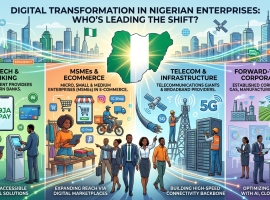
Digital Transformation in Nigerian Enterprises: Who’s Leading the Shift?
Print 🖨 PDF 📄 eBook 📱Digital Transformation in Nigerian Enterprises: Who’s Leading the Shift? Let…

ICFR Implementation Challenges in Nigeria: Understanding the Problems and Building Practical Solutions
Print 🖨 PDF 📄 eBook 📱ICFR Implementation Challenges in Nigeria: Understanding the Problems and Building…
Preparing a Firm for a Regulatory Audit in Nigeria
Print 🖨 PDF 📄 eBook 📱Preparing a Firm for a Regulatory Audit in Nigeria Get…

There are no comments